Showing posts with label NADA Task Force. Show all posts

Thursday, July 2, 2015

June 2015 SDADA Column

The world hates change, yet it is the only thing that has brought progress. -Charles Kettering

The past 12 months have brought some of the most significant change in NADA’s history. For nearly a century, NADA has pioneered some of the most valuable services in the industry for its growing membership, right under its roof. These services include the NADA Used Car Guide, which has been part of NADA's heritage for more than 80 years, and NADART, founded in 1957.

No one ever imagined we would part with either one, and we would not have unless we firmly believed doing so would benefit our dealer members and advance NADA's core mission.

This was the case when J.D. Power made an unsolicited offer to purchase the Used Car Guide business. With a difficult decision at hand but unanimous consensus, the NADA board of directors, the Guide board of advisors and NADA's finance and executive committees, all agreed that the best course of action was to sell the Guide to J.D. Power.

This decision, which was not reached easily or without careful consideration, will benefit our dealer members and the Guide's current and future customers. The Guide business will continue to grow and become an even stronger industry resource under J.D. Power.  As part of its agreement with NADA, J.D. Power will continue to provide NADA members with a complimentary Guide subscription as a membership benefit.

In a move unrelated to Guide, after conducting an in-depth review of various retirement plan providers, NADA made a decision to enter into a relationship with Empower Retirement, a division of Great-West Life and Annuity Insurance Company, to offer retirement plans to NADA members.  Empower Retirement is the second-largest retirement plan provider in the United States with nearly 7 million participants. The new NADA Retirement Program from Empower will go live in October of 2015, as the long-standing NADART program is retired.

NADA Retirement Program participants can expect to see many enhanced benefits, including a nearly 50-percent reduction in program fees, a state-of-the-art website designed to make it easier for participants to track their progress in saving for retirement, and fiduciary support services at a level higher than those offered by other retirement service providers, which is a service already familiar to NADART plan sponsors. NADART has been working closely with Empower to ensure a streamlined transition process for plans transferring to Empower.

While it's difficult to see these long-time services, built over NADA's history, leave the NADA family, we look to the future with optimism and renewed vigor. And, as always, we will continue to guard the interests of the franchised dealers we are privileged to serve, while remaining steadfast to NADA's mission that began nearly 100 years ago.

Most importantly, these moves will allow NADA to become more mission-focused, centering on core member services, which include protecting and strengthening the dealer franchise system, advocating on behalf of new-car dealers with Congress, the regulatory agencies in Washington, manufacturers, the media and the public, providing education and training resources for dealers and their employees, and providing dealers with better tools to enhance profitability.

ICYMI (In Case You Missed It…)

Retiring General Motors director Neville Isdell says GM has come a long way since the bankruptcy and is in capable hands, but he sees the turnaround taking 10 years.

David Robertson, Executive Director of the Association of Finance & Insurance Professionals, calls out Senator Elizabeth Warren’s disdain for dealers.

While a former dealership employee says he doesn’t think auto dealers are half as bad as many consumers seem to think they are, the July/August issue of Popular Mechanics carries an article a bit more cynical about the dealership experience.

In a pilot program, Ford dealers’ will use beacons, which will broadcast key information to the customer’s smartphone that might help close a sale, on models featured in their showrooms.

GM dealers are concerned as EBE 2.0 looms ahead. GM’s Dealer-Succession Bulletin causes consternation as well.

And finally…


NADA responds to inaccurate and irresponsible New York Times editorial.


Tuesday, October 23, 2012

October 2012 SDADA Column


You may recall that I told of my visit to the General Motors Renaissance Center headquarters back in August as a member of NADA's Task Force on Facility Image Programs and Multi-Tier Pricing in the space. One of the results of that meeting was a commitment by General Motors to consult with small and rural dealers on the EBE program.

Mark Reuss commented that he wanted to help dealers "do what they COULD do" on a timeline that “worked for them”. I specifically asked if that meant some flexibility going forward. I did not get a straight answer on that question.

So shortly after I returned from Detroit, I called my GM Regional manager and asked him to schedule a visit to my store. I got a call back a few weeks later from my Zone Manager who scheduled a visit to my store in mid-October.

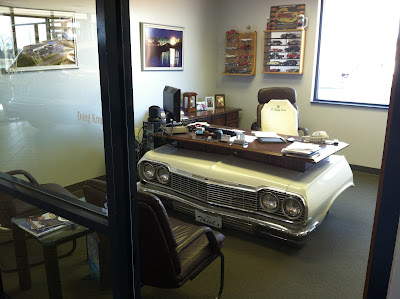
The Zone Manager came to visit my store recently. After introductions, he lusted over my desk for a couple of minutes (more on that later). I found him to be a very pleasant gentleman and we had a very cordial conversation as we learned a bit more about each other.

Eventually, the discussion turned to my facility and the EBE program. I gave him a bit of my background with the EBE program told him of the exceptions that I had asked for.

The short story here is that he had no authority, had no discretion, had no flexibility and was no help in getting relief from the EBE program. I could revisit all my discussion points that I visited with him about (they can be found here and here and here). But the bottom line is that it was a waste of time for both of us.

The irony of whole visit was the fact that he was smitten by my desk. When we discussed "customer touch points" and the fact that the EBE program disallowed the customer from seeing the desk in my office, he was stumped. After he thought about, he realized that the office was a customer touch point and there was no way that a customer could see the desk if my office was in compliance with EBE standards.

He took photos and is going to go through the motions of submitting (again) my requests but we both know that it is an exercise in futility. The requests go to the same group that rejected them before.

So I am much more skeptical about our visit to Detroit now. I feel like the whole notion about GM placing people in the field was more of an appeasement than an actual effort to help RCC dealers.

I will reiterate a point that I made after the Detroit trip: the NADA task force must hold GM accountable for the commitments they made.

I am not done with this. Stay tuned for developments...

NADA Issues Dealer Guidance on Counterfeit Air Bags

The National Highway Traffic Safety Administration (NHTSA) announced in early October a consumer advisory on counterfeit air bags.

Federal investigators have determined that thousands of counterfeit bags have been bought and installed in U.S. motor vehicles over the past three years.

NHTSA also has determined that in the event of a frontal collision, these counterfeit bags are unlikely to deploy properly or may deploy in a manner that can harm vehicle occupants. See below for an NADA dealer Q&A document.

Vehicles with counterfeit air bags installed are believed to constitute less than 0.1% of the total in-use fleet. Nonetheless, dealers should be prepared to respond to inquiries from the public on this matter.

NHTSA is urging concerned owners to start by visiting www.safercar.gov/Air+Bags to determine if they are at risk.

In addition to the NADA guidance, dealers should expect to receive communications directly from the auto manufacturers they represent, addressing how to detect and manage counterfeit air bags.

It's important to note that unlike a safety recall campaign, customers should expect to pay to have their air bags diagnosed, and if necessary, replaced.

Service Advisors Overtime Exemption Extended Through March

Congressional legislation to prevent a government shutdown includes an extension of a federal overtime exemption for service advisors through March.

Since the late 1970s, the U.S. Department of Labor (DOL) has held that the frontline employee-salespersons in the service department remain exempt from federal time-and-a-half pay requirements. In 2011, DOL attempted to reverse this policy. Congress intervened and temporarily stopped the Department from enforcing the change.

The Congressional ban was included in a funding measure that was set to expire at the end of September. Under the new continuing resolution that extends government spending through March 2013, DOL is prevented from enacting the new policy for service salespeople.

Friday, October 19, 2012

More of the Same...

You may recall that I told of my visit to the General Motors Renaissance Center headquarters back in August as a member of NADA's Task Force on Facility Image Programs and Multi-Tier Pricing in the space. One of the results of that meeting was a commitment by General Motors to consult with small and rural dealers on the EBE program.

Mark Reuss commented that he wanted to help dealers "do what they COULD do" on a timeline that “worked for them”. I specifically asked if that meant some flexibility going forward. I did not get a straight answer on that question.

So shortly after I returned from Detroit, I called my GM Regional manager and asked him to schedule a visit to my store. I got a call back a few weeks later from my Zone Manager who scheduled a visit to my store in mid-October.

The Zone Manager came to visit my store recently. After introductions, he lusted over my desk for a couple of minutes (more on that later). I found him to be a very pleasant gentleman and we had a very cordial conversation as we learned a bit more about each other.

Eventually, the discussion turned to my facility and the EBE program. I gave him a bit of my background with the EBE program told him of the exceptions that I had asked for.

The short story here is that he had no authority, had no discretion, had no flexibility and was no help in getting relief from the EBE program. I could revisit all my discussion points that I visited with him about (they can be found here and here and here). But the bottom line is that it was a waste of time for both of us.

The irony of whole visit was the fact that he was smitten by my desk. When we discussed "customer touch points" and the fact that the EBE program disallowed the customer from seeing the desk in my office, he was stumped. After he thought about, he realized that the office was a customer touch point and there was no way that a customer could see the desk if my office was in compliance with EBE standards.

He took photos and is going to go through the motions of submitting (again) my requests but we both know that it is an exercise in futility. The requests go to the same group that rejected them before.

So I am much more skeptical about our visit to Detroit now. I feel like the whole notion about GM placing people in the field was more of an appeasement than an actual effort to help RCC dealers.

I will reiterate a point that I made after the Detroit trip: the NADA task force must hold GM accountable for the commitments they made.

I am not done with this. Stay tuned for developments...

Wednesday, September 26, 2012

September 2012 SDADA Column


An adjective used to describe people who are environmentally aware (flower child, tree-hugger), open-minded, left-winged, socially aware and active, queer or queer-positive, anti-oppressive/discriminatory (racial, sexual, gender, class, age, etc.) with an organic and natural emphasis on living, who will usually refrain from consuming or using anything containing animals and animal by-products (for health and/or environmental reasons), as well as limit consumption of what he or she does consume, as granola people are usually concerned about wasting resources. Usually buy only fair-trade goods and refrain from buying from large corporations, as most exploit the environment as well as their workers, which goes against granola core values. The choice of not removing body hair (see amazon) and drug use are not characteristics that define granola people, and people, regardless of granola status, may or may not partake in said activities. This definition is sometimes confused with hippy.
-- Definition of a "Granola" according to Urbandictionary.com.

The "granolas" got a big win last month and almost no one noticed. The main stream media was so wound up about the Republican Convention and hurricane Isaac that they totally missed this one.

The Obama administration enacted the new corporate average fuel economy standards. Automakers will be forced to double the fuel efficiency of their vehicles to a fleet average of 54.5 miles per gallon by 2025.
Please don't get me wrong. Like most other car dealers I know, I am all for increased fuel economy and less dependence on foreign oil. But I want, and need, to be able to sell vehicles that my customers want to buy.

South Dakota is truck country. Our customers are farmers, ranchers, outdoors men and small business people for whom their vehicle is more than just a means of transportation. It is a tool with which they go about doing their work. They cannot get the job done in some bubble-shaped plug-in hybrid.

Not only will these new standards reduce the availability of trucks (if not eliminate them completely), you can expect the average price of vehicles to go up by $3,000 to $5,500 per vehicle as well. If the consumer cannot afford the new vehicles, they will not buy the vehicles and all the "fuel savings" is lost anyway.

The "granolas" will tell you that people will save that money in fuel. One problem, banks don't lend on fuel savings. They lend on equity and payment to income data. In 27 years, I have never had a bank contract buyer as me how much to factor into the equation for customers’ fuel savings. So if the customer can't buy the vehicle, he cannot save the fuel cost!

This will also cause a loss of jobs in the automobile manufacturing segment as customers are eliminated from the market. But then the Obama administration has never shown a great deal of regard for jobs.

The "granolas" will tell you that some thirteen automakers agreed to these new standards. Well, let's see, who those might be? Should we start guessing with those who do not have an entry in the full-size truck or SUV market?

So the "granolas" push us toward smaller (less safe), more expensive and less utilitarian vehicles.

I wonder if the "granolas" have ever considered where the electricity for those plug-in hybrids comes from. 54% of the electricity in our country is produced by coal - but then they want to rid us of that as well!


NADA Launches National Ad Campaign Against Stair-Step Incentive Programs

As most of you know, NADA Chairman Bill Underiner appointed me to the Industry Relations Task Force on Facility Image Programs and Multi-Tier Pricing. Our Task Force has found that a legal challenge against the manufacturers on the stairi-step pricing issue may be a tall mountain to climb. So we have chosen to mount a public relations effort against the manufacturers on this issue.  
To that end, we kicked off a national print ad campaign in September detailing the many negative aspects of manufacturer stair-step incentive programs.

The full-page ad, “Stair-Step Incentive Programs are Bad for the Auto Industry,” below, began running in Automotive News.

The ad points out that “stair-step programs create too many negatives to justify their use.”

Stair-step programs “harm brand credibility; hurt dealers of all sizes; undermine relationships between dealers and their customers; have an adverse affect on CSI scores; and destroy consumer confidence in dealers -- and in manufacturers’ brands.”

Thursday, August 9, 2012

I Have a Procedural Matter!

“Law is not a profession at all, but rather a business service station and repair ship.”. ~Adlai Stevenson

After the NADA task force meeting, there is very little I can report. There is this stupid issue of "attorney-client privilege". As much as I would like to share what happened today, there is too much riding on it! But I will suggest that things are moving forward!

Monday, August 6, 2012

From Inside the Ivory Tower


A lot of people have expressed an interest in the outcome of my visit to General Motors headquarters as part of the NADA delegation. So this is my account of that visit though there are certain specific aspects of our conversation that I do not feel are appropriate to discuss in this public forum.

The other members of the delegation had all been there before so I was the “wide-eyed rookie” in the group. After receiving our guest passes and proceeding through security, we proceeded to the 38th floor of GM's Renaissance Center headquarters. Kurt McNeil, VP of Sales at General Motors met us in the waiting area. Mark Reuss, President of General Motors North America joined us when we arrived in the conference room and Alan Batey, General Motors’ Chief Marketing Officer, came in about five minutes later.

Chairman Bill Underiner started the meeting by framing the discussion. After a completely worthless discussion about the so-called "voluntary" nature of the Essential Brand Elements facility image program, we pitched the idea of an EBE “Lite” that would entail just the exterior elements. Two members of the NADA delegation made a very strong case for such a concept.

Generally, there was very good, open exchange. The GM executives expressed a genuine concern about legal ramifications of changing the rules of the program or starting a new program at this point in the process. Reuss was particularly distressed about this.

I spoke on behalf of small and rural dealers. I expressed my concern about how the program does not scale well for low volume dealers. I talked about the lack of transparency in the exception process and how it breeds mistrust among the dealers. I stressed that this issue is a HUGE concern for small dealers.

One of the dealers made a great point about how resources that were committed to facilities could not be used for advertising, training and other aspects of marketing new GM vehicles.

GM committed to have a representative in every store that is contacted by the Regional Consulting Center (RCC). Most of these stores have not had a visit from a GM representative in a long, long time. They committed to a dialogue in these stores on an expedited time line. Reuss commented that he wanted to help dealers "do what they COULD do" on a timeline that “worked for them”.

Reuss displayed some real frustration and consternation about the relationship the GM has with its dealers, especially small dealers. He expressed a genuine desire to rebuild relationships with the dealer network. He asked for suggestions for these types of communiqués with the dealers. He did not seem to feel that he had an efficient method by which he could communicate with dealers.

I believe that GM, specifically Reuss, now has additional insight as to how the program is perceived and how it affects dealers. They have a big job ahead of them.

Did we get the commitment from GM that we sought entering the meeting? No. We did not get the scaled down version of EBE that was limited to the exterior elements.

Was the meeting a failure? That remains to be seen. If Reuss and company are sincere in their comments, we may have taken the first step in mending the severely damaged relationship between GM and their small and rural dealers. We will not know that for some time.

I really wanted to come home with some real news for my fellow dealers. Instead, I feel like we have a rather obscure, abstract “fix”. We did get an agreement from General Motors that they would change their process and that they would put people in the field.

So I will take the high ground here and accentuate the positive. I do think Reuss, Batey and McNeil listened to us. I think they want to make the program work for ALL dealers and that they will try to find a way to do that. I think the NADA task force will have to hold GM accountable for the commitments they made.

The entire task force has a meeting with outside legal counsel this Thursday. Stay tuned for details...

Monday, July 16, 2012

Time is Not on My Side

Contrary to that 60's Jerry Ragovoy song (performed by the Rolling Stones), as a General Motors dealer enrolled in EBE, time is not on my side.

This article in Automotive News only emphasizes that timetable for NADA's task force on facility issues and multi-tier pricing needs to be sooner rather than later with regard to the facilities issue.

While the article suggests that the Norman Braman suit could be a test case on the legality of manufacturer facility programs that reward participating dealerships with volume-based incentives, the issue will be settled for GM dealers long before this case comes to trial (if it ever does) 15 months from now. I assume General Motors knows that and is procrastinating the litigation of this issue as long as they can.

Meanwhile, the NADA task force needs to firmly apply the "pedal to the metal" as dealers are facing very difficult decisions on their facilities each day. They do not have time to wait for the outcome of Braman's suit.

(By the way, is Braman's real full name "Billionaire megadealer Norman Braman"? It seems that is the case if you were to read Automotive News. Just wondering...)

Tuesday, June 26, 2012

June 2012 SDADA Column

Our NADA summer board conference was a very good meeting with open and free dialogue among directors. Upon hearing the directors' concerns, NADA chairman Bill Underiner decided to appoint a task force that will push for changes in manufacturers' facility renovation programs and incentives that lead to perceived two-tier pricing.

I was very pleased when Chairman Underiner appointed me to serve on this task force. As you know, I am particularly sensitive to the treatment of smaller, rural dealers as it relates to those two areas. I will be viewing the proceedings of this task force from that standpoint.

This task force will challenge General Motors to find a way to offer dealers, especially smaller dealers, some options to comply with reasonable standards at a cost effective price. I will be looking for a way for GM to ask ALL of its dealers to help build their brand but not require the same "elements" of every dealer, regardless of size, market or geography. I am not naive enough to think that will be an easy task.

I analyze these issues in a bit more depth on my blog. I would love to hear your feedback. Please let me know what you think.

Some Manufacturer Stair-Step Programs Are a ‘Cancer in the Industry’ 

I hope you saw NADA Chairman Bill Underiner’s open letter in Automotive News earlier this month. In it, he takes the manufacturers to task regarding their multi-level pricing schemes and their effect on the retail automobile industry.

NADA has had a long-standing position in support of a level playing field, meaning lawful, equal and fair treatment by a manufacturer for all dealers, both large and small. Unfortunately, history shows that, at times, manufacturers’ incentive pricing programs create short-term incentives that favor the larger, more urban dealerships to the detriment of the smaller, more rural dealerships. 

Recent history also shows that the long-term effects of discriminatory programs are to marginalize the smaller dealers and place them at a competitive disadvantage in their marketplace.

These programs also have a tendency to cause confusion among consumers and dealers as to the actual dealer cost of vehicles. This leads to consumer doubt and mistrust that reduces the value of the manufacturer’s brand. It also undercuts the goodwill between consumer and dealer. This is certainly not good business for either the OEM or the dealer.

Dealers of all sizes have recognized the inherent unfairness of a manufacturer’s discriminatory pricing that tilts the playing field in favor of some dealers. For example, Earl Hesterberg, CEO of Group 1 Automotive, emphasized the perniciousness of these stair-step programs as recently as May 21 in Automotive News, where he characterized them as “… a cancer in the industry that isn’t good for dealers or customers.”

The fact is, manufacturers can unfairly create real competitive disadvantages for some dealers and cause real customer confusion and dissatisfaction in the marketplace.

The best way to maintain a level playing field is for factories to focus on what they usually do so well: build quality cars and trucks and avoid disparate treatment of their dealers that can limit their ability to compete. Let all dealers do what they do best: vigorously compete in pricing, service and otherwise for the customer’s business.

NADA to Appeal Court Decision on FTC’s Risk-Based Pricing Rule D.C.
District Court upholds FTC interpretation concerning the scope of the Risk-Based Pricing Rule

The U.S. District Court for the District of Columbia on May 22 granted the Federal Trade Commission’s motion for summary judgment against an action brought by NADA that challenged the agency’s broad interpretation of the scope of the federal Risk-Based Pricing Rule.

The law that the rule implements (section 311 of the FACT Act) applies to persons who, among other requirements, “use” a credit report in particular credit transactions. The FTC issued an interpretation in July 2011 stating that dealers engaged in three-party vehicle financing transactions who do not obtain, receive or review a credit report nevertheless “use” a credit report based on the finance source’s use of a credit report and therefore are responsible for complying with the Risk-Based Pricing Rule’s notice requirement.

Believing this interpretation to be flawed, unnecessary and burdensome to many dealers by requiring them to purchase credit reports for no purpose other than to comply with the Risk Based Pricing Rule, NADA subsequently initiated this challenge.

In its complaint, NADA argued that Congress never intended the word “use” to extend to this subgroup of dealers and that the FTC lacked authority to issue such an interpretation. Although the court found that the statute is capable of supporting NADA’s interpretation, it held that the FTC possessed authority to issue its interpretation and that its interpretation is reasonable.

Regardless of which party prevailed at the district court level, NADA anticipated that the other party would appeal the District Court decision to the D.C. Circuit Court of Appeals. NADA will now direct its outside counsel to commence the appeal.