Showing posts with label Facility Image. Show all posts

Monday, February 18, 2013

February SDADA Column


I just returned from the 2013 NADA Convention held in Orlando. It was great to see several South Dakota dealers in Orlando. I hope those of you who did attend found it beneficial.

The Exposition floor was packed with vendors and dealers. There were many new and updated products and services. I am amazed at how the expo floor and the vendors (BDC’s, CRM software, social media initiatives, etc.)  have changed over the past five years. 

David Wescott Takes NADA Helm

The NADA Board has its winter board meet just prior to our convention. Bill Underiner completed his year-long stint as chairman. Bill did a great job for NADA and especially for small dealers. 

Dave Westcott from North Carolina now takes over as chairman. Dave has served on many NADA committee's and brings a lot of experience. I am confident he will do a great job.

I received my committee assignments for the upcoming year. I will serve on the Public Affairs committee again this year and I will be on the Dealer Operations committee. It has been a couple years since I served on Dealer Ops so it will be interesting to get back to that. I also start my 3-year term on the Finance Committee having served a year filling out an appointment. I am looking forward to a great year.

Glenn Mercer Phase 2 Study Released

On Saturday in Orlando, Glenn Mercer highlighted the findings of the second  phase of the facility image programs. This study analyzes the Return on Investment (ROI) of image investments in the short term, and examines whether these investments might be right in the longer term, for Dealerships of the Future. The first phase of the study was completed a year ago.

Mercer said one of the goals of the Phase 2 study is not to prescribe a "one size fits all" solution, but to assist dealers and auto manufacturers alike to better understand each other's points of view better, and negotiate on a more informed basis for the most-efficient (low cost) and effective (high growth) way to invest in dealership facilities, not only for today, but for tomorrow as well.

Mr. Mercer said the current trend to build more expensive and more brand-customized auto dealerships will lead to excessive and wasteful spending, as dealers repeatedly raze and rebuild their facilities, and as auto makers constantly update their brand image campaigns.

Perhaps the most relevant finding of the study, at least for South Dakota dealers, was that standardization spending is almost always a "pure deadweight loss". That means there is no ROI to tearing up floor tile, replacing mullions and closing up "customer touch points". While this comes as no surprise to small and medium size dealers, I hope it is a revelation to the manufacturers!

FTC Warns Dealers on Buyer’s Guide 

The Federal Trade Commission has warned 11 used car dealerships in Jonesboro, Ark., that their failure to properly display the "Buyers Guide" on used vehicles offered for sale violates the FTC's Used Car Rule. FTC staff inspections in Jonesboro found that eight dealers failed to display Buyers Guides on almost all used cars offered for sale, and three dealers failed to display the guides on a significant number of used cars. Ten dealers properly displayed the guides on all or nearly all of the used cars offered for sale. The FTC sent warning letters urging the 11 dealers to come into compliance by properly displaying the guides in a clear and conspicuous location on all used cars.

I always welcome people to come to our beautiful state, but I invite FTC investigators stay the hell away!

Sunday, November 11, 2012

Time to Refocus

If you are a regular visitor to this spot, you know that I have been rather critical of General Motors' Essential Brand Elements (EBE) program here. I believe the program is unreasonable and unfair.

It is unreasonable because it is an overreach by General Motors into the dealership. It attempts to strip the dealer brand from the dealership and require interior elements that may not be useful or realistic for some dealers. It forces the same system on all dealers, large or small, rural or metro.

It is unfair because unless a dealer complies with these requirements, he is at a $500-700 per vehicle disadvantage. Dealers operate in a world where customers will move on to a different store for $50. Yet, GM representatives have the gall to suggest that it is an "optional" program. It's as optional as sails are on a sail boat!

Recently, my post regarding a visit from my GM Zone Manager to discuss the exceptions to the program that I requested caught the attention of GM executives. Apparently they did not like the fact that I found the visit to be a masquerade and told me so here.

This development has caused me great distress. These posts are intended to communicate updates to my family, my friends and the dealers that I represent in my NADA Director position. I believe my reach grew as these people felt the story I told to be unfair and they saw fit to forward it on. But I am not surprised at who has read it because it is published in a very public space.

I NEVER wanted the discussion to be about MY store. I only referenced my store because it was a personal experience that I could draw upon. I wanted to call attention to a program that I believe is unreasonable and unfair to all dealers, but especially so to small and most medium sized dealers - those that I represent. I thought my experience was very typical (as I found in visiting with other dealers) and thought it would give some specific examples of how unreasonable the program was.

So I will not be discussing my store's plight against EBE here any longer. I will gladly share any experiences from my fellow dealers (anonymously if they'd prefer). I will continue to post articles (from inside and out of the automobile trade press). I will continue to be a vocal critic of EBE and an advocate for my fellow small and medium size dealers.

Does this mean GM has won? I don't believe so. It only means that this spotlight will not be on my store or my desk any more and I will keep it sharply focused where it belongs - on the GM's unfair and unreasonable EBE program.

Thursday, October 25, 2012

EBE Makes News Outside of Automotive Press

Marc Heitz Chevrolet
Earlier this week, Automotive News covered the plight of Marc Heitz Chevrolet  in Norman, OK and their loss of $1 million of EBE funds annually. It is an interesting story (be sure to check out the comments at the bottom of the Automotive News article).

Last night, Lars Larson, a nationally syndicated talk show host, interviewed Chad Baker. Baker is the co-owner and General Sales Manager at Marc Heitz Chevy. It is a compelling interview that is significant because Larson is completely outside the traditional automotive industry media and he introduces the dilemma to the general public.

You can hear the interview here.

You may have seen where NADA Chairman, Bill Underiner, made some pretty strong comments at an Automotive Press Association event this week. He criticized manufacturers for "intrusion" into dealers' operations. Bill's comments were "spot on" and much appreciated by this dealer.

Meanwhile, Automotive News Europe poses a legitimate question about what the dealership of the future will actually look like. Does it look like an EBE store? Or does that matter?

Update 10/26/2012: Here is more coverage of this issue. Be sure to check out the comments at the bottom.

Tuesday, October 23, 2012

October 2012 SDADA Column


You may recall that I told of my visit to the General Motors Renaissance Center headquarters back in August as a member of NADA's Task Force on Facility Image Programs and Multi-Tier Pricing in the space. One of the results of that meeting was a commitment by General Motors to consult with small and rural dealers on the EBE program.

Mark Reuss commented that he wanted to help dealers "do what they COULD do" on a timeline that “worked for them”. I specifically asked if that meant some flexibility going forward. I did not get a straight answer on that question.

So shortly after I returned from Detroit, I called my GM Regional manager and asked him to schedule a visit to my store. I got a call back a few weeks later from my Zone Manager who scheduled a visit to my store in mid-October.

The Zone Manager came to visit my store recently. After introductions, he lusted over my desk for a couple of minutes (more on that later). I found him to be a very pleasant gentleman and we had a very cordial conversation as we learned a bit more about each other.

Eventually, the discussion turned to my facility and the EBE program. I gave him a bit of my background with the EBE program told him of the exceptions that I had asked for.

The short story here is that he had no authority, had no discretion, had no flexibility and was no help in getting relief from the EBE program. I could revisit all my discussion points that I visited with him about (they can be found here and here and here). But the bottom line is that it was a waste of time for both of us.

The irony of whole visit was the fact that he was smitten by my desk. When we discussed "customer touch points" and the fact that the EBE program disallowed the customer from seeing the desk in my office, he was stumped. After he thought about, he realized that the office was a customer touch point and there was no way that a customer could see the desk if my office was in compliance with EBE standards.

He took photos and is going to go through the motions of submitting (again) my requests but we both know that it is an exercise in futility. The requests go to the same group that rejected them before.

So I am much more skeptical about our visit to Detroit now. I feel like the whole notion about GM placing people in the field was more of an appeasement than an actual effort to help RCC dealers.

I will reiterate a point that I made after the Detroit trip: the NADA task force must hold GM accountable for the commitments they made.

I am not done with this. Stay tuned for developments...

NADA Issues Dealer Guidance on Counterfeit Air Bags

The National Highway Traffic Safety Administration (NHTSA) announced in early October a consumer advisory on counterfeit air bags.

Federal investigators have determined that thousands of counterfeit bags have been bought and installed in U.S. motor vehicles over the past three years.

NHTSA also has determined that in the event of a frontal collision, these counterfeit bags are unlikely to deploy properly or may deploy in a manner that can harm vehicle occupants. See below for an NADA dealer Q&A document.

Vehicles with counterfeit air bags installed are believed to constitute less than 0.1% of the total in-use fleet. Nonetheless, dealers should be prepared to respond to inquiries from the public on this matter.

NHTSA is urging concerned owners to start by visiting www.safercar.gov/Air+Bags to determine if they are at risk.

In addition to the NADA guidance, dealers should expect to receive communications directly from the auto manufacturers they represent, addressing how to detect and manage counterfeit air bags.

It's important to note that unlike a safety recall campaign, customers should expect to pay to have their air bags diagnosed, and if necessary, replaced.

Service Advisors Overtime Exemption Extended Through March

Congressional legislation to prevent a government shutdown includes an extension of a federal overtime exemption for service advisors through March.

Since the late 1970s, the U.S. Department of Labor (DOL) has held that the frontline employee-salespersons in the service department remain exempt from federal time-and-a-half pay requirements. In 2011, DOL attempted to reverse this policy. Congress intervened and temporarily stopped the Department from enforcing the change.

The Congressional ban was included in a funding measure that was set to expire at the end of September. Under the new continuing resolution that extends government spending through March 2013, DOL is prevented from enacting the new policy for service salespeople.

Friday, October 19, 2012

More of the Same...

You may recall that I told of my visit to the General Motors Renaissance Center headquarters back in August as a member of NADA's Task Force on Facility Image Programs and Multi-Tier Pricing in the space. One of the results of that meeting was a commitment by General Motors to consult with small and rural dealers on the EBE program.

Mark Reuss commented that he wanted to help dealers "do what they COULD do" on a timeline that “worked for them”. I specifically asked if that meant some flexibility going forward. I did not get a straight answer on that question.

So shortly after I returned from Detroit, I called my GM Regional manager and asked him to schedule a visit to my store. I got a call back a few weeks later from my Zone Manager who scheduled a visit to my store in mid-October.

The Zone Manager came to visit my store recently. After introductions, he lusted over my desk for a couple of minutes (more on that later). I found him to be a very pleasant gentleman and we had a very cordial conversation as we learned a bit more about each other.

Eventually, the discussion turned to my facility and the EBE program. I gave him a bit of my background with the EBE program told him of the exceptions that I had asked for.

The short story here is that he had no authority, had no discretion, had no flexibility and was no help in getting relief from the EBE program. I could revisit all my discussion points that I visited with him about (they can be found here and here and here). But the bottom line is that it was a waste of time for both of us.

The irony of whole visit was the fact that he was smitten by my desk. When we discussed "customer touch points" and the fact that the EBE program disallowed the customer from seeing the desk in my office, he was stumped. After he thought about, he realized that the office was a customer touch point and there was no way that a customer could see the desk if my office was in compliance with EBE standards.

He took photos and is going to go through the motions of submitting (again) my requests but we both know that it is an exercise in futility. The requests go to the same group that rejected them before.

So I am much more skeptical about our visit to Detroit now. I feel like the whole notion about GM placing people in the field was more of an appeasement than an actual effort to help RCC dealers.

I will reiterate a point that I made after the Detroit trip: the NADA task force must hold GM accountable for the commitments they made.

I am not done with this. Stay tuned for developments...

Monday, August 20, 2012

I'll Have a Carrot with That Stick

The only carrots that interest me are the number you get in a diamond. -Mae West

Automotive News recently reported that Chrysler has eradicated dealer incentives for customer satisfaction and eliminating penalties for dealers who don't build stores that meet the company's requirements. The automaker is leaving the customer experience and satisfaction up to the dealer.

General Motors tells its dealers that it is focused on the “customer experience” and that EBE is intended to give the customer the best possible experience. The experience is not about what color tile is on the floor, what hangs from your walls or what your receptionist desk looks like (or if you have one). The experience is about the time and care that each customer gets, both during and after the sale.

I learned a long time ago that you cannot pay people to care. GM can’t pay dealers to care and dealers can’t pay employees to care. We must hire people who have pride in their work and have the “people skills” necessary to carry out business as we intend.

I believe that you are much more concerned about providing the customer with a great experience if you sit next to your customers at your kids’ ballgames or at church or at a community function. The culture of a small rural store is much different than at a large store where customers can be (but aren’t necessarily) disposable. In a rural area, if you screw up the customer experience, that news is at the local coffee shop before your customer makes it home.

There does not seem to be anything wrong with the customer experience that GM customers are getting in the dealerships across South Dakota. They continue to reinforce dealership personnel with repeat business. According to the South Dakota Automobile Dealers Association, total market share for GM in South Dakota dealerships from January 2011 through June 2012 was 28.6% which is 68% more market share than GM’s national 18.0% YTD through July 2012. If the customer experience was poor, these customers would migrate to a different brand.

In the above referenced Automotive News article, Peter Grady, Chrysler's vice president for network development and fleet was quoted: "I believe the nature of the dealer is that the only thing better than making $1 million this year is making $2 million, and the only thing that's better than making $10 million is making $15 million," Grady said. "I think a dealer is inherently a competitive animal that wants to always strive to always be in some kind of a competition to make more money."

For anyone who has spent any time in a car dealership, Grady’s comment is obvious. Dealers don't need carrots and sticks from the factory; the marketplace provides all the incentives and disincentives needed. Programs like EBE and SFE are simply artificial carrots and sticks that cloud up the real processes. Multi-tier pricing destroys the credibility of the pricing model in the customer’s eyes.

Get rid of these programs and just focus on building world class vehicles. That has much more influence on the customer experience than any facility anywhere!


Monday, August 6, 2012

From Inside the Ivory Tower


A lot of people have expressed an interest in the outcome of my visit to General Motors headquarters as part of the NADA delegation. So this is my account of that visit though there are certain specific aspects of our conversation that I do not feel are appropriate to discuss in this public forum.

The other members of the delegation had all been there before so I was the “wide-eyed rookie” in the group. After receiving our guest passes and proceeding through security, we proceeded to the 38th floor of GM's Renaissance Center headquarters. Kurt McNeil, VP of Sales at General Motors met us in the waiting area. Mark Reuss, President of General Motors North America joined us when we arrived in the conference room and Alan Batey, General Motors’ Chief Marketing Officer, came in about five minutes later.

Chairman Bill Underiner started the meeting by framing the discussion. After a completely worthless discussion about the so-called "voluntary" nature of the Essential Brand Elements facility image program, we pitched the idea of an EBE “Lite” that would entail just the exterior elements. Two members of the NADA delegation made a very strong case for such a concept.

Generally, there was very good, open exchange. The GM executives expressed a genuine concern about legal ramifications of changing the rules of the program or starting a new program at this point in the process. Reuss was particularly distressed about this.

I spoke on behalf of small and rural dealers. I expressed my concern about how the program does not scale well for low volume dealers. I talked about the lack of transparency in the exception process and how it breeds mistrust among the dealers. I stressed that this issue is a HUGE concern for small dealers.

One of the dealers made a great point about how resources that were committed to facilities could not be used for advertising, training and other aspects of marketing new GM vehicles.

GM committed to have a representative in every store that is contacted by the Regional Consulting Center (RCC). Most of these stores have not had a visit from a GM representative in a long, long time. They committed to a dialogue in these stores on an expedited time line. Reuss commented that he wanted to help dealers "do what they COULD do" on a timeline that “worked for them”.

Reuss displayed some real frustration and consternation about the relationship the GM has with its dealers, especially small dealers. He expressed a genuine desire to rebuild relationships with the dealer network. He asked for suggestions for these types of communiqués with the dealers. He did not seem to feel that he had an efficient method by which he could communicate with dealers.

I believe that GM, specifically Reuss, now has additional insight as to how the program is perceived and how it affects dealers. They have a big job ahead of them.

Did we get the commitment from GM that we sought entering the meeting? No. We did not get the scaled down version of EBE that was limited to the exterior elements.

Was the meeting a failure? That remains to be seen. If Reuss and company are sincere in their comments, we may have taken the first step in mending the severely damaged relationship between GM and their small and rural dealers. We will not know that for some time.

I really wanted to come home with some real news for my fellow dealers. Instead, I feel like we have a rather obscure, abstract “fix”. We did get an agreement from General Motors that they would change their process and that they would put people in the field.

So I will take the high ground here and accentuate the positive. I do think Reuss, Batey and McNeil listened to us. I think they want to make the program work for ALL dealers and that they will try to find a way to do that. I think the NADA task force will have to hold GM accountable for the commitments they made.

The entire task force has a meeting with outside legal counsel this Thursday. Stay tuned for details...

Friday, July 20, 2012

July 2012 SDADA Column


Contrary to that 60's Jerry Ragovoy song “Time is on My Side” (performed by the Rolling Stones), as a General Motors dealer enrolled in EBE, time is not on my side.

A recent article in Automotive News about Norman Braman’s law suit against General Motors and their EBE program only emphasizes that the timetable for NADA's task force on facility issues and multi-tier pricing needs to be sooner rather than later with regard to the facilities issue. While the article suggests that the Braman suit could be a test case on the legality of manufacturer facility programs that reward participating dealerships with volume-based incentives, the issue will be settled for GM dealers long before this case comes to trial (if it ever does) 15 months from now. I assume General Motors knows that and is procrastinating the litigation of this issue as long as they can.

General Motors has been the focus of most of the comments in this space with regard to facilities programs. While I recognize that other manufacturers have facilities programs, GM’s EBE is, by most accounts, the most egregious and casts the longest shadow in our state. The feeling at NADA is that most of the other manufacturers are standing on the sidelines watching how EBE unfolds and will then follow in GM’s footprints.

Meanwhile, the NADA task force needs to firmly apply the "pedal to the metal" as GM dealers are facing very difficult decisions on their facilities each day. They do not have time to wait for the outcome of Braman's suit.
(By the way, is Braman's real full name "Billionaire megadealer Norman Braman"? It seems that is the case if you were to read Automotive News. Just wondering...)

The task force will have a couple of very significant meetings the first week of August. The GM dealers on the task force will be meeting in Detroit with Mark Reuss who is the President of General Motors North America. I look forward to the opportunity to visit with Mr. Reuss about the small dealers’ perspective.

Later that week, we will meet with our outside counsel in Washington on both the facility programs and multi-tier pricing issues. I hope we can make some progress at these meetings. Stay tuned for details!

Report: Employment at New-Car Dealerships Up 4.6% in 2011

Even though, according to one small business expert, if you've got a business - you didn't build that and somebody else made that happen, car dealerships are setting the pace across South Dakota and America when it comes to new hiring around the country. It seems that this hiring in dealerships is happening despite what our government is doing rather than because of what they are doing. I think most dealers are very nervous about what happens in the beltway.

There were 933,500 workers employed at U.S. new-car and -truck dealerships in 2011, a 4.6 percent increase from the previous year, said Paul Taylor, NADA chief economist. The findings were released as part of NADA Data 2012, the association’s latest state-of-the-industry report on dealership financial trends. The increase in the number of employees occurred as the number of dealerships, which had declined in recent years, continued to stabilize. In the first quarter of 2012, there was an increase of 66 dealerships on a net basis. “The arrival of new brands and new dealerships is a sign that even more vigorous competition is on the way in the U.S. vehicle marketplace,” Taylor said. “As new brands enter the U.S. market, the net dealership count may increase in future years of strong economic growth.”

In 2011, the average new-car dealership employed 53 workers and had an annual payroll of $2.6 million. Dealerships also provided an average 14.5 percent of total retail payroll in their states in 2011. Taylor also noted that “franchised dealers are major employers as well as significant contributors to their communities’ economies, tax bases and civic and charitable organizations.”

Wow! Really Mr. President?!

You didn't get there on your own. I'm always struck by people who think, well, it must be because I was just so smart. - Barrack Obama 7/13/2012


Monday, July 16, 2012

Time is Not on My Side

Contrary to that 60's Jerry Ragovoy song (performed by the Rolling Stones), as a General Motors dealer enrolled in EBE, time is not on my side.

This article in Automotive News only emphasizes that timetable for NADA's task force on facility issues and multi-tier pricing needs to be sooner rather than later with regard to the facilities issue.

While the article suggests that the Norman Braman suit could be a test case on the legality of manufacturer facility programs that reward participating dealerships with volume-based incentives, the issue will be settled for GM dealers long before this case comes to trial (if it ever does) 15 months from now. I assume General Motors knows that and is procrastinating the litigation of this issue as long as they can.

Meanwhile, the NADA task force needs to firmly apply the "pedal to the metal" as dealers are facing very difficult decisions on their facilities each day. They do not have time to wait for the outcome of Braman's suit.

(By the way, is Braman's real full name "Billionaire megadealer Norman Braman"? It seems that is the case if you were to read Automotive News. Just wondering...)

Tuesday, June 26, 2012

June 2012 SDADA Column

Our NADA summer board conference was a very good meeting with open and free dialogue among directors. Upon hearing the directors' concerns, NADA chairman Bill Underiner decided to appoint a task force that will push for changes in manufacturers' facility renovation programs and incentives that lead to perceived two-tier pricing.

I was very pleased when Chairman Underiner appointed me to serve on this task force. As you know, I am particularly sensitive to the treatment of smaller, rural dealers as it relates to those two areas. I will be viewing the proceedings of this task force from that standpoint.

This task force will challenge General Motors to find a way to offer dealers, especially smaller dealers, some options to comply with reasonable standards at a cost effective price. I will be looking for a way for GM to ask ALL of its dealers to help build their brand but not require the same "elements" of every dealer, regardless of size, market or geography. I am not naive enough to think that will be an easy task.

I analyze these issues in a bit more depth on my blog. I would love to hear your feedback. Please let me know what you think.

Some Manufacturer Stair-Step Programs Are a ‘Cancer in the Industry’ 

I hope you saw NADA Chairman Bill Underiner’s open letter in Automotive News earlier this month. In it, he takes the manufacturers to task regarding their multi-level pricing schemes and their effect on the retail automobile industry.

NADA has had a long-standing position in support of a level playing field, meaning lawful, equal and fair treatment by a manufacturer for all dealers, both large and small. Unfortunately, history shows that, at times, manufacturers’ incentive pricing programs create short-term incentives that favor the larger, more urban dealerships to the detriment of the smaller, more rural dealerships. 

Recent history also shows that the long-term effects of discriminatory programs are to marginalize the smaller dealers and place them at a competitive disadvantage in their marketplace.

These programs also have a tendency to cause confusion among consumers and dealers as to the actual dealer cost of vehicles. This leads to consumer doubt and mistrust that reduces the value of the manufacturer’s brand. It also undercuts the goodwill between consumer and dealer. This is certainly not good business for either the OEM or the dealer.

Dealers of all sizes have recognized the inherent unfairness of a manufacturer’s discriminatory pricing that tilts the playing field in favor of some dealers. For example, Earl Hesterberg, CEO of Group 1 Automotive, emphasized the perniciousness of these stair-step programs as recently as May 21 in Automotive News, where he characterized them as “… a cancer in the industry that isn’t good for dealers or customers.”

The fact is, manufacturers can unfairly create real competitive disadvantages for some dealers and cause real customer confusion and dissatisfaction in the marketplace.

The best way to maintain a level playing field is for factories to focus on what they usually do so well: build quality cars and trucks and avoid disparate treatment of their dealers that can limit their ability to compete. Let all dealers do what they do best: vigorously compete in pricing, service and otherwise for the customer’s business.

NADA to Appeal Court Decision on FTC’s Risk-Based Pricing Rule D.C.
District Court upholds FTC interpretation concerning the scope of the Risk-Based Pricing Rule

The U.S. District Court for the District of Columbia on May 22 granted the Federal Trade Commission’s motion for summary judgment against an action brought by NADA that challenged the agency’s broad interpretation of the scope of the federal Risk-Based Pricing Rule.

The law that the rule implements (section 311 of the FACT Act) applies to persons who, among other requirements, “use” a credit report in particular credit transactions. The FTC issued an interpretation in July 2011 stating that dealers engaged in three-party vehicle financing transactions who do not obtain, receive or review a credit report nevertheless “use” a credit report based on the finance source’s use of a credit report and therefore are responsible for complying with the Risk-Based Pricing Rule’s notice requirement.

Believing this interpretation to be flawed, unnecessary and burdensome to many dealers by requiring them to purchase credit reports for no purpose other than to comply with the Risk Based Pricing Rule, NADA subsequently initiated this challenge.

In its complaint, NADA argued that Congress never intended the word “use” to extend to this subgroup of dealers and that the FTC lacked authority to issue such an interpretation. Although the court found that the statute is capable of supporting NADA’s interpretation, it held that the FTC possessed authority to issue its interpretation and that its interpretation is reasonable.

Regardless of which party prevailed at the district court level, NADA anticipated that the other party would appeal the District Court decision to the D.C. Circuit Court of Appeals. NADA will now direct its outside counsel to commence the appeal.

Monday, June 18, 2012

If the Shoe Doesn't Fit...

Our NADA summer board conference was a very good meeting with open and free dialogue among directors. Upon hearing the directors' concerns, NADA chairman Bill Underiner decided to appoint a task force that will push for changes in manufacturers' facility renovation programs and incentives that lead to perceived two-tier pricing. 

I was very pleased when Chairman Underiner appointed me to serve on this task force. If you have visited this space before, you know that I am particularly sensitive to the treatment of smaller, rural dealers as it relates to those two areas. I will be viewing the proceedings of this task force from that standpoint.

This task force will challenge General Motors to find a way to offer dealers, especially smaller dealers, some options to comply with reasonable standards at a cost effective price. I will be looking for a way for GM to ask ALL of its dealers to help build their brand but not require the same "elements" of every dealer, regardless of size, market or geography. I am not naive enough to think that will be an easy task.

I had a dealer friend ask me if I thought General Motors should abolish the Essential Brand Elements (EBE) program and wondered what I thought they should do with those who have already made a commitment. I think that is a great question and I believe it is one that the task force had better be prepared to deal with.

There are serious questions about the role of a showroom facility in the rural setting and the importance  the customer places on that. It is becoming less a factor in the buying process as the customer goes a long way into that process in our virtual showroom - our web sites. I question whether ANYBODY at GM has thought hard and long about that.

I personally believe that General Motors has every right to expect ALL dealers, big and small, rural and metro, to have a clean, welcoming facility that projects a strong brand image for the manufacturer that they represent. There is more than one way to do that. I don't think that necessarily means a renovation every 5-6 years. I certainly do not believe that it should be part of a marketing program.

As far as EBE is concerned, I think there is a place for the program. I believe the requirements are far too stringent for smaller dealers and the economics of both the investment and the reimbursement program set forth by GM do not work for smaller volume dealers. When you have such large number and wide spectrum of dealers, it seems that at least three levels of participation would be warranted.

Does it make sense that the exact same program requirements (showroom tile, a $5,000+ greeters stand, complete glass on three sides of the showroom, etc.) would work equally well for a Chevrolet dealer in a rural community selling ten to twelve new Chevrolet vehicles each month and a metro dealer selling a thousand new vehicles per month? Does it make sense that a showroom facility in a northern climate with cold winter wind and snow be the same as one that resides in the sun belt? 

General Motors tells the dealers that it is a "voluntary" program. If you are not in compliance, however, you will missed out on the EBE quarterly payment of between $500 and $750 per vehicle. This in a business where the customers will walk over $50!! 


EBE is not a voluntary program. The greater your sales volume, the better it seems to work for you. I know dealers who are telling their people to build whatever it is that GM wants, just keep the EBE payments coming in. I have talked to other dealers who, if they project their EBE payments out through the end of the program, they won't amount to half the costs they are being asked to incur to make their facility compliant.

Not every foot does fit in a size 10 shoe. In fact, in this case, not everyone wears a size 20 shoe! If you do, the EBE program fits pretty well. But if you don't, you end up buying a lot more shoe than you need and the shoe is to be priced according to its size!

Thursday, June 7, 2012

Spending Millions on Mullions

In my last update, I indicated that I had asked General Motors for three exceptions on my EBE plan. I asked for an exception on the gray tile that GM required when I built versus the gray tile they are now asking for. The actual response from the "Ivory Tower" was "Request denied because tile appears to be too dark compared to program spec tiles". My zone manager told me that he convinced "them" to grant the tile exception request though I must sign a letter that, in part, specifies: 
"However, we anticipate this tile may need to be replaced 5-10 years in the future due to wear, overall condition, etc. If and when Chevrolet deems the tile condition is no longer acceptable, Dealer agrees to replace the existing tile with the program tile. Please counter-sign below to affirm you understand and accept this conditional exception approval."
Well, I have not signed the letter (surprise, surprise!). I'm not sure that automobile dealerships will even have showrooms in 5-10 years. Ask executives at Best Buy or Barnes & Noble what color their floor covering will be in 5-10 years. The bricks and mortar business model for all retail space is untenable. That is part of the problem with the GM EBE program - no consideration has been given to what the dealership will look like and how it will function in 5-10 years. Shouldn't we be investing in plans that move us that direction?!

I asked for an exception on the the window frames that GM required in their Image 2000 program (and for which I paid about 30% more money) when I built the facility. They are currently a "General Motors blue", but now GM wants a silver color. Their response was "Request denied, blue mullions are too far a departure from the required silver mullions. Mullions can be painted or capped to meet the color requirements."

 That tile appears to be too dark compared to program spec tiles!!!
I know of a dealer who got an exception for BROWN mullions! Apparently "General Motors blue" mullions are a more radical departure from the color scheme than is the BROWN!!! This brings to light a deeper problem with the program. It would seem that there should be some consistency with the exceptions. It is either the right color or it isn't. If it isn't, then exceptions will be granted for all or none. There is a lack of transparency that breeds mistrust. I have re-sent that request for exception, letting them know that I was aware of the dealer with brown mullions. I am looking forward to their response!


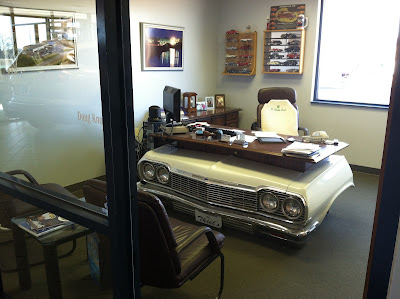
My third exception request was regarding this whole notion of my office being a customer "touch point" and thus requiring the color scheme, wall prints and furniture set forth by GM. I received a familiar response: "Request denied. Dealers office located right off showroom floor considered customer touch point. Car front desk not in line with furniture spec." (Some of my friends were very nervous to hear that GM considered my office a touch point! ;o)


Let me translate the corporate speak in that response: "This (1964 Chevrolet Impala) desk is too unique for any dealership. We want "cookie cutter" dealerships that completely remove any sense of dealer branding. If customers saw this desk, they might remember it and the dealership in which it sat. We want the boring furniture and wall prints we have chosen for EVERY Chevrolet store in America!"

Glenn Mercer, in NADA Facility Image Study presentation, said that GM boastfully says they are approving approximately 85% of the exception requests. If that is so (and my case would show that to be quite high), perhaps the standards are a bit too stringent. Perhaps if they would relax their standards some, this whole back and forth game could be avoided. But then they would not have a stranglehold on the power, would they?

More to come...


Monday, April 23, 2012

That's No "Touch Point", That's My Office

The Customer "Touch Point" in Question
I am still working toward becoming a General Motors EBE compliant store. I detailed my original Gensler visit here. Since then I have asked for several exceptions to the Gensler plan.

I asked for an exception on the the window frames that GM required (and for which I paid about 30% more money) when I built the facility. They are currently a "General Motors blue", but now GM wants a silver color. I asked for an exception on the gray tile that GM required when I built versus the gray tile they are now asking for. I asked for an exception on this whole notion of my office being a customer "touch point" and thus requiring the color scheme, wall prints and furniture set for by GM.

I detailed these requests in an email to my GM Zone Manager that I sent on March 23. I did not hear anything back so I sent another email last week. Finally, on April 23, one month later, I got a call from the Zone manager. He wanted to discuss my requests.

The window mullions and the floor tile were pretty straight forward requests. He asked for a couple of clarifications but the requests were pretty easy.

The office issue was a problem. In my letter to him, I made it pretty clear what my position was:

My office looks out onto my showroom floor so that I can see my customers come into my store. I have been told that I have two choices with regard to this particular design feature in my store. I can build a wall in front of my office so that customers cannot see into my office or I can take my family photo, my college degree and the overhead photo of my store among other items on display off my office wall. This is not an economic issue for me, this is a business practice issue. I find it deeply offensive that General Motors wants such absolute control over my facility that they would tell me what I can or cannot hang on my office wall.
The Gensler representative educated me on "customer touch points" and how my office becomes a "touch point" if the customer can see into the office. My office is not a "touch point". I will see who is in my store from my office and my family photo will remain on my wall. My customers like the freedom to stick their head in my office to say “hi”. They only do that because they can see that I am in my office. Placing a wall there would be the equivalent of telling my customers that I do not have time for them and to leave me alone. 
My Zone manager suggested to me that there have not been any variances on this issue and that my office was a "customer touch point" because the customer could see into the office. I replied to him that it was about time a variance was granted to someone and it just as well be me and that the point of my office design was not about the customer seeing me, but rather me seeing the customer.

I am no interior designer but I do not think that my customers find the interior of my office offensive. In fact, if I had a nickel for every time someone told me how much they liked my desk, I wouldn't need any of GM's EBE subsidy. My desk is a centerpiece of my store. My family photo will remain on my wall as will my college diploma and my overhead photo of my store.

I told the Zone manager that I wanted him to submit the request. I want to see if General Motors will deny the request. We had a discussion about some "Vice-President of All Things EBE" at General Motors understanding the culture of my store but that did not go well and I decided to put the brakes on it.

I asked him when I would hear back on this issue, he told me it could be a week or it could be a month. So I'll just hold my breath...

Saturday, April 14, 2012

Updates on the Facility Front

A story on NorthJersey.com - Hackensack, NJ details the story of a former Cadillac Hummer dealership on which dealer Tony Fernandez spent $9 million to build a Quonset-hut-style showroom and service center shortly before General Motors dropped the truck brand. So, over the past year, at an additional cost of about $1.2 million — financed with a second mortgage — Fernandez has remodeled his former Hummer facility to comply with GM's EBE standards so that he would not be cut out of crucial cash incentives from GM.

In the article, Tom Henderson, a GM spokesman, says about 1,000 dealers have completed or have begun facilities upgrades. "We think it's a fairly generous program," he said. "A majority of our dealers are pretty satisfied with it."

That beeping you hear in the background is the bullshit detector going off (why does it always go off when GM executives are quotes?). In fact all the lights are on and it's smoking — I don't know exactly what that means, but I have a hunch. Perhaps Mr. Henderson would like to show us some data on all those dealers who are satisfied with GM's facility image program. You can count me as one dealer who is signed up for it but is not even remotely satisfied with it. I can tell you that I've talked to many others.
"It's a voluntary program open to all dealers nationwide. We do pay [compensation] on a quarterly basis tied to specific metrics, to defray the costs," he said.
"Voluntary" Mr. Henderson says. I suppose Henderson will tell me that the IRS considers my April 15th obligation "voluntary" next?

In this Automotive News article, Weimar, Texas, Chevrolet dealer, Tommy Brasher does a great job of making the small and medium size dealers' case. I agree with his assessment in that I like the look of what they've asked me to do with the outside of the building. I just don't like their desire to control every aspect of my facility.
But Brasher sympathizes with other small dealers who are hard-pressed to finance a teardown or relocation. In many cases, he says, customers in those small towns won't be impressed by a glitzy new showroom anyway.
James Ziegler rings in here on this issue. I completely agree with his last paragraph:
This subject is at the center of every discussion in every dealer group I have interacted with in recent months. I believe 2012 will be the year this issue becomes a full-scale battle between dealers and certain auto makers. I predict auto makers will back down as dealers become more resistant and united.
This is the topic of conversation at every dealer meeting I attend as well. I hope that Ziegler is right with that last sentence!

Tuesday, April 10, 2012

Glenn Mercer at NADA/IHS Automotive Forum

I attended the NADA/IHS Automotive Forum in New York City on April 3. Glenn Mercer gave a short presentation entitled "Retailing Trends and Overview of the NADA Facility Study". After his presentation, he sat on a panel with several dealers as they discussed the automotive retailing industry and how facilities work in that equation.

There was considerable reference to his study during the discussion. Mercer said that there has never been an independent study of manufacturer facilities programs which is really striking considering the vast sums of money dealers are asked to spend by the manufacturers.

Very few dealers argued that they had a responsibility to provide a clean, modern facility that was "supportive of the brand". That ANY dealer would argue that is troubling and is a possible clue as to why these facility programs are so heinous.

He asked the questions of car buyers, "What matters most to you when it comes to selection of a dealer from which to purchase an automobile?". Facility was at the bottom of the list of considerations. Which begs the question "What does the dealership of the future look like?". Are these programs helping us getting closer are pushing us further away from the industry's model of the future?

The manufacturer needs to show better demonstration and quantification of the VALUE of the investment in facilities. After the most recent downturn, all dealers are demanding a better return for their investment, whether it is advertising, janitorial or some other service. Dealers must see a path to return on investment.

Mercer said that the programs don't scale well for smaller, rural dealers. He suggested that the manufacturers need to tier the programs to remove the "small store cost penalty". There is no perfect program for all dealers, large and small, urban and rural. However, when you have large dealers giving the green light for ANY upgrades just to keep the money coming and small dealers trying to figure out how to borrow money for the changes, it is fairly obvious that program doesn't work in a small, rural setting (read GM's EBE program).

A couple of other interesting quotes from Mercer: "Floor tile was the single most complained about subject in the entire survey over four months!" & "Supportive of the brand" is an OEM mantra.

Mercer does a very good job or presenting an independent, unbiased view on this issue. NADA needs to use him strategically.

April 2012 SDADA Column

You may have read about some crazy South Dakota dealer who has been chasing college basketball for the past thirty plus years in a recent NADA Headlines story. Well that same dealer sandwiched this year’s basketball trek between NADA committee meetings in Washington, DC and New York. Both the basketball and the meetings were productive!

I attended Government Relations Committee and Public Affairs Committee meetings in DC. The Government Relations Committee heard from Rep. John Campbell (R-CA), who holds a special place in dealers’ hearts for sponsoring the Campbell Amendment which excluded auto dealers from the jurisdiction of the Bureau of Consumer Finance Protection (CFPB) last year. Rep. Campbell, a former car dealer, spoke of the frustration current legislative environment in which the greatest accomplishment seems to be to see how far they can “kick the can down the road”. He did not look for much action on anything until after the November election.

That was a common theme as I visited with Senator Thune and Representative Noem. I did not see Senator Johnson (again), only a staffer. Thune and Noem are supportive of NADA’s positions on the estate tax, CAFE and LIFO but expected no action on these issues until next year unless a “lame duck” Congress saw fit to take them on. It is doubtful Sen. Reid will have an appetite for that so look for no action until 2013.

The Public Affairs Committee discussed the two issues that dealers seem to be most concerned with, facility image programs and multi-tier pricing, at length. While the multi-tier pricing issue is one that cuts across the country, it is a violation of each state’s existing franchise laws and thus, NADA is limited in their alternatives. The consensus is that this issue will have to be handled at the state level, by state associations. NADA can offer limited support but it seems that state associations might find more help by working together to take on the manufacturers on this. I have weighed in on this issue in detail here.

The facility image program, however, is a different story. I feel NADA needs to take a lead role on this issue. There are a couple of opportunities to stand with dealers ongoing.

Perhaps you read megadealer Norman Braman is suing General Motors over the manufacturer's Essential Brand Elements program. This would seem to be good news for all dealers as Braman has deep pockets and appears ready to fight. Dealer Jack Fitzgerald also is suing General Motors in a Maryland state court over the EBE program.

NADA needs to stand by these dealers, and any others willing to take on the manufacturers, in a very public way. These dealers must be able to count on NADA’s legal, public relations and financial support. Dealers on the Public Affairs Committee agreed that we need to help “take the fight to the people” by letting all dealers know about the details of the fights as they unfold.

I would really appreciating hearing your thoughts on these issues. As I mentioned above, these two issues seem to drive EVERY conversation that I have with dealers and they seem to be looking to NADA for some leadership.

NADA/ATD Study: EPA Underestimated Costs for Model Year 2004-2010 Heavy-Duty Trucks
I am quite certain this won’t surprise you: a government agency has underestimated the cost of regulation! NADA and ATD released a new report March 8 that calls into question the Environmental Protection Agency’s (EPA) cost analysis of emissions control requirements for model year (MY) 2004-2010 commercial trucks. The mandates resulted in substantially higher prices for commercial vehicles, depressed sales and delayed the environmental benefits that the EPA originally sought. NADA/ATD released the following statement:

“Until now, few studies have ever compared the EPA’s cost predictions to the actual cost of meeting its motor vehicle emissions mandates. The study, which looks back at the 2004-2010 medium- and heavy-duty truck emissions mandates, reveals that the EPA underestimated actual compliance costs on average by a factor of two to five. It shows what can happen when a regulatory proposal – based on far in-advance predictions – seeks to set mandates far in the future. Importantly, the study documents the real-world market disruptions that can occur as a result. The lessons learned from this report apply directly to the proposed MY 2017-2025 fuel economy regulations for light-duty vehicles. That rulemaking, combined with previous Obama administration fuel economy mandates, will raise the average price of a vehicle by $3,000, according to EPA and National Highway Traffic Safety Administration estimates. When faced with unreasonable federal regulatory mandates that increase motor vehicle costs, buyers of light-duty vehicles – similar to what commercial truck buyers experienced – will seek out less expensive alternatives in the marketplace.” Click here for the study.

Consult Your Tax Practitioners Soon About the UNICAP Safe Harbors
On Nov. 9, 2010, the IRS issued Revenue Procedure 2010-44, which created two optional safe harbor methods of accounting for motor vehicle dealerships (including light, medium, and heavy duty truck dealerships). If properly elected and applied, the new safe harbors permit dealers to (i) deduct, instead of capitalize, certain costs related to their inventories, and (ii) significantly simplify their computation of these costs (known as their Uniform Capitalization – or UNICAP – computation). If qualifying dealers elect the safe harbor methods of accounting for their first or second tax year ending after Nov. 9, 2010, they may do so without having to consider most of the potential restrictions that apply to automatic method of accounting changes. Consequently, for dealers whose tax year corresponds with the calendar year and who did not elect these methods for the 2010 tax year, they should speak with their tax practitioner soon about whether they should elect the UNICAP safe harbors for the 2011 tax year. The election is made on IRS Form 3115. For more information, consult summaries of the revenue procedure by the IRS Motor Vehicle Technical Advisor and NADA.

Sunday, March 11, 2012

Guest Post by Kevin Vanatta - Newberry Motors

Kevin Vanatta is a General Motors dealer in Newberry, Michigan, which is a community of almost 3,000 on the upper peninsula of that state. His store is somewhat remote in that the next closest dealership is almost 70 miles away.

Kevin has been in the automotive industry for 38 years and has been a dealer for 20 years. He is active in his community and his store is an integral part of the Newberry community.

He recently had an opinion piece published in AutoRetailNet. I asked him if I could post it here and he graciously consented.
In my opinion, what GM has done should be against the law because it creates two tier pricing for dealers. What I mean by that is if dealer A chooses to go with the program he is going to get a “kick back” for hitting certain levels of achievment, thereby creating a pricing differential. It can be argued that the “kick back” money is to be invested in the facility upgrade, but what if it isn’t? Instead it could be used to assist in getting a car deal done, thereby giving dealer A an advantage over dealer B that didn’t go with the program.
Secondly, as an independent business owner, I should be allowed to “do it my way.” That is why I have chosen to be “independent.” If I wanted someone to tell me what to do and when and how, I would have gone to work for someone else. If the manufacturer wants to buy me out to have their say, well it can talk to me in $$$$$.
I am not against a certain type of look or the thought that any manufacturer wants to standardize, but I can assure you that when the client is looking at buying a car or requiring service that he or she really doesn’t care what color the tile is. Customers simply want to be taken care of in a courteous, professional manner by someone that can understand their concern or need and help them to be satisfied in a timely fashion. I believe that customers want to feel like the dealer they are doing business with will be there long-term, to take care of their ongoing needs.
Lastly, and equally as important, if not more so, is that not all facilities/communities/areas of responsibility are created equal. The investment for my facility is not much less than a metro dealer who has many more potential clients in their marketing area, although yes, he has more competition. What is the real question that is being asked by the manufacturer when he requires us to use its styling ideas? Is it really trying to make or keep the customer happy, or is it just to create a look? My choosing at Newberry Motors to upgrade my business plan to satisfy GM’s requirements would price me out of the market and put me out of business, because no upgrade is going to grow the number of potential clients in my area.
One of the requirements of EBE and the GM Sales and Service Agreement that came out of the bankruptcy is that I can not have any other new brand on my lot, which is Chrysler in my case. In 1992, when I became a GM Dealer, they approved the fact that I could have Chrysler products on the same lot and sold out of the same showroom, but under the protection of the bankruptcy court they slid this little legalese in there. What will happen if or when push comes to shove? i don’t have an answer at this time but i’m thinking it may be quite ugly!
EBE has put me and many other smaller dealers between a rock and a hard place, when all we hope for is to have a manufacturer partner that will be a real part of our team and be in business with us for the long haul.


Kevin has stated the feelings of many small, rural dealers. I appreciate his honest and sincerity. I am often asked if I fear retribution from General Motors be speaking out. I haven't given that a whole lot of thought because when something is unfair or wrong, I feel compelled to speak out.


I certainly welcome other comments in this space. If you are interested in a formal post, just send it to me. You are also welcome to comment below.

Friday, March 9, 2012

NADA's Factory Image Program Study


So Mr. Dealer, would you take a look at the charts below and tell us where you would spend your money? That's just what we thought!!


Thursday, March 8, 2012

March 2012 SDADA Column

I recently had my General Motors EBE facility site visit. I don't know how many of you have gone through the process of ponying up $10,000 to have someone from Gensler come to your store and point out all the ways your store is hindering your business. Although I found the representative from Gensler to be  a very pleasant gentleman, it was a painful process for me.

If you want all the gory details, check out my blog at http://harrykss.blogspot.com/2012/02/searching-for-right-shade-of-gray_29.html. The abridged version goes like this:


My store is fifteen years old. It was built to GM's "Image 2000" specifications. I have made some significant improvements since it was built. The interior has been repainted twice and exterior has been repainted once. I still regularly get comments about what a nice facility it is.

I went into this process hoping to make the best of it. I was prepared to make a modest investment in my store. I am not opposed to building the large blue entry portal on the front of my building. I see some benefit in that. I'm not certain that GM needs to specify every last detail of how it is built but I won't give a lot of push back on that.

I paid extra money for the blue window frames (or mullions) that General Motors wants me to now replace. The 3500+ square feet of gray tile they specified when we built is in good conditional and fully functional yet it is neither the right shade nor size and thus GM wants to tear it up. They want me to take the photo of my family down off my office wall (because customers can see into my office). Naturally, they want me to buy a bunch of overpriced furniture that I think is just plain ugly (though I'm sure it looks good somewhere)! There are a dozen other similar changes they want in my store.

If I don’t comply with these standards, I will be at a $500/vehicle disadvantage to any dealer who does comply. This program is not really about facility upgrades at all. If it were, the payouts would be tied to the cost of doing the upgrades themselves and not to the number of vehicles purchased from GM during the program. As you know, this pricing scheme violates South Dakota franchise laws which prohibit multi-tier pricing. If we do not enforce our laws, then we deserve just exactly what we get.

Again, I refer you to my blog entry at the address above. I would be interested to hear from you on this topic. Please give me a call or send me an email.


EPA Underestimated Emissions Control Costs for Model Year 2004-2010 Heavy-Duty Trucks

NADA and ATD have called into question the EPA’s cost analysis of emissions control requirements for model year (MY) 2004-2010 commercial trucks. The mandates resulted in substantially higher prices for commercial vehicles, depressed sales and delayed the environmental benefits that the EPA originally sought.

According to NADA/ATD, until now, few studies have ever compared the EPA’s cost predictions to the actual cost of meeting its motor vehicle emissions mandates. The study, which looks back at the 2004-2010 medium- and heavy-duty truck emissions mandates, reveals that the EPA underestimated actual compliance costs on average by a factor of two to five. It shows what can happen when a regulatory proposal – based on far in-advance predictions – seeks to set mandates far in the future. Importantly, the study documents the real-world market disruptions that can occur as a result.

The lessons learned from this report apply directly to the proposed MY 2017-2025 fuel economy regulations for light-duty vehicles. That rulemaking, combined with previous Obama administration fuel economy mandates, will raise the average price of a vehicle by $3,000, according to EPA and National Highway Traffic Safety Administration estimates. When faced with unreasonable federal regulatory mandates that increase motor vehicle costs, buyers of light-duty vehicles – similar to what commercial truck buyers experienced – will seek out less expensive alternatives in the marketplace.

Take Advantage of These NADA Member Benefits

All Legal/Regulatory Webinars to be Provided at No Charge to Members

I hope you will take advantage of this NADA member benefit. NADA University is offering all legal and regulatory webinars, live and on-demand, as a member benefit (complimentary) beginning in March 2012. It includes all past legal/regulatory webinars whose information is current. In addition, dealers may extend their no-cost member benefit to their CPAs, attorneys and other contracted professionals who work with them on compliance matters. Dealers can simply add those professionals as sponsored users within the dealership’s NADA U accounts, automatically providing complimentary access to member benefits. The legal/regulatory webinars are provided in addition to other NADA U member benefits: 10 Learning Hub programs, Driven guides, NADAPerks, MarketINSIGHT webinars and all resources in the Industry Information section of Resource Toolbox.

On-Demand: NADA-Google Learning Hub Series Offered at No Charge to Members

NADA University and Google are presenting a series of four webinars, offered at no charge to NADA and ATD members only. The first two webinars, “The Smartphone Revolution” and “The Google + Project for Dealers” are activated on-demand for members in NADA University, Learning Hub, in the Internet category. Other dates and topics will be announced—watch this space.


Wednesday, February 29, 2012

Searching for the Right Shade of Gray

So yesterday I had my appointment with the Gensler guy. That is the company that General Motors has contracted with for their facility image program. I had been dreading this day since I had committed the $10,000 to pay for him to come and "consult". I didn't sleep the night before his visit.

He was professional and a very nice gentleman who was just doing the job he is paid to do. He turned out to be a great resource for me as we visited. In fact, he agreed with many of the points I make below. He made what was a painful meeting, tolerable.

I put a very significant part of my net worth into a state-of-the-art dealership facility in 1996. I built it to General Motors specifications. I built a facility that would serve my customers well, that my employees could be proud of and that would represent General Motors in a first class manner. I have made several changes over the past fifteen years to keep the store updated. In the past eight years, GM has taken away Oldsmobile and Pontiac and refused to give me GMC to help to compensate for the loss of the other two. And then there is the small matter of them going bankrupt and the effect that had on my business.

I am not interested in having General Motors tell me how to manage or "brand" my facility. They want to manage every aspect of my facility - from the color of the bathroom tile to what I have hanging in my personal office to what kind of light fixtures I have in my showroom. What works in Chicago, Miami and Los Angeles does not work in Chamberlain/Oacoma, South Dakota. I agree with AutoNation Inc. CEO Mike Jackson who says, "When they're telling me the color of the toilet paper in the restroom, I'm saying, 'You've gone too far.'"

There is nothing wrong with the gray tile in my store. It is a shade or two darker and a bit smaller than the tile that GM and Gensler's extensive research has proven will cause everyone entering my showroom to grovel for a new GM vehicle. But I'm willing to take my chances with the type and color that I have as it is easy to keep clean, offers reasonable traction and serves my customers' needs just fine. I guess I am unreasonable in that I don't want to rip out over 3,000 square feet of perfectly good tile!

GM's branding initiative would not allow customers to be able to see into my personal office unless I furnish it with GM-approved furniture, paint, floor covering and art on the walls. The family photo I have hanging in my office would have to come down as would my college diploma and the overhead photo of my dealership! My customers would not be allowed to see into our conference room which means my salespeople would not be able to see customers on my showroom floor if they are in a meeting.

General Motors wants me to replace the window frames that they required (and for which I paid extra money) when I built the facility. They are currently a "General Motors blue", but now they want a silver color. Needless to say, the cost for this change will run in the tens of thousands of dollars. And yet, I have never had a customer tell me that they wouldn't buy a car from me because my mullions were blue! (I have, however, had customers tell me that they wouldn't buy because GM went broke and took taxpayer money.)


This is just the kind of dealership re-branding exercise that HUMMER dealers were forced into shortly before that brand was consigned to the ash heap of history. In the past ten years, Pontiac, Oldsmobile, Hummer, Saturn, Mercury, Plymouth and Daewoo have all been lain to rest leaving a wake of empty dealership facilities and countless dealers who are still paying the construction debt!

I am pretty sure I know my customers and my retail market better than General Motors since only four different people employed by GM have ever stepped foot in my store over the past 15 years and no one has been here in the past two years. That number would have been two except for turnover of GM personnel.

I have an obligation to offer my customers have a clean, inviting, facility staffed by friendly, concientious employees. But I have concerns about the "bricks and mortar" business model, especially in the rural areas. Many customers are a long ways down the path to purchase before they ever step foot into my facility. I need to see a clear path to return on investment for every dollar I spent on my facility.

I like the looks of the big blue entry element that you see at many Chevrolet dealerships (see photo above). This is the iconic image that GM wants to promote for the Chevrolet brand. It is their "golden arches". I would consider doing that if I was allowed to use local suppliers and contractors (my customers!).

I think many of the other brand elements are just plain ugly. I don't like the blond, maple laminate tops on all my desks and counter tops. I don't want to buy them at any price but especially at the inflated price that GM has negotiated for their "partners", the dealers.

General Motors would have you believe that this is a volunteer program and that they are helping to pay for the upgrades. Let me call "bullshit" on that one. What they will do is sell a car to you for $500 more than the dealer who is in compliance with their Essential Brand Elements program. Dealers who are in compliance get $500 for each vehicle invoiced to them on a quarterly basis. If I'm not compliant, I am at a $500 disadvantage on each new vehicle in a business where people will drive 100 miles to save $50.

This program is not really about facility upgrades at all. If it were, the payouts would be tied to the cost of doing the upgrades themselves and not to the number of vehicles purchased from GM during the program.

This pricing scheme violates South Dakota franchise laws which prohibit multi-tier pricing. It also violates franchise laws in about 35 other states as well. Why are those laws not being enforced? Well if it is within my power, we will soon start enforcing them in South Dakota.


If you live in a small rural community that is fortunate enough to have a dealership contributing to your local economy, you too should wonder why those laws are not being enforced. This practice is the greatest threat there is to the franchised automobile network. If you don't like the idea of traveling 100 miles plus to have your car serviced, you might ask why laws are being ignored.

So I am left with the question of what kind of return I would get on a $350,000-400,000 investment into a highly specialized facility in a rural area in central South Dakota. I tried to complete that calculation. You can see what my calculator thought of it!