Tuesday, August 11, 2015

Broken Hearted

It was a typical Friday afternoon in August at Harry K Chevrolet-Buick. I was in the showroom considering the prospect for a couple cars deals that afternoon and whether or not the wind would lend itself to an opportunity to go sailing that evening. Our son, Alex, was coming home for the weekend so we were looking forward to some sailing, perhaps some kayaking, perhaps some smoked mammal flesh and a generally fun weekend.

As I stood in the showroom, I had a feeling like I had eaten something but could not completely swallow it; like it was lodged in the bottom of my esophagus. I was a little lightheaded which I attributed to the fact that I had pretty much skipped breakfast and had only eaten a couple pieces of cheese for lunch.

The light headed feeling was not uncommon if I ate a late lunch. A morning bicycle ride would often tap me out but a few carbs would always snap me right out of it. I had gone on a 15-mile bicycle ride that morning so I thought my blood sugar might be a bit low. With that in mind, I headed to the vending machine for the quick fix of a Planters Peanut Bar.

When the peanut bar didn't have the intended effect, I started to think that perhaps I was dehydrated. I always take a gallon cooler of water to work and drink it through the day and I decided that I hadn't hit the water hard enough yet that day. I took a couple of long pulls on the water and waited for it to work its magic.

But it didn't. My sales manager was in my office and I told him I didn't really feel well. He offered an aspirin. Though I never considered it to be a real possibility, I thought that an aspirin would be a good idea in case I was having some kind of heart issue. He got me one and I took it immediately.

Shortly thereafter, I felt really lightheaded; I thought I was going to the floor for a moment. I was sweaty and my color was not good (so I was told). By now, my wife, Judy, was in my office and I told her that I needed to go to the hospital. She said she would start the car and get it cooled off. I told her not to bother, I needed to get to the hospital.

While on the way to the hospital, my lightheadedness subsided somewhat. I still felt some discomfort in my chest but it felt better as well. But I knew something was wrong.

Within five minutes of arriving at Sanford Chamberlain Hospital, I was hooked up to the EKG and five minutes later, I was diagnosed as being in the process of a heart attack.


Me, a fifty four year old man in excellent health having a heart attack? No way! The look on Judy's face when they said this was complete disbelief. Many mornings in the colder months start with me on my trainer and Judy on the treadmill with Fox News on the TV for 35-45 minutes.

I am a healthy guy. I ride my bicycle 4-5 times a week - if not outside then on my trainer in the basement. I lift weights twice a week. I golf, kayak, hunt and am very active.

We try to eat right. Though we travel some and dine out one or twice a week in the summer, our diet is pretty good. I'm probably 10-12 pounds over my ideal weight but I am conscious of that and am always striving to get there. I don't eat a perfect healthy diet but, again, I am conscious of my diet and try to eat well.

I have a few cocktails on the weekend and a glass of wine with dinner once a week but there are some who would suggest that wine works in the favor of my heart. I would consider myself healthier than most and quite active for my age.

So to say that I was surprised when I had a heart attack on August 7, 2015 at work would be more than an understatement and none of the statements above meant anything as I lay in the hospital at that moment.

Working in my favor was the fact that we were at the hospital within 30 minutes of my initial symptoms. Within minutes they were on the phone with the cardiology folks in Sioux Falls. They gave me some nitroglycerin and injected tPA clot buster. They summoned the airplane from Sioux Falls.

Let me just say right here that I received first class, professional care from everyone at Sanford Chamberlain Hospital. I feel extremely fortunate that those folks were there. Kala Shepherd, CNP, was absolutely terrific. She made great decisions and was in touch with the cardiology department in Sioux Falls immediately.


The King Air fixed wing aircraft from Sioux Falls arrived about 60-75 minutes after the initial diagnosis of "cardio event". I took an ambulance ride to the airport where they loaded me into the Sanford Hospital aircraft. We were on the ground in Sioux Falls forty five minutes later.

While flying to Sioux Falls though, my symptoms started to subside. I no longer felt the discomfort in my chest and was no longer light headed. I figured when I got to Sioux Falls that I would probably have a few tests, a lecture on lifestyle changes, and then have to wait for Judy (who decided to drive with Sarah) to take me home.

I was transferred into an ambulance at the airport. The trip to the hospital was complete with lights and sirens. I told the ambulance guys that I'd probably come to Sioux Falls more often if I could avoid traffic and SF drivers like that all the time.

When I arrived, they were waiting for me in the cath lab like a pack of hyenas with bibs on and forks in both hands! They went right to work on me and in what seemed like 20-30 minutes, they inserted a stent in my right coronary artery (which was 95%) blocked and put a intra-aortic baloon pump in my heart. No other major arteries were blocked.


The stent went in through my right wrist and the pump went in through my right femoral artery. They inserted the pump because my blood pressure was low. They also informed me that the clot buster drug administered in Chamberlain was unsuccessful.

I was in a cardiac care room shortly thereafter. It was about 6:45 pm. My first symptoms occurred shortly after 2:00 pm. It was an unbelievable, life changing sequence of events that happened in less than five hours.

The next 26 hours were miserable as I had to lie flat on my back because of the pump in my heart. Not only could I not sleep on my back, but the pump in my heart gave me a weird sensation that distracted my sleep. It was like my stomach was continuously gurgling. By Saturday morning, I was exhausted.

Saturday mid-morning, the nurses brought in a fan and rolled me on my side (slightly) and I was able to sleep for a couple hours. I felt a lot better after that.

They took the pump out about 2:00 pm on Saturday. Because they perforate the femoral artery to insert the pump, it is important to ensure that the artery does not bleed. To do this, pressure has to be applied to the wound; a lot of pressure. The device they used for this has a strap that goes around the waist and can apply as much pressure directly to the wound as needed. I received a good amount of pressure for a couple hours and by the time they changed to a lesser pressure device, I was in pain.

About 8:00 pm on Saturday evening, I was able to get up and walk around (after the catheter came out - YIKES!!!). That is the point at which I started feeling better. I went for a walk around the hall a few times. I slept well Saturday evening.

On Sunday I was very active. I walked 2 miles in the hall. I think I looked like a caged lion to the nursing staff. I don't think it was a common occurrence for the cardio patients to be that active. The underlying strength of my heart proved to be a real advantage throughout this entire ordeal.


I had many calls and visits from friends on Sunday. I was reminded how fortunate I am to have a wonderful wife, two great daughters and two great sons. Judy and I are so lucky to have so many wonderful friends both far and near!

I knew I would get discharged on Monday. So after seeing the cardio rehab specialist, the customer service rep, the doctor's CNP, the doctor and what seemed like a dozen others, I got to leave at about 1:30 pm on Monday.

I had plans to take a golf trip (annual trip with friends) the following week and had been "taking the temperature" of each person I saw whether they thought that was still possible. Everyone I had asked thought I would be able to go but when the doctor told me I just needed to "listen to my body" if I went, I was elated.

So what's next? The cardio rehab lady suggested that my greatest risk factors were stress and family history. My Dad had a quadruple bypass in 1988 and had numerous stents put in after that. I always attributed his condition to his poor management of diabetes and complete lack of exercise. Apparently he had some genes working against him that are now working against me.

We all have stress and we all handle it in different ways. Having 40 employees and three businesses might add a bit more stress to my life than some others, but I need to learn to deal with it better. I will be focused on doing that.

But what I learned (was reminded of!) most directly is that EVERY day is a gift. We should not take it for granted and we should enjoy it and make the most of it.

So the next time you see me, remind me of that! And I will probably remind you right back!

Thursday, August 6, 2015

Learning the Ropes


Learning the Ropes - this expression alludes to sailors learning the rigging so as to handle a sailing vessel's ropes. It was being used figuratively by the late 1800s. 

My first experience with sailing was in college with a fraternity brother who took me to Branched Oak State Recreation Area in east central Nebraska the summer of 1981. I was attending summer school at Creighton University in Omaha and we made the hour-long trip north of Malcolm, Nebraska (northwest of Lincoln) in Lancaster County many times.

We sailed on a 16 foot Hobie catamaran, known as a Hobie 16. The Hobie is a beachcat or a class of catamaran ("cat") sailboat intended to be able to run up onto the beach. We spent many Sunday afternoons doing just that at Branched Oak Lake.

The Hobie 16 that I learned to sail on
We would trapeze out over the side of the craft, bouncing our butts off the water for a while before typically getting launched across the cat when a gust of wind hit us just right (or wrong!). It was great fun for a 21 year-old college student!

That summer launched my love for sailing. Though it would be another 15 years before I had any kind of sailing craft of my own, that passion was kindling deep inside me.


My first sailboat was a Snark Sunflower 3,3 model (Length 11 feet, Beam 3' 6", Weight 65 lbs.). Our kids were young then. Though it was a small craft, there was room for one of them to sail with me. Most of my sailing with this boat was done in the marina, though I did venture out onto the lake when alone and with light winds. We had a lot of fun with the Sunflower.

My next sailing craft was a 2003 Escape Play Cat Catamaran 16'. This boat coordinated with the Krawdaddy era. So we would pull the Play Cat behind our pontoon boat, then once anchored, we would sail around the lake near the pontoon. We had this boat for seven years and had lots of fun with it.

Dad and me on the Escape Play Cat
After selling the Krawdaddy in July of 2008, I knew that I wanted a sailboat. I began looking for one in August of 2008, using several websites. I learned about sailboats and the models that might work for our use. I also found several sites that offered boats for sale.

I don't know how many boats I looked at on sites like eBay, sailingtexas.com and sailboatlistings.com. I literally looked at thousands of boats September through January. As I looked at these boats, I continued to narrow the list of boats that would work.

At one point, I thought I wanted a Hunter 23.5. I even printed out a sales brochure and the owners manual to look them over. But I was not convinced the water ballast system was right for our use. I looked at other “trailer sailors” including McGregor, C&C, and Catalina among others.

I was also looking for a boat that hadn't been in salt water as I knew the salt water was much harsher on the boat than fresh water. This brought the search more toward the Midwest, which would make chasing the boat down once I bought it much easier.

In mid-February 2009, I came across a listing for a 2001 West Wight Potter 19. I had read some positive things about the WWP19 and so I started searching for more of them. I finally came across the listing for this boat on sailingtexas.com. I printed out the sales brochure and owners manual to study. Finally, I called the owner of the boat.

Charlie Harrett was very helpful and friendly in my initial contact with him. Charlie had owned the boat for about four years. He had gotten into racing and wanted a faster boat. I could tell as we spoke, that he really liked this boat and had enjoyed sailing it. On February 19, 2009, we agreed on a price and we had a new boat (the second happiest day of our lives??).

I listed the boat on uship.com, an online service that matches shippers with freight. I had used it a couple of times with auction vehicles.

Soon I had a dozen shippers wanting to pull the boat to South Dakota from Louisville, KY. I was tied up with meetings for two consecutive weeks before I was able to make arrangements with a shipper.

The Blewjay as it arrived
As soon as I bought the boat, I started thinking about a name for her. I always thought part of the appeal of the Krawdaddy was that the name fit so well and was so reflective of the boat.

I began compiling potential names for our new sail boat. I searched the web for sites that specialize in boat names. I used a phrase site and a rhyme site to get additional ideas. We ran the list of potential names past the entire family to get their input. Blewjay (a play on the wind and our beloved Creighton Bluejays) finally won out over Mast Transit, Gustbuster and Windjammer.

The boat finally arrived from Louisville to Chamberlain on March 13, 2009. The gentleman who pulled it was from northwest Arkansas. He told me that it pulled down the road very nicely.

I learned that West Wight Potter owners were a very passionate lot. I found a dozen different sites and forums dedicated to WWP sail boats. On these sites, I found a few modifications I was interested in making to our new boat.

I also decided to review some sailing books. Though I had been told many times that if I could sail a sixteen foot catamaran, that I would have no problem with a nineteen foot sailboat, I wanted to be a proficient sailor. I ordered a couple of books on the fundamentals of sailing.


The Blewjay on the cover of the 2012 Chamberlain-Oacoma Travel Guide

Shortly after purchasing Blewjay, I suggested to Judy that we take sailing lessons while in Seattle for our NADA summer board meeting. She agreed and so I began a search for a company that could offer Judy, Sarah and I a short intense Keelboat Certification course.


Sailing lessons
After correspondence with several companies, we struck an agreement with Rob at Sailing Express in Everett, WA. Rob agreed to get us all certified and let us use a boat for a day when it was all over.

So we flew to Seattle on Friday, June 12, three days prior to our NADA summer board meeting.. We stayed at The Inn at Port Gardner which was right at the marina and was the venue for our lessons.

We spent the first morning in the classroom and we went out on the boat in the afternoon. Judy was the first skipper on the O'Day 24. She had great winds and did a nice job of heeling the boat and really speeding along. By the time I took the helm, the wind was blowing about 20 knots which was way to much wind for our sails and it was about time to quit anyway. I skippered the boat into the marina.

The next morning we made our way back to the chart room for our sailing class. Rob had us in the classroom until 1:00 pm when we took our lunch break. After lunch, we met at the boat where Sarah was the first skipper of the day. We had wonderful sailing conditions for our junket. Everyone had a chance to be captain. At the end of the day, we ran into a pod of gray whales. It was awesome to watch them. We got quite close.

After the whales, we headed into the marina. We returned to the room for an hour of last minute preparation before our certification test. We stayed out so long watching whales that we didn't get to take the test until 8:00 pm. The 130-question test took about 40-45 minutes and was relatively easy after two days of preparation.

We had the boat for the next day. We got going early so we could make the trip to Langley, a quaint little sea village on Whidbey Island. It was about seven miles from Everett. Though the winds were light to none, we had a great day in Puget Sound. We got back to Everett at about 4:15 pm to catch our hour long limo ride to Seattle for our NADA meetings. So after three days in the classroom and the boat, Sarah, Judy and I were all ASA certified.

We had the WWP 19 for two summers and enjoyed it but found that it was too small for more than 4 people (and they had to sit hip to hip). We wanted to be able to take more than two people sailing and decided that we wanted to upgrade a bit.

The Potter had a decent sized cabin (that we did not really use) and that feature cut down on the size of the cockpit (which we wanted more of). So I began to search for sailboats that had large cockpits.

While I looked at many different boats, I kept coming back to the Colgate 26. Among the features that were attractive to me were: very little wood (only wood is the tiller) which means less maintenance; cockpit is self-bailing as are the cockpit seat lockers and there are no ports or vents to possibly leak; a huge cockpit (can take a bigger crew) and high performance yet very stable (didn't want to scare those newbies).

Once I decided on the Colgate 26, I started searching. I found a pair of 2004 models for sale at the Sagamore Resort on Lake George in northeast New York state. The resort had recently been sold and the new management was no longer interested in conducting sailing lessons. Thus, they were selling their five Colgate 26 sailboats. They had two left when I contacted them in December 2010.

Sagamore Resort's remaining Colgate 26 when we picked ours up
After striking a deal with the Sagamore, Alex and I made the trip to New York to get our new boat. He got home from college for holiday break and we left the next day. We made the trip in three (and a half) days. We were lucky with the weather.

Our new boat upon return from New York
We decided that the Blewjay name was just too fitting to let go so we dubbed our new boat the Blewjay Due which was a nod to Alex's previous spring semester spent studying in Florence, Italy. Due is Italian for "two" (and rhymes with Blewjay!).

So we removed the Sagamore signage on our new boat, christened it with Blewjay Due vinyl and prepared it for it's initial splash into its new home, Lake Francis Case, in the spring of 2011.


We have found the Colgate 26 is the perfect boat for our use. There is plenty of room, it is low maintenance and yet it offers all the performance features of a much larger boat. 

Both local marinas are full of pontoon boats which function great on the waters of South Dakota's Missouri River reservoirs.There are not many sailboats in our area. We've never had more than four in our marina at one time. There are currently three. The other sailboat owners are from out of town. Sailing is a bit of a mystery to the locals. 

The first mate prepare to land the Blewjay Due at sunset
We are halfway through our fifth summer with this boat and I am enjoying it more each year. This summer we have had more opportunities to sail and been able to share the experience with more of our friends.


Plenty of room for our crew!

Sailing has become something Judy and I really enjoy doing together and sharing with our friends. Our family has learned to enjoy sailing as they have grown. They are no longer enamored with the PWC's speed and noise and tubing and towables aren't the thrill they used to be.

Nothing beats a steady South Dakota evening breeze, some good tunes and a good ol' South Dakota sunset (unless it's that glass of wine once back in the slip!).

Fair Winds!

Thursday, July 30, 2015

Hating on Ribbons in the Garden


As I have documented in the past, I am an avid college basketball fan. I have attended 34 consecutive Final Fours. Over the years, I have attended over twenty Big 8, Big 12 and Missouri Valley Conference tournaments. I have also attended many NCAA first and second round games and regional games.

I have followed college basketball across the country and have been fortunate to see many games in many different venues. I've had the opportunity to visit with fans from schools across the country.

Two years ago, when Creighton University joined the Big East Conference, we attended the mens basketball tournament as a family. When purchasing the tickets, we were told that the Big East used a "ribbon seating" format in Madison Square Garden. In all of my college basketball travels, I had never heard of "ribbon seating". In fact, a Google search does not reveal any results that are relevant to this definition.

When I inquired with the Creighton ticket office, I was told that rather than seating fans of different schools in a "block", where they all sit together, tickets are distributed in "ribbons" or strips of two to perhaps ten seats in a row. Fans sit with and among those from other Big East schools.

The goal of "ribbon seating" is to not have big blocks of empty seats appearing on television. But the “ribbon seating" is not fooling anyone. Madison Square Garden looks empty on Wednesday night of the tournament because it is empty. The four lowest seeds are playing. There is no seating configuration that will change that.

Treating the fans well and making their experience positive, however, will do more than anything else to resolve the issue of empty seats. There are dozens (hundreds?) of prime seats (lower level at mid-court) that were empty for the first four sessions of the tournament this year. How did "ribbon seating" fix that?

I offer a couple ideas for why the Big East Conference should consider traditional block seating for fans of the Big East tournament:

First, and most importantly, traditional block seating offers a better game experience for the fans who are paying the bills. I don't know any fans that wouldn't prefer to sit with other fans of the same team. I believe the conference would take some of the pressure off the member schools because fans are not as sensitive about their priority seating if they are seating with fans of the same school.

Secondly, if all fans from each institution sit together, they will not have to be bothered by other fans sitting in front of them who don't care about the game going on and are up and down to the rest rooms or concession areas. There is nothing more annoying when trying to watch my team's game than some fan that disrupts the entire row at the least opportune time because he doesn't care about the current game. I experienced that many times during the two Big East tournaments I have attended.


Third, you would prevent animosity between fans of different schools sitting in the same section when some fans want to stand and other want to sit. Block seating circumvents this issue because fans of the same team tend to stand as a group and sit as a group. My family has been called some very special names in the "heat of the moment" the past two years. We also had our view of the court obstructed by fans holding signs and flags in front of us. Why not avoid the conflict?

Finally, it would be nice if the conference did something that is good for the fans in the arena rather than letting television dictate their every decision. I recognize the importance of the television contract. Madison Square Garden is a unique arena in that the lighting contrast between the floor and the seating is dramatic (perhaps the most dramatic of any major venue). It is difficult to see the seats because they appear quite dark on television.

I can attest to the fact that the empty seats from losing teams will find their way into the hands of basketball fans. The experience of wading through oceans of ticket scalpers on the way in to the Garden ensures that. Those blocks of seats will fill in when a school loses. The tickets are expensive. If fans choose to go home after their team loses, they will sell their ticket prior to their departure. But when a team loses, there is a better chance fans will go to remaining tournament games if they can sit in the block of fellow supporters of their school rather than among fans of other schools.


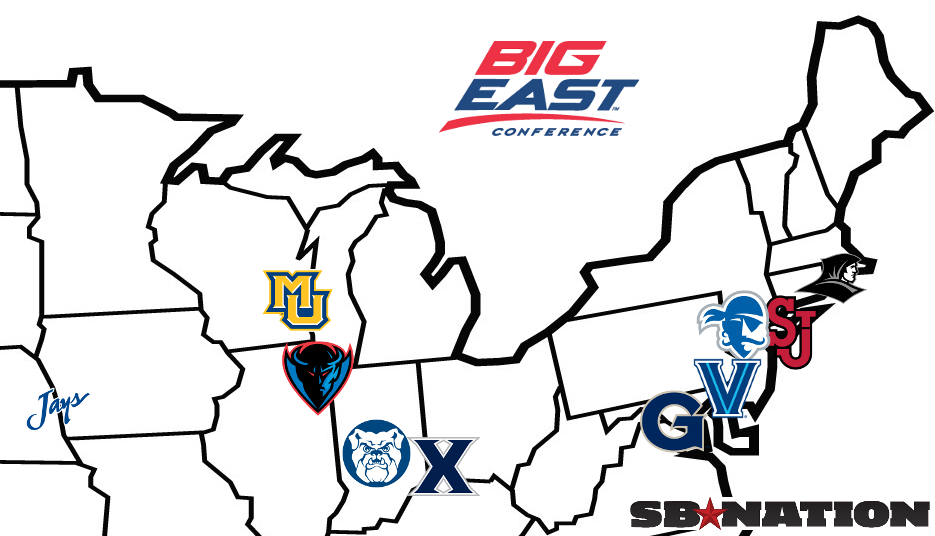
This is not the old Big East where most schools were a short drive away. Five schools, Creighton (1,100 miles), Marquette (900 miles), DePaul (800 miles), Butler (700 miles) and Xavier (600 miles) all required air transportation to get to New York for a weekend tournament. Add the cost of four nights in the hotel and four days of meals in the city and you have a considerable investment by a fan of any of these schools to attend the tournament.

The fans in the arena are customers. Please treat us as such. Make our experience a better one. Let us sit with each other after we make that investment to support the Big East Conference.

C'mon Big East. I urge you to consider changing the seating for future Big East Men's Tournaments to a tradition block configuration. If the only reason you can give for utilizing "ribbon seating' is that "it is the way we've always done it", then it's time to re-think it.

P.S. I received a response to the letter I sent to the Big East commissioner.  "The BIG EAST Conference is always searching for ways to improve the fan experience and we are spending the summer working with MSG staff and our institutional ticket and marketing representatives to review our current ticketing practices and methods.  We will be certain to incorporate your thoughts into our discussions." It was copied and pasted very neatly into the email.

Friday, July 24, 2015

Returning to the Cowboy State

Judy and I travelled to Jackson, WY in June for an National Automobile Dealers Association board of directors meeting. We went in a couple days early and were able to travel up to Yellowstone and the Tetons for a day and then spent a day in and around Jackson.

The Yellowstone National Park and Grand Teton National Park are such beautiful areas. I find the Grand Teton to be one of the most majestic sights I've ever seen. My eyes are drawn to it whenever it is in view.


I had not been to the Jackson area for 15 years. Judy and I took the kids to Yellowstone in the early 90's. Then in the summer of 2000, a friend, Craig Kirsch, and I rode in a bicycle ride called Ride Around Wyoming (RAW) which was sponsored by Three Peaks Christian School in Sheridan, WY, then a school of 31 students who supported the ride. I believe the school has now closed and the ride no longer exists.

Atop the Teton Pass el. 8,432 feet
June 30, 2000

I kept a journal during our ride and used a Sony Mavica camera to take some photos. This was at the onset of the digital photography age and the Mavica used removable disks (floppies) as the recording media. It was about the size of a brick and about as heavy as one.

I sent the journal and photos back home each day via email. The photos were downloaded from the floppies and inserted into the email message. I used a modem to email from my laptop computer. In a couple places, this was not even an option.

I wrote the journal in WordPerfect, which was among the major word processing programs at the time. I cannot find a program to translate that file to Word so I have scanned my printed copy (complete with typos) of the journal. digital version. I cannot even get Google docs to translate the .pdf so you will have to download it to view it.


Our six-day ride brought us south out of the mountains and onto the high plateau, into Utah, then Idaho and culminated in an ascent over Teton Pass on the final day. It was a great adventure at the time. But the memories have aged wonderfully - a great week with a great friend in truly spectacular country.

So here is my journal from 15 years ago. Craig and I have both had fun reminiscing.


Monday, July 20, 2015

July 2015 SDADA Column

But the bottom line would be that auto dealers would be exempt from direct supervision by the consumer financial protection bureau. The Senate auto dealer compromise, if accepted by House negotiators, would be one of Obama's most high profile losses in his efforts to overhaul Wall Street regulations. The main contours of the House and Senate bills generally match the administration's goals, but Obama has personally lobbied against efforts to carve auto dealers out of the consumer agency's jurisdiction.   - CBS Money Watch, June 23, 2010

In 2010, a Senate made up of 59 Democrats and 41 Republicans and a House made up of 233 Republicans and 200 Democrats passed a Dodd-Frank bill creating the Consumer Financial Protection Bureau (CFPB). Immediately concerns were raised since due to its unprecedented investigative and regulatory authority, its lack of accountability, and the unparalleled authority placed in its sole director, Richard Cordray.

Despite the above mentioned dealer exemption, the CFPB has made every effort possible to indirectly end the auto lending business model. Beginning with the Ally Bank settlement in December 2013 ($98 million) and recently the agreement by American Honda Finance Corp. to pay up to $25 million, the CFPB has bullied, intimidated and harassed automobile lenders in an attempt to end discretionary dealer markups.

The CFPB continues to have the dealer finance model squarely in its crosshairs. I don't think I need to mention to this audience that were it not for finance income, the new vehicle department would be largely unprofitable in most stores.

Though a couple of automotive lenders have embraced a flat fee model, most have remained committed (for now) to the current dealer discretion finance model. One has to wonder how long they (especially non-captives) will endure the CFPB's scrutiny.

NADA recently filed a Freedom of Information Act (FOIA) request to make public an agency memo that appears to plainly undermine the Bureau's long-standing claims that it is not targeting auto dealers through enforcement actions.

The Dodd-Frank Act specifically prohibits the CFPB from regulating auto dealers. Yet the Bureau's actions have caused many, including both Republican and Democratic members of Congress, to question whether the CFPB has attempted to skirt its jurisdictional boundary in an effort to regulate dealers.  -NADA News Release
Reps. Frank Guinta (R-N.H.) and Ed Perlmutter (D-Colo.) have introduced H.R. 1737, the Reforming CFPB Indirect Auto Financing Guidance Act of 2015. The legislation would repeal a CFPB bulletin from 2013 that was designed to pressure lending institutions into eliminating the availability of auto financing discounts.

Stay tuned. It would seem this issue is far from settled!

Blumenthal Wants to Ground Used Cars With Open Recalls

The Senate will soon vote on an amendment that would make it illegal to sell for dealers to sell any vehicle with an open recall. Though the Senate Commerce Committee (chaired by Senator Thune) shot down the Democratic amendment proposed by senators Ed Markey (D-Massachusetts), Bill Nelson (D-Florida) and Richard Blumenthal (D-Connecticut) that would ground vehicles with an open recall, it appears the amendment will be introduced on the Senate floor.

As we dealers know, many recalls have almost nothing to do with vehicle safety. We have recently seen recalls for items as trivial as a printing error in the owner’s manual. General Motors recalled Camaros because the air bag warning label on the sun visor may peel off.

Senator Thune recognized the logistical issues that go with such a policy when interviewed in the New York Times earlier. Imagine a South Dakota dealer taking an Infiniti or Porsche with an open recall on trade. The dealer would have to load that vehicle on a trailer and haul it to Minneapolis or Omaha. That would not lead to  favorable treatment for a consumer either.

Keep your eye on this issue as well.

ICYMI (In Case You Missed It…)

Subaru dealership employee chastises manufacturers for offering more lucrative car deals through Costco than through their own dealer network.

NHTSA blocks former chief from testifying in a class-action lawsuit against Toyota.

Despite some main stream media reports to the contrary, more than one industry expert says there is no bubble in automobile lending.

And finally…

Obama's overtime plan might impact auto dealers

Thursday, July 2, 2015

June 2015 SDADA Column

The world hates change, yet it is the only thing that has brought progress. -Charles Kettering

The past 12 months have brought some of the most significant change in NADA’s history. For nearly a century, NADA has pioneered some of the most valuable services in the industry for its growing membership, right under its roof. These services include the NADA Used Car Guide, which has been part of NADA's heritage for more than 80 years, and NADART, founded in 1957.

No one ever imagined we would part with either one, and we would not have unless we firmly believed doing so would benefit our dealer members and advance NADA's core mission.

This was the case when J.D. Power made an unsolicited offer to purchase the Used Car Guide business. With a difficult decision at hand but unanimous consensus, the NADA board of directors, the Guide board of advisors and NADA's finance and executive committees, all agreed that the best course of action was to sell the Guide to J.D. Power.

This decision, which was not reached easily or without careful consideration, will benefit our dealer members and the Guide's current and future customers. The Guide business will continue to grow and become an even stronger industry resource under J.D. Power.  As part of its agreement with NADA, J.D. Power will continue to provide NADA members with a complimentary Guide subscription as a membership benefit.

In a move unrelated to Guide, after conducting an in-depth review of various retirement plan providers, NADA made a decision to enter into a relationship with Empower Retirement, a division of Great-West Life and Annuity Insurance Company, to offer retirement plans to NADA members.  Empower Retirement is the second-largest retirement plan provider in the United States with nearly 7 million participants. The new NADA Retirement Program from Empower will go live in October of 2015, as the long-standing NADART program is retired.

NADA Retirement Program participants can expect to see many enhanced benefits, including a nearly 50-percent reduction in program fees, a state-of-the-art website designed to make it easier for participants to track their progress in saving for retirement, and fiduciary support services at a level higher than those offered by other retirement service providers, which is a service already familiar to NADART plan sponsors. NADART has been working closely with Empower to ensure a streamlined transition process for plans transferring to Empower.

While it's difficult to see these long-time services, built over NADA's history, leave the NADA family, we look to the future with optimism and renewed vigor. And, as always, we will continue to guard the interests of the franchised dealers we are privileged to serve, while remaining steadfast to NADA's mission that began nearly 100 years ago.

Most importantly, these moves will allow NADA to become more mission-focused, centering on core member services, which include protecting and strengthening the dealer franchise system, advocating on behalf of new-car dealers with Congress, the regulatory agencies in Washington, manufacturers, the media and the public, providing education and training resources for dealers and their employees, and providing dealers with better tools to enhance profitability.

ICYMI (In Case You Missed It…)

Retiring General Motors director Neville Isdell says GM has come a long way since the bankruptcy and is in capable hands, but he sees the turnaround taking 10 years.

David Robertson, Executive Director of the Association of Finance & Insurance Professionals, calls out Senator Elizabeth Warren’s disdain for dealers.

While a former dealership employee says he doesn’t think auto dealers are half as bad as many consumers seem to think they are, the July/August issue of Popular Mechanics carries an article a bit more cynical about the dealership experience.

In a pilot program, Ford dealers’ will use beacons, which will broadcast key information to the customer’s smartphone that might help close a sale, on models featured in their showrooms.

GM dealers are concerned as EBE 2.0 looms ahead. GM’s Dealer-Succession Bulletin causes consternation as well.

And finally…


NADA responds to inaccurate and irresponsible New York Times editorial.


Sunday, May 10, 2015

The Fish Warriors

I grew up a block from some of the best walleye fishing on earth. As a kid, I loved to fish. Up to
about age 15, I fished a lot. Almost all of my fishing was off the rip rap (rocks) just in front of our house.

I would walk down to the river with my fishing rod and reel, tackle box and minnows and fish until (at least) dark. Building a driftwood fire was part of the experience so coming home smelling like smoke (and fish if I was lucky) was a regular occurrence.

I cannot remember my Dad ever fishing with me. He loved to check in on me when I fished and would always brag about the fish I caught. But he did not have the patience to fish.

So when I bought a guided fishing outing for two at a benefit auction, I had a plan to have my son, Alex, and my Dad do the fishing while I played videographer to capture the memories. It was perfect for both because our guide provided all necessary equipment, baited the hook and even took the fish off the hooks. All we had to do is show up at the marina on time!.

I knew Dad would agree to go because it meant he got to spend the day with Alex. He was a typical grandpa - whatever he could do to spend time with his twelve year-old grandson was a worthy activity.

So on a crisp May morning in 2001, we headed to the marina to meet our fishing guide. He was unloading the boat as we arrived and we were on the river and fishing less than twenty minutes later.

The video shows it better than my words can describe it but what you will see here is a grandfather and his grandson (both dressed in the obligatory Nebraska Huskers gear) enjoying a South Dakota tradition.


My only regret is that this is the only time these two did this together. Though they spent quite a few days together afield pursuing the South Dakota state bird, this was their only day together walleye fishing on the Missouri River.

Jimmy Houston may have more dramatic fishing footage but he doesn't have anything that comes close to this video to me.

Tuesday, April 21, 2015

April 2015 SDADA Column

I recently attended an NADA Government Relations Committee meeting in Washington, DC. I had very productive discussions with all three members of our South Dakota congressional delegation. Senators Thune and Rounds and Representative Noem are all supportive of our legislative priorities: support the CFPB Reform Bill to keep auto loans affordable and accessible, ensure that changes in LIFO and advertising deductibility do not hurt small business, and focus on strategies to boost recall completion rates instead of grounding vehicles for minor recalls.

Each of these priorities is an easy discussion because they have such broad appeal outside of our industry. Community banks are being crushed by the same heavy-handed tactics the CFPB is trying to apply to auto dealers and lenders. Ultimately, fewer community banks and fewer auto lenders does not serve the consumers which is what the CFPB purports to do.

LIFO (last in, first out) is a longstanding inventory accounting method used by businesses to help mitigate rising inventory costs as it allows companies to calculate their income by basing sales on the newest inventory for goods, such as vehicles and parts, which increase in price over time. It is a strategy used by many businesses, big and small, to keep more capital in the business for future investment. Any drastic changes will decrease capital investment by businesses.

Any bill regulating rental and used vehicles under any open recall could cause a significant disruption for consumers, rental companies and dealers. As we dealers know better than anyone, the majority of vehicle recalls do not require the drastic step of grounding the vehicle. In fact, many of the recalls we saw in 2014 would have been handled under "service bulletins" in the past. The current vehicle recall process was not designed to differentiate among potential levels of risk. It would make much more sense to create policies tailored to boost consumer recall response and completion rates. Of course, that's why we shouldn't expect those policies from Washington regulators!

Wall Street Journal Offers Peeks Behind the CFPB Curtain

While Senator Elizabeth Warren (D-MA) was saying that the CFPB should assume oversight of auto dealers, which were left out of the Dodd-Frank Act (a discussion fully vetted during the debate of Dodd-Frank), the Wall Street Journal was offering some insight into exactly how the CFPB goes about their business.

In an April 6 editorial entitled Washington’s Latest Bank Heist, the Wall Street Journal exposed the double secret methodology (Bayesian Improved Surname Geocoding) behind CFPB's accusation that auto dealers are charging minority buyers higher interest rates on car loans than they're charging similar white customers.

A week later, on April 13 in Do Two Half-Victims Make a Whole Case?, the Journal opined that it was unreasonable to fine an auto lender (specifically Ally) if you could not identify a victim.

These two opinion pieces make the auto dealers argument in a very clear and simple manner. No ad NADA could ever buy would come close to the value of these op-ed pieces. I urge you to read them and pass on to anyone who does not understand the issue!

Detroit News Commentary: Direct Auto Sales Could Raise Car Prices

In another article that makes the dealers' case, Lawrence J. Spiwak, president of the Phoenix Center for Advanced Legal & Economic Public Policy Studies, makes the case that intra-brand price competition, which is the by-product of many state franchise laws, saves the automobile consumer money.  Not requiring auto manufacturers to sell their cars through independently owned local dealerships will only serve to drive end prices up for consumers.

Another opinion piece that lays out the issue clearly and concisely in a medium that ads cannot be purchased. Just when you think the media are stacked against you...


Wednesday, March 18, 2015

March 2015 SDADA Column

One of my mantras when I am working on a glass of good bourbon and a fine cigar is to "never allow the truth to derail a good story". It's usually good for a laugh. It's always justifies my embellishment!

Somehow though, it is not quite as funny when the Department of Justice abides by the same premise. In May 2009, the U.S. Justice Department looked at the economic effects of state franchise laws that ban on direct sales of vehicles by manufacturers to consumers. The author of the Justice Department report, economist Gerald Bodisch, used the example of a direct sales model, a GM program in Brazil, whereby a consumer could order a Chevrolet Celta online. He opined about how wonderful this program was.

There was only one problem with this report - the program ended in 2006 because it was too costly. That is a full three years before the report by the DoJ was filed. This earned the Department of Justice four Pinocchios from the Washington Post.

Silly me. I did not expect that it would be acceptable for the Justice Department to embellish. I wonder what kind of bourbon Mr. Bodisch drinks. It would appear that it's something in the 100-proof plus range! Cheers!

CFPB's Richard Cordray Takes Tough Questions From Congress

I don't know if you've seen this video of Richard Cordray, director of the Consumer Financial Protection Bureau, testifying before members of Congress who expressed serious concerns about the CFPB’s guidance on dealer-assisted financing. It is worth a couple minutes of your time to see that the CFPB's behavior has garnered bipartisan dismay. (Watch Rep. Roger Williams (R-Texas), a car dealer, tell a story of what really happens in the showroom.)

Members on both sides of the aisle noted that the agency has overstepped its jurisdiction and continues to ignore an important Charles River Associates study that questions the CFPB’s testing methodology. The flawed methodology is being used in the CFPB’s overreaching guidance of auto loans, yet Cordray refused to discuss the CFPB’s reasoning in dismissing the study.

NADA Supports Efforts to Disapprove NLRB Ambush Rule

In December, the National Labor Relations Board (NLRB) issued the "ambush" election rule which shortens the time between when union organizers ask for a union election and when that election must take place. The rule forces companies to allow these elections to occur as soon as 11 days after they're notified. The rule's new timeframe limits an employer's ability to communicate with employees prior to the election. The rule also requires employers to provide, within two business days of an election direction, employees' personal telephone numbers and e-mail addresses.

NADA opposed this rulemaking in a number of ways, through filing multiple sets of comments and our involvement with the Coalition for a Democratic Workplace (CDW). CDW filed a lawsuit in the United States District Court for the District of Columbia to stop the implementation of this rule and coordinated multi-industry Senate and House letters in support of S.J. Res.8., which NADA signed. S.J. Res. 8 is a joint resolution nullifying this rule through the use of the Congressional Review Act. On March 4, the Senate approved S.J. Res. 8 by an almost party line vote of 53-46. The House is expected to take the measure up on March 18. The President's advisors announced on March 3 that they will recommend a veto of the resolution. Congress would need a two-thirds majority to override a presidential veto.

NADA believes that the current election timeframe is reasonable and allows employees to hear from both the union and the employer before making a decision. The NLRB's rule upsets this balance by putting employers at a disadvantage. Contact NADA Legislative Affairs if you are interested in learning more about the upcoming vote in the House by sending an email to legislative@nada.org.

Monday, March 2, 2015

Don't Park That Cash in Your Leased Vehicle

Leasing your next vehicle may be a more attractive option than it has ever been before. I have posted previously about the leasing. Driven by high residual values and low lease (interest) rates, lease payments currently allow you to drive more vehicle for the money than purchasing does.

Leasing also afford the car buyer to avoid a long-term commitment. When you sign a lease, you’re essentially financing the vehicle for a set period of time and when the lease is up, you return the vehicle to the lessor and move on. This can be an attractive option for anyone who isn't interested in keeping a vehicle for the long haul or those who want to trade up for a new model every few years.

I am often asked about down payments on a lease. Most manufacturer-advertised lease payments include a down payment. It is usually in the fine print at the bottom of the television screen and flashes up so fast you cannot read it. It may be at the bottom of the page in print so small you need a microscope to decipher it or speed read at the end of the radio commercial faster than you can listen!

In order to guarantee customers the lowest and most attractive payment possible, these ads include a sizable down payment up front. Typically, this money goes towards paying a portion of the vehicle lease up front. But ponying up all that cash early on doesn't always work in your favor.

While a down payment may lower your lease payment, there is some risk that comes with putting money down to lower your payments. Often this down payment money comes from the equity in the vehicle that you may be trading. While it seems logical to roll this money into the next vehicle, it is not necessarily the best thing to do.

If the leased vehicle is stolen or totaled in an accident during the first few months of the lease, the insurance company would reimburse the leasing company only for the value of the car. They will not reimburse you for the money you put down. Not only would you be short a vehicle but you’d also be out your down payment money.

Paying less up front or even nothing at all may make your monthly payment a little higher but you wouldn't have to worry about coming up short if something were to happen to your leased vehicle. If you have the discipline to do so, you can put your money in an investment account and benefit from it growing rather than spending it to reduce your payments. You always have that money to fall back on in case you have trouble making a payment some month.

Leasing is a very good option for most prospective vehicle buyers. But you must structure the lease in the manner that is most beneficial to your situation. Let me strongly caution against putting money down on your leased vehicle.