Showing posts with label Used cars. Show all posts

Wednesday, July 12, 2017

July 2017 SDADA Column

In June I attend the American Financial Services Association (AFSA)/NADA Executive Forum in
Washington, DC. These two trade association sponsor this event each year to discuss topics that affect automotive lending. Almost all captive and large automotive lenders were represented at the forum.

The lenders top concerns included cyber security, falling vehicles values and management of ancillary products. Dealers' top concerns were pressure on profitability, new regulatory threats by the CFPB and FTC, and existing regulatory and legal compliance challenges.

It was the first time in several years that regulatory threats did not top both lists. While regulatory threats still loom, it is telling that both lenders and dealers feel other perils have surpassed those.

While a business-friendly administration should keep the regulatory threats at bay, both organizations will have to stay vigilant and watch the beltway regulators!

Friday, May 26, 2017

May 2017 SDADA Column

Relying on the government to protect your privacy is like asking a peeping tom to install your window blinds.

– John Perry Barlow

New technology related to connected cars is evolving quickly. Many of the new features associated with this connectivity require new types of data, which puts privacy in the spotlight for manufacturers, government and consumers. Needless to say, that means that the dealers need to be on top of the issue as well.

When that vehicle is traded and that info remains, both the customer and the dealer remain at risk. Do you have a procedure for deleting the info from a trade?

The Future of Privacy Forum (FPF) and the National Automobile Dealers Association (NADA) released a first-of-its kind consumer guide, Personal Data In Your Car. The Guide helps consumers understand the kind of personal information collected by the latest generation of vehicles, which use data to further safety, infotainment and customer experience.

The Guide describes several components that are integral to properly protecting consumer data. For example, services that collect and share personal information should be accompanied by a clear privacy policy. The reality is that yes, cars are starting to know more about you, but what it knows may save your life.

Personal Data In Your Car highlights that nearly all leading automakers have committed to protecting consumer information by committing to the Automotive Privacy Principles. These Principles guide privacy practices in the automotive industry. They went into effect beginning with model year 2017 vehicles and for subscription services beginning on January 2, 2016.

This guide will help you and your customer protect their private information.

Wednesday, June 29, 2016

June 2016 SDADA Column

Do Americans know how lucky they really are? They have Uncle Sam to protect them from themselves.

The Federal Trade Commission has proposed a survey of consumers regarding their experiences trading in, buying and financing vehicles at dealerships. The commission will conduct 40 interviews with consumers that are 90 minutes in length.

In 2015, there were over 38 million used vehicle transactions and over 17 million new vehicle transactions in our country. The FTC will conduct 40 interviews and will then have a complete understanding of the automotive market in America!

This survey is a repeat of the one the FTC conducted five years ago. That survey found no systemic problems with the auto-retailing sector. Processes have certainly gone to hell since that survey!

I know I can be a bit cynical but perhaps we should survey health care patients, attorney clients, insurance company customers, mobile phone customers, etc. Is there no room for improvement in any of these transactions? Some would suggest that market forces and competition would be very good at improving and streamlining the processes.

At some point, perhaps consumers must be responsible for their own choices. There are many options in  the marketplace. Consumers have control over where they buy. That can (and should) be the ultimate regulator!

A Peek Behind the CFPB Curtain

This "must see" video (http://goo.gl/Mcu0qe) takes a somewhat humorous look at the shenanigans going on with the CFPB in their attempt to regulate and punish those involved in auto finance lending. This is your government at work!

Supreme Court Issues Pro-Dealer Opinion in Service Writer Overtime Case 

The Supreme Court issued an opinion in Encino Motorcars v. Navarro, vacating a 2015 Ninth Circuit Court of Appeals decision that had held that dealership “service writers” are not covered by the federal “salesmen” exemption from overtime pay. In doing so, the Supreme Court expressly rejected a 2011 U.S. Department of Labor (DOL) interpretative regulation that service writers/advisors are not "salesmen" exempt from overtime. In particular, the Court faulted DOL for failing to give adequate weight to dealerships’ reliance interests during the rulemaking process, and for failing to provide a “reasoned explanation” for the abrupt change of policy. The Supreme Court’s decision requires the Ninth Circuit to reconsider its prior decision consistent with the language of the Fair Labor Standards Act (FLSA) without giving “controlling weight” to the DOL’s 2011 regulation.

In March 2015, the federal Ninth Circuit Court of Appeals ruled that service writers are not exempt from overtime as “salesmen.” That decision was based on the Ninth Circuit’s conclusion that preamble language found in a 2011 DOL rulemaking constituted an interpretation of the FLSA entitled to legal deference. Together with the state dealer associations covered by the Ninth Circuit, NADA filed an amicus brief in support of a certiorari petition with the U.S. Supreme Court. The Supreme Court granted “cert” in January and heard oral argument in April. Former Solicitor-General Paul Clement expertly (and successfully) argued on behalf of the petitioner with NADA’s amicus brief being cited several times during the argument and in the Opinion itself.

Overtime FAQ for Dealers

As I mentioned in this space last month, the U.S. Department of Labor (DOL) issued a rule that dramatically increases the salary and compensation levels that must be met in order for "white collar" dealership employees to be exempt from overtime. NADA has issued a new FAQ publication on the white collar rule's impacts on dealerships and their employees.

OSHA Issues New Injury and Illness Electronic Reporting Mandate 

Starting in 2017, certain dealerships must begin submitting employee workplace injury and illness records to the Occupational Safety and Health Administration (OSHA). All dealerships must maintain reasonable procedures by which employees can report work related injuries and illnesses promptly and accurately. The new reporting rule builds on existing mandates requiring dealerships with 10 or more employees to accurately record and post employee workplace injury and illness using OSHA Forms. In the future, these forms must be made available to OSHA and state labor inspectors upon request. Car dealerships with fewer than 250 employees at a single "establishment" are not required to submit forms to OSHA.

Wednesday, January 6, 2016

Hang Together? Or Separately?

"We must, indeed, all hang together or, most assuredly, we shall all hang separately."  
-Benjamin Franklin

If you're a student of the American Revolution, you will recognize the quote above. Franklin's message was that the signers of the Declaration (as well as colonists in general) had to help and support each other or they were doomed.

I believe that is much like a local community. If those of us in a community do not support our local businesses, we won't hang separately or be executed, but we are doomed.

If you live in a small town, you surely have been encouraged to “buy local.” But what, exactly, does "buy local" really mean? Certainly you are being encouraged buy groceries, hardware and clothing locally. But the higher the price of the items you buy locally, the greater the impact your purchase has on the local economy.

According to the website local-first.org, $73 of every $100 you spend returns to the community through avenues such as taxes (which support the local schools and teachers), payroll (which employees may again spend locally), and other expenditures (like support of local events, activities and organizations).


When you buy locally, businesses have the opportunity to create more jobs locally. Simple economics dictates that more local jobs means a greater demand for workers and thus higher wages and/or better benefits for everyone in the marketplace.

When you buy in Mitchell, Rapid City or Sioux Falls or online, none of the money spent stays in in our local community to pay taxes, payroll or any other expenditures. In other words, you are not supporting the local schools and teachers, local events, activities or organizations. 

"But I Can Save Money"

Can you save money? Are the goods or services you are buying really less expensive? Are they of the same quality? Did you consider the value of your time (driving or riding to another community)? Did you factor in the cost of your transportation (fuel, maintenance, depreciation of your vehicle, etc.)? Did you factor in the cost of shipping and handling (of an online order)?

My experience is that, if given the opportunity, local business owners do or would be willing to match the true cost of goods. To be fair, this should include some of the costs mentioned above. The question is, are you willing to give them that opportunity. Do you care enough about the future of our community to look at a transaction fairly and give the local vendor that opportunity?

I am not advocating feel-good, it's-worth-paying-more-for-local concept. I believe that if you do give the local businesses the opportunity to earn your business, you will be rewarded with better prices, better service and a better community. 

Proud to be Your Local Automobile Dealer

As an automobile dealer with stores in Chamberlain and Winner, I ask you to consider applying the logic above when you purchase your next vehicle. I would enthusiastically welcome the opportunity to help you find your next vehicle, get the financing package that fits your needs and provide service for your vehicle going forward. I believe we can bring value and enjoyment to your ownership experience.


Find the Right Vehicle...

The automobile world has changed drastically over the past 15-20 years. It used to be that you would have to go to the dealership to see a vehicle. The internet allows you to shop online for the right vehicle. Smart phones and tablets let you do that from virtually anywhere. 

It does not make sense for a small town dealership to stock hundreds of vehicles and pay the interest associated with stocking so many vehicles when we can have access to many more vehicles without the expenses. We have a network of dealer-partners across the Midwest with which we trade and buy cars, trucks and SUVs. This expands our "true" inventory exponentially. 

Our professional staff will find the new or used vehicle you are looking for. You won't have to drive all over looking for that "just right" automobile. You tell us what to find, and WE WILL FIND IT!!

...At the Right Price...

When you buy local at Harry K's, you will save money! Our prices will reflect lower costs and will
save you money when compared big city stores. Our overhead expenses (interest, taxes, facility, utilities, salaries, etc.) are much lower and we pass that savings on to our customers!

...And Payment...

At Harry K's, we have access to more than a dozen different financial institutions that specialize in automobile financing. We will shop these banks and pit them against each other to get you the best interest rate possible. 

We will use our buying power to help you get financed even if you have had some bad luck in your financial past. We will work hard to serve your financing needs because you're not just another customer, you're our friends and/or neighbor as well!

...And We'll Take Care of You Down the Road...

Our service professionals are training weekly so that they provide the best service for your vehicle. The value to you is that you can be assured that your vehicle will continue to perform at the highest level and when you come back to trade your vehicle, it retains the greatest value possible because we have a service record.

Growing Together

We believe that when businesses in the community thrive, the community thrives. Unlike big city businesses or dealerships, we are proud to give back to our community. We know the summer rec and swim team schedules because our sons and daughters play and swim on the teams. We are not just your local dealer, we are stakeholders in your community. Supporting your local dealer means supporting the small-town community.


You are more to us than a paycheck or a profit. You are our friends and neighbors. Give us a chance to earn your business. I believe you benefit and our community will benefit!


Monday, July 20, 2015

July 2015 SDADA Column

But the bottom line would be that auto dealers would be exempt from direct supervision by the consumer financial protection bureau. The Senate auto dealer compromise, if accepted by House negotiators, would be one of Obama's most high profile losses in his efforts to overhaul Wall Street regulations. The main contours of the House and Senate bills generally match the administration's goals, but Obama has personally lobbied against efforts to carve auto dealers out of the consumer agency's jurisdiction.   - CBS Money Watch, June 23, 2010

In 2010, a Senate made up of 59 Democrats and 41 Republicans and a House made up of 233 Republicans and 200 Democrats passed a Dodd-Frank bill creating the Consumer Financial Protection Bureau (CFPB). Immediately concerns were raised since due to its unprecedented investigative and regulatory authority, its lack of accountability, and the unparalleled authority placed in its sole director, Richard Cordray.

Despite the above mentioned dealer exemption, the CFPB has made every effort possible to indirectly end the auto lending business model. Beginning with the Ally Bank settlement in December 2013 ($98 million) and recently the agreement by American Honda Finance Corp. to pay up to $25 million, the CFPB has bullied, intimidated and harassed automobile lenders in an attempt to end discretionary dealer markups.

The CFPB continues to have the dealer finance model squarely in its crosshairs. I don't think I need to mention to this audience that were it not for finance income, the new vehicle department would be largely unprofitable in most stores.

Though a couple of automotive lenders have embraced a flat fee model, most have remained committed (for now) to the current dealer discretion finance model. One has to wonder how long they (especially non-captives) will endure the CFPB's scrutiny.

NADA recently filed a Freedom of Information Act (FOIA) request to make public an agency memo that appears to plainly undermine the Bureau's long-standing claims that it is not targeting auto dealers through enforcement actions.

The Dodd-Frank Act specifically prohibits the CFPB from regulating auto dealers. Yet the Bureau's actions have caused many, including both Republican and Democratic members of Congress, to question whether the CFPB has attempted to skirt its jurisdictional boundary in an effort to regulate dealers.  -NADA News Release
Reps. Frank Guinta (R-N.H.) and Ed Perlmutter (D-Colo.) have introduced H.R. 1737, the Reforming CFPB Indirect Auto Financing Guidance Act of 2015. The legislation would repeal a CFPB bulletin from 2013 that was designed to pressure lending institutions into eliminating the availability of auto financing discounts.

Stay tuned. It would seem this issue is far from settled!

Blumenthal Wants to Ground Used Cars With Open Recalls

The Senate will soon vote on an amendment that would make it illegal to sell for dealers to sell any vehicle with an open recall. Though the Senate Commerce Committee (chaired by Senator Thune) shot down the Democratic amendment proposed by senators Ed Markey (D-Massachusetts), Bill Nelson (D-Florida) and Richard Blumenthal (D-Connecticut) that would ground vehicles with an open recall, it appears the amendment will be introduced on the Senate floor.

As we dealers know, many recalls have almost nothing to do with vehicle safety. We have recently seen recalls for items as trivial as a printing error in the owner’s manual. General Motors recalled Camaros because the air bag warning label on the sun visor may peel off.

Senator Thune recognized the logistical issues that go with such a policy when interviewed in the New York Times earlier. Imagine a South Dakota dealer taking an Infiniti or Porsche with an open recall on trade. The dealer would have to load that vehicle on a trailer and haul it to Minneapolis or Omaha. That would not lead to  favorable treatment for a consumer either.

Keep your eye on this issue as well.

ICYMI (In Case You Missed It…)

Subaru dealership employee chastises manufacturers for offering more lucrative car deals through Costco than through their own dealer network.

NHTSA blocks former chief from testifying in a class-action lawsuit against Toyota.

Despite some main stream media reports to the contrary, more than one industry expert says there is no bubble in automobile lending.

And finally…

Obama's overtime plan might impact auto dealers

Thursday, January 15, 2015

January 2015 SDADA Column

It goes without saying that the NADA Director's Column is intended to be about NADA issues. While I have discussed South Dakota issues in this space before, they have not usually been the primary focus. But he South Dakota Automobile Dealers Association has a very important bill in front of the legislature this year and I feel compelled to address it.

The bill will repeal the South Dakota damage disclosure. We have been down this road before but the hail storms last summer seem to have raised awareness of what a bad law that our current damage disclosure law is. In fact, several legislators have learned firsthand about "diminution of value".

The used car dealers, insurance companies, body shops and salvage dealers have also expressed support of this bill. Through the years, we have struggled to get all these parties on the same page. As the saying goes, "the stars have aligned".

Two years ago, I added a body shop in my Ford store. Since then, I've seen the lengths to which people will go to avoid having to disclose damage on their vehicle. They have learned how a damage disclosure can crush the value of a late model vehicle. If you give people a reason to lie, cheat or steal, don't be surprised when they do so. Our current damage disclosure law causes people to do just that.

I have never talked to a member of SDADA that thinks the damage disclosure law is a good one. We have discussed raising the damage limit or excluding certain equipment. That is simply spraying perfume on the pig.

This is our best opportunity to kill this law. We need your help. Please talk to your legislators about this bill. Make certain that they understand it and why we want to do it. Point out to them that all of this information is now public (Carfax, Auto Check, etc.) and that many of us are providing this information to your customers at no cost before they buy your vehicle.

Get involved. Make a phone call. Let's put a stake in the heart of the damage disclosure law once and for all!

Dealers Much More than "Middleman" for Consumers

Tesla's sales model had stirred much discussion about the role of the traditional automobile dealer. We have been cast as everything from oligopolists, who just want to preserve an antiquated system, to middlemen, who add no value to the process.

NADA's arsenal of resources intended to get the dealers' story out continues to grow. The videos and other materials found here make a great short presentation for your Kiwanis or Rotary meeting. Please consider spreading the word.

NADA’s “Get the Facts” initiative is designed to inform policymakers, opinion leaders and the media about the numerous benefits of the dealer franchise network through a variety of multimedia resources and videos available at nada.org/getthefacts.

The current franchised new-car dealer model has benefited consumers, manufacturers and local communities for nearly a century. It is supported by both dealers and factories as the best and most efficient way to buy, sell, service and finance cars in the marketplace. NADA’s Get the Facts page sets the record straight about the benefits of the franchise system for consumers and local communities all over America.

This campaign emphasizes that local franchised auto dealers: fiercely compete for business and drive consumer prices down; take the side of consumers in warranty and safety recalls; create good-paying local jobs and significant tax revenue for local communities; and simplify an otherwise complex car-buying experience.

Dealers and local dealer associations are encouraged to link to the videos on their websites, and with permission can co-brand the videos with their own logos. For more information about co-branding content from NADA’s “Get the Facts” initiative, contact publicaffairs@nada.org.


Tuesday, August 5, 2014

Grandpa's Caddy


I've previously written about my Grandpa Frank. While he left a very significant impression on me during the seven and a half years we shared, perhaps his most lasting concrete legacy was his 1964 Cadillac Sedan Deville. He bought his car in 1965 from Novak Cadillac in Omaha. He replaced his 1961 Chevrolet Bel Air.

I remember the Chevrolet Bel Air from one eventful trip in it when I was three or four years old. I was riding from Chamberlain to Winner with Grandpa and Grandma on a hot (and I mean HOT!) South Dakota afternoon. Air conditioning in cars was a still a luxury - one that Grandpa had not splurged on in that car. I was roaming the spacious back seat by myself. We were somewhere near Hamill, SD when we hit a bump on the road (South Dakota roads were the same back then - every bridge was three inches above the road!) that caused the back window of the Chevy to shatter and the glass to fall down on me.

Grandpa pulled over immediately. Grandma was crying and asked me if I was alright. I was crying and I told her that I was fine - though I probably needed to change my undershorts! When Grandpa asked me why I was crying, I told him I was scared because Grandma was crying. Grandpa scolded Grandma, they put me in the front seat with them and we set off on the half hour trip to Winner!

Shortly after that, Grandpa decided to get his new Cadillac. I remember sitting on the arm rest on the front seat between Grandpa and Grandma in the Caddy. It was like a built in booster seat. This was in the days before child car seats and even seat belts for all passengers. I felt like I was the king when I rode with them in that seat.


I remember Grandma driving that car after Grandpa passed. She was so little for such a big car but she handled it with no problem. After Grandma moved from Winner to Chamberlain in the mid-eighties, Grandma drove it very infrequently. She drove it for groceries and to church.

Grandma passed away in January 1987 and I expressed interest in purchasing the car from my Mom and her two sisters. I think they were excited that I was interested and that it might stay in the family. I bought it from them and began the long, slow process of reconditioning it.

The car was in great shape mechanically but had some cosmetic blemishes. Over a five or six year period of time, I put on a new vinyl roof, painted the body and put on a new set of wide whitewall tires. I replaced some interior parts that had been lost or broken over the years. Later I replaced the seat covers, replaced the in-dash clock, put in a Bluetooth MP3 player and speakers and a did few other small fixes,

The original owners manual, window sticker and sales contract were in the car when I purchased it. I found a service manual, showroom literature and some magazine advertisements.


When (daughter) Rachel and (son) Alex (this was BS - before Sarah) were young, we drove the car to Winner to the drive-in theater a couple different times. The kids loved rides in the Caddy because people would spontaneously wave at the car - not us but the car - with a big smile on their face. You could almost see that the car was evoking memories of their youth as they watched us pass by them.


One Fourth of July morning, I took Rachel over to Roam Free Park (which overlooks Chamberlain and the Missouri River) and took some photos of her (on her birthday). Years later, she would take some of her high school senior portraits with the car - one of which hangs in my office!


The Caddy played a prominent role in Rachel and Andrew's wedding last summer. Not only did it shuttle the bride and groom to the church and reception/dance, it was featured in the wedding photos. That was so appropriate since Rachel has been posing with it since she was about four years old.


When Rachel was in college, she commissioned a very talented friend to paint a watercolor of the Caddy sitting at Roam Free Park. It hangs proudly in my office.


Each summer, the Caddy glides out of storage where it is nestled in a car cover in a garage. It's white walled tires roll down the streets of Chamberlain for a month to six weeks. It accumulates a couple hundred miles every years - adding to its total of 78,000+. It's a great ride to church on a summer Sunday morning. The locals smile and wave as its rolls down the streets of Chamberlain. The tourists drop what they're doing and gawk.

The vanity plate on the Caddy reads "64 CADI". That's why is it so ironic when people want guess what year it is. Like a teenage boy with the Swimsuit Sports Illustrated, they are so smitten with the car's beauty that they don't even notice!


This year, the Caddy is 50 years old. While it may have had a few wrinkles, the "work" that's been done has served it well - it looks pretty damn good. Because it's half century has been spent mostly in a garage and receiving lots of TLC, it  may be just hitting its prime!

I love the Caddy. I love it because it is a classic. I love it because it represents a different era - a simpler time. I love it because of what it does to people when they see it. I love it because when you put your foot on the accelerator, the 429 cubic inch V-8 roars (and moves the gas needle). I love it because you can put a family of four in the trunk. I love it because any pre-1970 song, regardless of fidelity, sounds great on its stereo. I love it because the wide whitewalls make the car look like it is wearing sneakers. I love it because when you sit behind the wheel, you cannot help but smile. But most of all, I love it because it was Grandpa and Grandma's car - their pride and joy!

We have had a lot of fun with the Caddy. I'm pretty sure Grandpa had no idea of the legacy that car would carry when he made that trip to Omaha in 1965.


Update - 9/4/2014: On August 30, I took the Caddy to the Prairie Cruisers Car and Tractor Show in Winner, SD. The show is part of the community's annual Labor Day celebration. Ironically, in its return to its "old stomping grounds", Grandpa's Caddy won a Best in Class award. Several old timers recognized it as Frank Wurnig's Cadillac. It made for a fun afternoon.


Thursday, July 31, 2014

My First Cars

Cars are part of our American culture and as such, everyone remembers their first car. Some remember their first car for what it was - year, model, make, engine, etc. Others remember their first car for where it took them, the friends who rode shotgun, the responsibilities it brought (or didn't bring) or the sense of freedom that came with it.

For me, it was much more of the second group than it was the car. Perhaps if I had driven one of the the "muscle cars" of that era, it would be about the car. But my first car was anything but a muscle car. It was closer to a aircraft carrier!

When I got my South Dakota "learner's permit" back in the fall of 1974, I inherited the family station wagon. It was a 1967 Mercury Colony Park Station Wagon. Before it belonged to my family, it was the property of the Holiday Inn in Mitchell, SD. They had a vinyl sign on the wood grain side of the wagon. When the vinyl was removed, one could see how the wood grain had weathered. The wood grain under the vinyl had not weathered so my first car advertised the Holiday Inn in a not so subtle way.

That mattered little to me. Nor was I bothered by the fact that you could land small aircraft on the hood, that you could rent out the back of the vehicle to a small family, that it got about 3 gallons/mile (yes that is backwards but gas was about $.35 so it mattered little), or that it was a "sled".

I can't find any photos of the old Mercury but the photo below is a pretty good representation of my car. It was maroon instead of white. (Picture a dark image of a Holiday Inn sign on a faded wood grain!)

It was my car. It got me where I needed to go. I did not have to ride my bicycle or depend on my parents for a ride anymore. And the optimist in me rationalized that I could get all my fishing gear in the back of the wagon easily. What more could a 14 year-old ask for?!

1967 Mercury Colony Park Station Wagon

...until I started high school. The upperclassmen were not near as enamored with my "Woody Wagon" as I was and were quite outspoken about it. Let's just say I caught my share of crap about it. Soon after starting high school, I was working Mom and Dad for a better, "cooler" ride.

After a year or so of "salesmanship" on my part, Dad took me to the local Ford dealership and bought me a two year-old 1974 Ford Pinto - it was the top selling car in America that model year. It was orange with a stripe across the rocker panel and it had a glasspack muffler (exhaust gas passes straight through the center of the muffler) which meant it sounded a tough as a Pinto can sound.

I was thrilled and immediately began customizing the Pinto. While for most high school boys, that meant headers, wheels, new carburetor, etc, for me it meant a new stereo - the first automobile cassette player in Chamberlain -  a 5-band equalizer/amplifier and speakers with enclosures. I'm certain that 200 decibels was within my reach!

Soon I had all the upperclassmen stopping me to look at the stereo in my Pinto. Shortly thereafter, they were asking for my help in securing and installing a stereo of their own. I sensed a business opportunity and before long I was ordering and installing stereos.

All the money I earned went toward upgrading my Pinto's system. It was my "demo" model and was certainly justified as I tried to expand my audiophile empire. It allowed me to own the best automobile stereo in town throughout high school.

This was much more important then than it is now. We didn't have iPods, Walkmans or even "boom boxes" yet. If we wanted music, it came from our cars. We would often spend hours "cruising" the streets of Chamberlain. That was a big part of our recreation. The cruising was much better with great tunes blasting from a hot stereo!

One summer day my Dad came home to find I had cut a hole in the roof of the Pinto with a jigsaw. He was aghast to learn I was putting a sunroof in my car. He was sure I had ruined the car. I did a good job though (after I endured fixing a couple leaks) and I'm certain I had the only Pinto with a sunroof. 

1974 Ford Pinto
I drove the Pinto to Creighton University in Omaha in the fall of 1978. While it was an adequate vehicle, there wasn't much room to transport my limited belongings back and forth (especially with those speaker enclosures in the way!). So while the Pinto was a great high school car, it certainly wouldn't do for a "college man" - or so I told my parents.

1978 Ford Thunderbird
After several months of "salesmanship" again, they bought me a one year-old 1978 Ford Thunderbird in the summer of 1979. It was a luxury car compared to my Pinto. The Pinto stereo certainly would not do in this car - I would need an upgrade. And so it went.

My college buddies called it the "Thunderchicken" but that did not stop them from piling in for our road trips to follow our beloved Creighton Bluejays basketball team play or to follow Bruce Springsteen's tours across the Midwest. We roamed from Denver to Chicago with five of us packed to the car. It was a good thing that our luggage was little more than a change of underwear and a tooth brush!

The "Thunderchicken" served me well through the rest of my college years. I drove it until I went to work for Lederle Laboratories and got a company car. I courted my wife in both the Pinto and the T-bird (it was a long courtship!). I'm pretty sure she wouldn't have acknowledged knowing me when I was driving the "Woody Wagon"!

Each of these cars is still a part of me. Unlike others from my generation though, I have not spent any time looking for these vehicles or a facsimile to restore. I have many fond memories of these vehicles, the places they took me, who was with me and the events we attended stored in my mind. That will do just fine!

Thursday, April 17, 2014

April 2014 SDADA Column

“It’s so hot I saw two trees fighting over a dog” - Southern colloquial expression

I recently returned from an NADA Finance Committee meeting in New York. While there, I was able to attend the NADA/JD Power Automotive Forum. This was the fifth annual one-day event, originally organized by NADA, bringing together leaders from OEMs, suppliers, retailers, and the media to discuss how industry and economic conditions will shape the future. Dealers have participated in forum panels in years past, but never has the NADA Chairman addressed the group.

This year, NADA Chairman Forrest McConnell kicked off the NADA/JD Power Automotive Forum with a great speech about the consumer benefits of the current franchise dealer network for sales, service and handling vehicle recalls. But he used his southern wit and charm (and colloquialisms) to bring his message to a level all could appreciate.

Just a sample of McConnell's magic: "If you tip a waiter 10% you're cheap. If you tip 3% they're on you like a rat on a Cheeto. The franchise system is a model that drives competition up and prices down. It is singlehandedly the best model for selling vehicles anywhere. The auto industry needs the franchise system."

Forrest is a great ambassador for the nation's dealers. But I'm thinking that the Yankees in the room had a visual on the big fat rat (with sunglasses) eating a Cheeto that mighta caused them to miss the rest of his point!! Gotta love those southern colloquialisms.

These links will give you more information on McConnell's speech. You can see his CNBC interview here.

Consumer Finance Protection Bureau Seeks to Shape the Message

I don't know if you saw this article in American Banker but it really lays out how the Consumer Finance Protection Bureau works (dubiously) to shape the media's message to the public by bringing in hired guns and imposing midnight media embargoes to prevent opponents from  commenting in the same news cycle. This would seem to be all fair in a competitive business world but not in the context of a government shaping its message to the public.

I agree with the comment at the end of the article: " Objectivity and transparency continue to be challenges for the CFPB. But rather than cure these deficiencies, the Bureau appears to be increasing its biases and opacity."

Economic expansion and a supportive credit environment will keep used prices stable

Average wholesale prices of used cars and light trucks up to eight-years-old will decrease by a range of 0.5% to 1% in 2014, according to the NADA Used Car Guide in its latest report, 2014 Used Vehicle Price Forecast (which you can download here). This modest drop will keep levels on par with 2012 and 14% higher than 2010. “Economic growth is expected to accelerate to its fastest pace since 2005, keeping demand for new and used autos high,” said Jonathan Banks, executive automotive analyst for NADA Used Car Guide. “A strong economy, combined with other positive factors, leads to a more positive outlook for used vehicle prices in 2014.”

Monday, August 20, 2012

How You Can Drive a Newer, Nicer Car for Less Money


Would you like to drive a newer, nicer car for less money? Of course you would. Virtually everyone would. What's the catch you ask? There is no catch. Let me explain...

People tend to think of car payments when I pose the question above. While there is no question that car payments are a big component of your transportation costs, there are a few other very important factors.

In addition to car payments, your monthly transportation costs include insurance, fuel costs and maintenance and repair. I would like to challenge you to think beyond car payments and instead focus on all your monthly transportation costs. Let's examine each of the four components.

Car payments - As I mentioned, this is what people typically think about when we talk about transportation costs. Traditionally, a new car means a higher payment. Depending on your current loan terms, a newer, nicer car could mean lower car payments. The current loan environment is perhaps the best we have ever had in the auto industry. At Harry K's, we shop about a dozen financial institutions in order to get you the very best possible rate and terms. We use our volume credit buying strength to your advantage.

Insurance - People often think a newer, nicer vehicle means higher insurance costs. While that may be true in some cases, it is not always true. New and late model used vehicles have many safety features that may actually reduce your insurance costs. If the insurance payment does go up, often the increase is minimal. We have resources available to us that will help you determine what your insurance costs will be.

Fuel Costs - Over the past several years, roller coaster gasoline prices have made everyone more sensitive to fuel economy. Almost every new or late model vehicle will get better fuel economy that an older model of the same type. We have a special calculator that will help you determine how much a newer vehicle will save you in monthly fuel costs.

Maintenance & Repair - Obviously, a newer, nicer car should save you maintenance and repair costs. We also have a program that can help you lower or eliminate these costs.

So your monthly transportation costs are a total of these four factors. If you reduce your costs in one of these areas, it can increase by that same amount on another of the areas and your overall monthly transportation cost remains the same. For example, if you buy a vehicle that gets better fuel economy and will save you $15/month (remember we have a special calculator that will help you determine this) your car payment can increase by $15/month and your overall transportation costs remain the same.

I'd love to show you more exact data that deals with your specific information. Call Harry K Chevrolet at 800-888-0544 or Harry K Ford at 800-888-1419.

Thursday, April 19, 2012

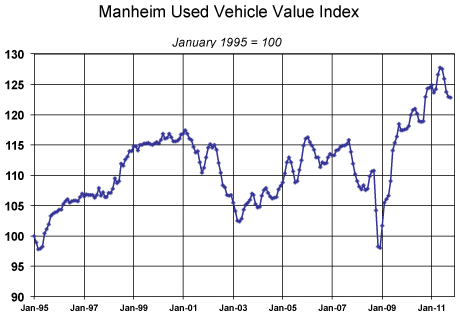
Why Are Used Vehicle Prices So High?

I am often asked why used car prices are so high. While they are generally expected to peak in April, used vehicle prices will remain stable for the next several months. In fact, compact and mid-size cars will appreciate in value and outpace other segments because of rising gasoline prices.

Why? Well flash back 33 months to the federal governments "Cash for Clinkers" program. While a boom for new vehicles, that program took 700,000 used vehicles off the road and sent them to the crusher. Those vehicles came from the lower end of the price spectrum and created a shortage in that price range.

At the same time, our country went from a 16 million new vehicle market, to 13.1 million in 2008, 10.5 million in 2009 and 11.2 million in 2010. In those three years, there were 13.2 fewer new vehicle transactions than in prior years.

According to NADA economist Paul Taylor, roughly 55 percent of new-car deals have a trade-in so that means about 7.3 fewer trades plus the 700,000 "clunkers" equals 8 million fewer vehicles in the used car market. If you understand a price curve or supply and demand, you understand that a lower supply means higher prices.

That is why trade-in values are at historically high levels - as much as 35% higher trade-in values for the same car as same-time a year ago. If you have a vehicle to trade, you can expect to get more trade value than in the past. If you have a low mileage or compact or mid-size car, you can expect top dollar in trade. High mileage SUVs have lagged as fuel prices have gone up.

It also means that if you have borrowed money on your vehicle, your equity position (the amount you owe compared to the value of the car) is at a peak as well.

If you typically buy a late-model used vehicle, you may want to consider an new model. The price difference is more than offset by the additional warranty and the fewer miles on the new vehicle.

Manufacturers are taking advantage of the inflated used vehicle prices by offering very lucrative lease deals. Lease payments are driven by the residual value of the leased vehicle (or predicted value of the new vehicle at the end of the lease). The higher the residual value, the lower the monthly lease payment. They are offering short term (24-30 month) leases using a strong residual value to drive lease payments to very, very attractive levels.

Leasing seems to be a bit confusing to people. I like the analogy of only buying a gallon of milk rather than the whole cow. Leasing allows you to pay for only that portion of the vehicle that you use. It also takes some of the risk out of vehicle ownership. You should at least have leasing under consideration.

Almost all new vehicles will offer better fuel economy as well. So regardless of whether you find buying or leasing more attractive for your situation, there has NEVER been a better time to get into a new vehicle.