Monday, November 26, 2012

November 2012 SDADA Column


The latest assault on the franchise system comes from Ford as they place their Lincoln dealers squarely in the crosshairs. Lincoln has informed their dealers that they plan to eliminate the holdback payment which has been a standard practice for the franchise several decades. Ford indicated they made the decision in part because other luxury OEMs like Audi and BMW do not pay their dealers holdback.

Ford also says that Lincoln dealers will have an opportunity to earn additional Dealer Cash payments if they meet a variety of available programs (jump through all their “hoops”). Ford has made the programs needlessly complex. Ford will have four Dealer Cash programs for their dealers:
• Lincoln Commitment Program - Phase 1: Pays 2.75% of Invoice for Lincoln dealers who meet signage, training and customer initiative requirements - e.g. washing customer service cars.
• Lincoln Commitment Program - Phase 2: Pays an additional 1% of Invoice for Lincoln dealers who meet additional training requirements and manage to provide 70+% of their Internet Leads with a quality response within 12 hours.
• Lincoln CPOV Incentive - Pays 2% of all new Lincolns Invoiced per quarter if a dealer meets Lincoln's CPOV sales target.
• Lincoln CPOV Incentive - Pays a flat fee for each CPOV vehicle based on some other (not reported) criteria.
The “frosting on the cake” is that Lincoln's going to raise the invoice price of their vehicles 1% to pay for their new programs but MSRP pricing will remain the same.  There goes another percent of the ever shrinking Dealer Margin.

Ford indicated they've been working with their Dealer Council concerning these changes. I would love to hear the view of Dealer Council representatives who think these changes are good for the Lincoln brand or the franchise.

NADA has sent Ford a letter regarding this matter urging them to reconsider. NADA's Task Force on Facility Image Programs and Multi-Tier Pricing has taken this issue up on their agenda as well.

Do you think the other manufacturers are watching this issue closely? Do you think any of them would love to eliminate dealer holdback? Perhaps we should start a pool on which manufacturer follows suit and when it will happen. Keep an eye on this.

National Automobile Dealers Charitable Foundation Helps Victims of Hurricane Sandy

The National Automobile Dealers Association has pledged $1 million to jump-start a national fund-raising campaign for the Emergency Relief Fund of the association’s charitable foundation. The Emergency Relief Fund provides assistance to dealership employees that are affected by natural disasters.

The SDADA board of directors voted to contribute $2,500 to the Emergency Relief Fund at the November meeting in Huron. Trace Beck generously volunteered to match the $2,500 SDADA contribution.

Beck Motors and Wegner Auto had employees benefit from the NADACF Emergency Relief Fund last summer when Pierre was flooded by the Missouri River.

Since 1992, the Emergency Relief Fund has provided nearly $5 million to more than 7,700 dealership employees.
If you are looking for ways to help the victims of Hurricane Sandy, the NADACF is a great tool for that purpose. I urge you to consider contributing. Please contact me if you have questions.


Friday, November 16, 2012

Your Actual Mileage May Vary!

It is fair to say that fuel consumption is a significant factor when Americans are on the hunt for their next vehicle. Recognizing this, automakers go to great lengths to tout fuel consumption in an effort to convince car buyers to buy their product. Competition is fierce, especially in a $4/gallon fuel environment. Little wonder then that car buyers are incensed over news on November 2, South Korean automakers Hyundai Motor America and Kia Motors America announced that they had overstated the fuel economy on nearly a million late model vehicles.

In June, acting as the poster boy for fuel efficiency, Hyundai petitioned the U.S. government to declare August “National Fuel Efficiency Month.” Hyundai North American CEO John Krafcik made this comment, “As America’s most fuel-efficient car company, we want to inspire people and show them how fuel efficiency can help their wallets and the planet at the same time, no matter what kind of car they drive”.

There is no shortage of hand-wringing among the automotive press. They are quick to fawn over these fuel consumption figures (without verifying them in many cases I might add), and then among the first to chastise the automakers when the truth comes out.

Apparently this is a case of asking for forgiveness rather than permission:


“I sincerely apologize to all affected Hyundai and Kia customers, and I regret these errors occurred,” said Dr. W. C. Yang, chief technology officer of Hyundai/Kia research and development. “Following up on the EPA’s audit results, we have taken immediate action to make the necessary rating changes and process corrections.” 
Hyundai said “procedural errors at the automakers’ joint testing operations in Korea led to incorrect fuel economy ratings for select vehicle lines.” 
“Given the importance of fuel efficiency to all of us, we’re extremely sorry about these errors,” said John Krafcik, president and CEO of Hyundai Motor America. “When we say to Hyundai owners, ‘We’ve got your back,’ that’s an assurance we don’t take lightly. We’re going to make this right for everyone, and we’ll be more driven than ever to ensure our vehicles deliver outstanding fuel economy.”
Hyundai blames procedural errors for the problem. Really? Anyone who took sixth grade math can divide the miles driven by the fuel used. It didn't take Hyundai/Kia owners long to figure out that they weren't getting the fuel mileage the manufacturers claimed they would! Is it possible that Hyundai/Kia stretched the truth?

From the Detroit Free Press:
Sung Hwan Cho, president of Hyundai's U.S. technical center in Michigan, said the EPA requires a complex series of tests that are very sensitive and can have variations that are open to interpretation. The companies did the tests as they were making a large number of changes in their cars designed to improve mileage. The changes, such as direct fuel injection into the cylinders around the pistons, further complicated the tests, Cho said.
Who the hell verifies these "EPA Fuel Economy" figures anyway? These inflated mileages were discovered during an audit by the Environmental Protection Agency. One would think that, since the EPA has their name on them, they would require some proof of the claim.

How would the consumer press have reacted is this would have been Chevrolet or Ford rather than Hyundai or Kia? How about the main stream media? Do you think this would have been in the news for one night and then fallen out of the news cycle? Just wondering...


Sunday, November 11, 2012

Time to Refocus

If you are a regular visitor to this spot, you know that I have been rather critical of General Motors' Essential Brand Elements (EBE) program here. I believe the program is unreasonable and unfair.

It is unreasonable because it is an overreach by General Motors into the dealership. It attempts to strip the dealer brand from the dealership and require interior elements that may not be useful or realistic for some dealers. It forces the same system on all dealers, large or small, rural or metro.

It is unfair because unless a dealer complies with these requirements, he is at a $500-700 per vehicle disadvantage. Dealers operate in a world where customers will move on to a different store for $50. Yet, GM representatives have the gall to suggest that it is an "optional" program. It's as optional as sails are on a sail boat!

Recently, my post regarding a visit from my GM Zone Manager to discuss the exceptions to the program that I requested caught the attention of GM executives. Apparently they did not like the fact that I found the visit to be a masquerade and told me so here.

This development has caused me great distress. These posts are intended to communicate updates to my family, my friends and the dealers that I represent in my NADA Director position. I believe my reach grew as these people felt the story I told to be unfair and they saw fit to forward it on. But I am not surprised at who has read it because it is published in a very public space.

I NEVER wanted the discussion to be about MY store. I only referenced my store because it was a personal experience that I could draw upon. I wanted to call attention to a program that I believe is unreasonable and unfair to all dealers, but especially so to small and most medium sized dealers - those that I represent. I thought my experience was very typical (as I found in visiting with other dealers) and thought it would give some specific examples of how unreasonable the program was.

So I will not be discussing my store's plight against EBE here any longer. I will gladly share any experiences from my fellow dealers (anonymously if they'd prefer). I will continue to post articles (from inside and out of the automobile trade press). I will continue to be a vocal critic of EBE and an advocate for my fellow small and medium size dealers.

Does this mean GM has won? I don't believe so. It only means that this spotlight will not be on my store or my desk any more and I will keep it sharply focused where it belongs - on the GM's unfair and unreasonable EBE program.

Thursday, October 25, 2012

EBE Makes News Outside of Automotive Press

Marc Heitz Chevrolet
Earlier this week, Automotive News covered the plight of Marc Heitz Chevrolet  in Norman, OK and their loss of $1 million of EBE funds annually. It is an interesting story (be sure to check out the comments at the bottom of the Automotive News article).

Last night, Lars Larson, a nationally syndicated talk show host, interviewed Chad Baker. Baker is the co-owner and General Sales Manager at Marc Heitz Chevy. It is a compelling interview that is significant because Larson is completely outside the traditional automotive industry media and he introduces the dilemma to the general public.

You can hear the interview here.

You may have seen where NADA Chairman, Bill Underiner, made some pretty strong comments at an Automotive Press Association event this week. He criticized manufacturers for "intrusion" into dealers' operations. Bill's comments were "spot on" and much appreciated by this dealer.

Meanwhile, Automotive News Europe poses a legitimate question about what the dealership of the future will actually look like. Does it look like an EBE store? Or does that matter?

Update 10/26/2012: Here is more coverage of this issue. Be sure to check out the comments at the bottom.

Tuesday, October 23, 2012

October 2012 SDADA Column


You may recall that I told of my visit to the General Motors Renaissance Center headquarters back in August as a member of NADA's Task Force on Facility Image Programs and Multi-Tier Pricing in the space. One of the results of that meeting was a commitment by General Motors to consult with small and rural dealers on the EBE program.

Mark Reuss commented that he wanted to help dealers "do what they COULD do" on a timeline that “worked for them”. I specifically asked if that meant some flexibility going forward. I did not get a straight answer on that question.

So shortly after I returned from Detroit, I called my GM Regional manager and asked him to schedule a visit to my store. I got a call back a few weeks later from my Zone Manager who scheduled a visit to my store in mid-October.

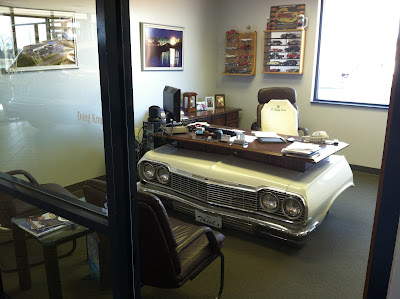
The Zone Manager came to visit my store recently. After introductions, he lusted over my desk for a couple of minutes (more on that later). I found him to be a very pleasant gentleman and we had a very cordial conversation as we learned a bit more about each other.

Eventually, the discussion turned to my facility and the EBE program. I gave him a bit of my background with the EBE program told him of the exceptions that I had asked for.

The short story here is that he had no authority, had no discretion, had no flexibility and was no help in getting relief from the EBE program. I could revisit all my discussion points that I visited with him about (they can be found here and here and here). But the bottom line is that it was a waste of time for both of us.

The irony of whole visit was the fact that he was smitten by my desk. When we discussed "customer touch points" and the fact that the EBE program disallowed the customer from seeing the desk in my office, he was stumped. After he thought about, he realized that the office was a customer touch point and there was no way that a customer could see the desk if my office was in compliance with EBE standards.

He took photos and is going to go through the motions of submitting (again) my requests but we both know that it is an exercise in futility. The requests go to the same group that rejected them before.

So I am much more skeptical about our visit to Detroit now. I feel like the whole notion about GM placing people in the field was more of an appeasement than an actual effort to help RCC dealers.

I will reiterate a point that I made after the Detroit trip: the NADA task force must hold GM accountable for the commitments they made.

I am not done with this. Stay tuned for developments...

NADA Issues Dealer Guidance on Counterfeit Air Bags

The National Highway Traffic Safety Administration (NHTSA) announced in early October a consumer advisory on counterfeit air bags.

Federal investigators have determined that thousands of counterfeit bags have been bought and installed in U.S. motor vehicles over the past three years.

NHTSA also has determined that in the event of a frontal collision, these counterfeit bags are unlikely to deploy properly or may deploy in a manner that can harm vehicle occupants. See below for an NADA dealer Q&A document.

Vehicles with counterfeit air bags installed are believed to constitute less than 0.1% of the total in-use fleet. Nonetheless, dealers should be prepared to respond to inquiries from the public on this matter.

NHTSA is urging concerned owners to start by visiting www.safercar.gov/Air+Bags to determine if they are at risk.

In addition to the NADA guidance, dealers should expect to receive communications directly from the auto manufacturers they represent, addressing how to detect and manage counterfeit air bags.

It's important to note that unlike a safety recall campaign, customers should expect to pay to have their air bags diagnosed, and if necessary, replaced.

Service Advisors Overtime Exemption Extended Through March

Congressional legislation to prevent a government shutdown includes an extension of a federal overtime exemption for service advisors through March.

Since the late 1970s, the U.S. Department of Labor (DOL) has held that the frontline employee-salespersons in the service department remain exempt from federal time-and-a-half pay requirements. In 2011, DOL attempted to reverse this policy. Congress intervened and temporarily stopped the Department from enforcing the change.

The Congressional ban was included in a funding measure that was set to expire at the end of September. Under the new continuing resolution that extends government spending through March 2013, DOL is prevented from enacting the new policy for service salespeople.

Friday, October 19, 2012

More of the Same...

You may recall that I told of my visit to the General Motors Renaissance Center headquarters back in August as a member of NADA's Task Force on Facility Image Programs and Multi-Tier Pricing in the space. One of the results of that meeting was a commitment by General Motors to consult with small and rural dealers on the EBE program.

Mark Reuss commented that he wanted to help dealers "do what they COULD do" on a timeline that “worked for them”. I specifically asked if that meant some flexibility going forward. I did not get a straight answer on that question.

So shortly after I returned from Detroit, I called my GM Regional manager and asked him to schedule a visit to my store. I got a call back a few weeks later from my Zone Manager who scheduled a visit to my store in mid-October.

The Zone Manager came to visit my store recently. After introductions, he lusted over my desk for a couple of minutes (more on that later). I found him to be a very pleasant gentleman and we had a very cordial conversation as we learned a bit more about each other.

Eventually, the discussion turned to my facility and the EBE program. I gave him a bit of my background with the EBE program told him of the exceptions that I had asked for.

The short story here is that he had no authority, had no discretion, had no flexibility and was no help in getting relief from the EBE program. I could revisit all my discussion points that I visited with him about (they can be found here and here and here). But the bottom line is that it was a waste of time for both of us.

The irony of whole visit was the fact that he was smitten by my desk. When we discussed "customer touch points" and the fact that the EBE program disallowed the customer from seeing the desk in my office, he was stumped. After he thought about, he realized that the office was a customer touch point and there was no way that a customer could see the desk if my office was in compliance with EBE standards.

He took photos and is going to go through the motions of submitting (again) my requests but we both know that it is an exercise in futility. The requests go to the same group that rejected them before.

So I am much more skeptical about our visit to Detroit now. I feel like the whole notion about GM placing people in the field was more of an appeasement than an actual effort to help RCC dealers.

I will reiterate a point that I made after the Detroit trip: the NADA task force must hold GM accountable for the commitments they made.

I am not done with this. Stay tuned for developments...

Monday, October 15, 2012

There's ls Lot Riding on It

Like so many other aspects of your automobile, tires are improved, last longer and offer more safety. Well-maintained tires keep your car safer, help it last longer, and save you money, too. So here are some tips from the National Automobile Dealers Association to keep your tires in good shape and your travels safe:
  • Choose your tires carefully. Too many drivers buy a tire based on initial price or appearance. Tire selection should be based on the correct size recommended for the vehicle and its load recommendations. You should consult with a knowledgeable tire or automobile dealer about selecting the proper tire for your typical driving patterns.
  • Buy a tire gauge and keep it handy in your car at all times. It will inform you if you need to add more air to your tires. You can find them at any automotive retailer or supply store.
  • Check your tire pressure at least once per month, and especially before a long trip. Remember, under inflation is a tire's No. 1 enemy, because it can cause damage that may lead to tire failure. However, over inflation can cause uneven wear plus handling and stopping problems. Use the manufacturer's recommended air pressure listed on the sticker of your vehicle's door jamb or owner's manual as a guide. Always check the pressure of your tires when they are cool or cold. Driving heats up tires, making readings incorrect.
  • During wet weather, slow down. As your speed decreases, the tire footprint (the amount of the tire's tread contacting the road surface) increases, providing better traction. You also reduce the risk of hydroplaning should you run into water puddled on the road.
  • Rotate your tires every 6,000 miles. If your tires show uneven wear, ask your automotive service professional to check for and correct any misalignment, imbalance or other mechanical problem involved before rotation.
  • Check your vehicle alignment periodically. It's especially important to have an automotive professional check your alignment if you notice your vehicle is pulling to one side when you're driving.
  • Inspect and measure your tire tread. You can do this yourself by placing a penny in the tread groove and if you can see the top of Lincoln's head, then it is time to replace your tires.
  • Check the tire sidewalls to make sure there are no gouges, cuts, bulges or other irregularities.
  • Make sure you do not overload your vehicle because it can create excessive heat inside your tires. An over-loaded vehicle puts stress on tires that can cause damage and lead to tire failure. Check the manufacturer's load recommendation, which can be found on the vehicle information placard inside the driver's side door post, or in the vehicle owners' manual.
Have your tire balance checked periodically. An unbalanced tire and wheel assembly may result in irregular wear.

If you are one of the 85% of Americans who don't regularly check tire pressure, you should consider nitrogen. We take in nitrogen with every breath. Air is composed of:

1% Water Vapor and Other Gases – Escapes up to 250 times faster than Nitrogen
21% Oxygen – Escapes 3-4 times faster than Nitrogen
78% Nitrogen – The largest molecule in air, dry, non-flammable.

Because of their large size, nitrogen molecules are the least permeable and stay in your tire longer. It's not about the nitrogen. It's about reducing oxygen, water vapor and other gases.

By reducing the percentage of oxygen, water vapor and other gases in your tires from 22% to 7% or lower, your tires will maintain proper pressure longer than if you use “plain old air.” For example, with 95% nitrogen in your tires, they retain optimal pressure three to four times longer.

Remember that by checking your tires regularly, you will keep your travels safe, enjoyable and affordable.

Friday, October 12, 2012

Open Letter to SDHSAA

I sent this letter to the South Dakota High School Activities Association about 3 1/2 years ago. I did not even get an acknowledgement from them. Instead, they chose to make hand checking a "point of emphasis" for about the tenth year in a row. I guess they thought I'd go away if they ignored me.

To whom it may concern:
I have announced boys and girls basketball games at Chamberlain High School since 1991. I have also been a fan and a parent of a high school basketball going back even further.
I have announced and observed over six hundred high school basketball games over the past 22 years. Most of those were viewed from the scorer's table.

I have seen different "points of emphasis" passed down by the South Dakota High School Activities Association. The enforcement of most of these campaigns typically falls on the officials. In most cases, the officials emphasize the rule in question, they get a bunch of negative feedback from the crowds and eventually the "point of emphasis" goes away.

While I understand the sentiment behind most of these efforts, (to make the game easier to officiate in some way) I am always skeptical of these campaigns because I do not believe the game is "broken" and needs to be fixed.

For some time now, I have felt that players need to do a better job of “checking in” to the ball game. The manner in which most players report falls between plopping down near the scorers table and slapping the table.
In order to make the official scorer’s job easier, players should be required to report their number and the number of the player for whom they are replacing. The scorer is responsible for tracking the quarters each player plays. Additionally, each facility should have a prominent "X" on the floor in front of the official scorer so players know to whom they are to report.
Coaches could spend five minutes at the beginning of the season discussing the proper way to check in to a game. After that, if a player does not properly report to the scorer’s table, he or she will not be acknowledged until he or she does so.
Both the official scorer and the scoreboard operator would benefit from this practice. It is not unusual for four or five players to be reporting in to the game while an official is calling a foul. The scorer could note the players entering the game prior to the chaos of foul reporting and substitution. Sometimes a player is sitting close to a coach discussing strategy as he or she awaits a break and the official scorer or scoreboard operator doesn't know he or she wants to enter the game because the player either did not report or did a poor job of reporting to the scorer.
I strongly encourage the SDHSAA to consider this issue as a "point of emphasis". I believe it would improve the flow of the game at the scorers table. I encourage the SDHSAA to canvas scorers and scoreboard operators to see if they feel their responsibilities would be easier. I feel certain those officials would agree.
Respectfully yours,
Doug Knust
I wish everyone could see the process up close. It would be very simple to fix this. If a player did not check in correctly, he or she would not enter the game until they did.

It's pretty easy to be cynical when it comes to the SDHSAA. I have seen some pretty damn dumb rules come from them. But this letter was written sincerely and with a desire to improve the process. I thought it would at least be deserving of a reply.

I guess not. They were too busy looking for socks that were too long or a head band that was the wrong color!

Friday, October 5, 2012

Limited, Not by Our Abilities, But by Our Vision


"The only way you can predict the future is to build it." -Alan Kay

I am a pretty fortunate guy. I have the opportunity to work with quite a few young people in our community in various programs. As I do so, I can’t help but wonder, what reasons do we give them to stay in the Chamberlain-Oacoma area after they complete their education here. What will keep them from moving to Mitchell, Sioux Falls or Rapid City? What will entice them to come home to raise their family in the community where they grew up.

The Chamberlain Area Event and Fine Arts Center is a reason. It is a very strong statement that we believe in ourselves, our community and, most importantly our future and our youth.

Currently, the Chamberlain National Guard Armory hosts most school or communities' events of any size. It is a sixty year old facility that, when built, was a state-of-the-art facility. It has received some upgrades over the years but, in the near future, many more upgrades are going to be needed to allow us to use that facility for all the functions it is being used for today. Uncomfortable temperatures, inadequate parking and treacherous sidewalks prevent people from attending events at the armory throughout the year. As a community, we deserve so much more than what the Armory can now offer.

We currently have a window of opportunity that is unprecedented. Interest rates are at historically low levels - the lowest in my lifetime. Given these current interest rates and price of materials for construction, this is the lowest price tag we’ll be looking at for this project. Waiting five or 10 years could increase the cost of the project astronomically.

Chamberlain-Oacoma is where east meets west in South Dakota. This facility allows us to capitalize on the unique geographical advantage our communities enjoy. There is no facility like it in our area. This event center could become home to trade shows, outdoor shows, community plays, traveling concert or speakers series and much more. Even traditionally outdoor events could find a home indoors!

This is a $13.18 million project. The Chamberlain School District support includes $1 million savings, $4 million in capital outlay certificates and $550,000 federal impact aid funds. The Barger Foundation has committed $1.35 million over 10 years. The proposed bond redemption is $5.28 million. One million dollars will be raised from private entities. The City of Chamberlain and the City of Oacoma may also participate financially. The private funding will not target local businesses who will support the project through their support of the bond redemption.


The the 90 cent levy for the new high school will be paid off on November first of this year (one week before the election). The 2012 taxes (payable in April and October of 2013) will reflect the 90 cent levy reduction. If the bond passes, an 88 cent levy will be reflected on the 2013 tax liability (payable in April and October of 2014 and ongoing).

It is important to note that the current levy will not be in addition to an existing one, but rather will replace it at a lower value. There is not a question of whether or not our taxpayers can afford this because they have for the past twenty years. This levy only impacts private, commercial and agricultural property owners.

Click to enlarge
Another important note is that the levy most probably will decrease. As the bond terms get shorter, the district can refinance at lower rates. As our tax base continues to grow, the tax liability is spread out over that larger base, reducing the tax liability on everyone.

The attached image shows how the levy affects individual property owners or you can use this tax calculator. For just pennies a day, our community can take control of its future.

Everyone knows that working together, we get more done. Sometimes it is difficult to put personal interests or biases aside, but as Helen Keller said, "Alone we can do so little; together we can do so much."

This issue requires a 60% majority plus one vote to pass. If you support this project, it is not enough to just vote "Yes". You need to get involved and become an advocate. You need to talk to your circle of influence, your network and let them know what's at stake. You must explain that their taxes are not going to go up and that this is a bargain in this interest rate environment.

The Chamberlain Area Event and Fine Arts Center is opportunity for our community to seize control of our future. It is a state-of-the-art facility that will serve our communities' needs for fifty plus years. I urge you to vote yes on election day!


Update: Here is KDLT's October 19 story on the Event Center.


Thursday, September 27, 2012

Don't Buy the Whole Cow if You Just Want a Glass of Milk!

So you think you know what car you want. Now you have to decide whether to buy the car or lease it. For some, there is no dilemma because they either don't think leasing is right for them or they don't understand leasing. Either of those may be true, but you owe it to yourself to learn more about leasing before eliminating the leasing option.

Used vehicle prices have been very strong for the past eighteen months as I noted here. Manufacturers have used the shortage of late model used cars to their advantage in offering lease payments on relatively short leases (less than 30 months) knowing that the vehicles will come back off lease into a strong used car market. So the residual values (what the car is worth at the end of the lease) are higher which means a lower lease payments.

Here are some factors to consider as you make your next vehicle decision:


Leasing Advantages

  • Lower Monthly Payments - because you only pay for the portion of the car or truck that you actually use, your monthly lease payments can be up to 60% lower than for a purchase loan for the same car and same term. You get more car for your money. 
  • No (or low) Down Payment - when the lease begins, you'll just have to pay the first month's payment, title, taxes, registration, banking fees, and a security deposit. Some promotional lease deals require a down payment to get to the advertised payment. But because car leases require little or no down payment, your cash is freed up for other things. 
  • Warranty throughout Ownership - because the lease term is shorter than a purchase term, your vehicle is likely covered during the entire time you drive it.
  • New Vehicle More Often - drive a new vehicle every two to four years, depending on the term length of your lease.
  • Lower Tax Bite - you don't pay sales tax on the entire value of a leased vehicle as you would if you purchased. You're only taxed on the portion of the value that you use during your lease.
  • No Used-Car Hassles - the headaches of  negotiating a trade value or selling a used car are eliminated. When your lease ends, you simply turn it back to the leasing company and walk away.
  • Gap Coverage Included - Most car leases automatically include free "gap" protection in case your vehicle is totaled in an accident or stolen, which pays off your vehicle even if insurance doesn't cover the full loss. Loans do not generally come with automatic gap protection.
  • Option to Buy - you have the first option to purchase your leased vehicle at the end of the lease at a price that is determined at the time you lease the vehicle.
  • Reduce the Risk of Car Ownership - South Dakota has a damage disclosure law which requires that you disclose any damage to your vehicle exceeding $5,000 at the time you sell it. This typically diminished the value of the car significantly. Some states consider SD Damage Disclosure a "Salvage" brand on the title when the vehicle is titled in their state. If you are leasing the vehicle, though you are responsible for carrying insurance and repairing the vehicle, you are not liable for any diminution of value.

Leasing Disadvantages

  • Early Termination Cost - if you must terminate your lease before the end of your contract, the cost is usually very high, much higher than might be expected. However, cost can be minimized by making the right termination choices. But because the leases are so short (under 30 months). Most people end their lease on schedule and do not end early, which avoids all early termination costs.
  • Little or No Ownership Equity - because monthly lease payments are so low, you typically do not build ownership or trade-in value in your leased vehicle. It is possible, however, that the market value of a vehicle at lease-end is higher than the purchase option price specified in the lease contract — which means you may have some equity trade value. You could end up with a few thousand dollars of unexpected equity.
  • Excessive Mileage Charges - here in the Midwest, we tend to drive more miles annually than people do in other parts of the country. If you exceed the mileage allowance in your lease contract, you will be charged for the extra miles at a specified per-mile rate, usually a reasonable $0.20 per mile. A large mileage excess could result in a hefty charge, even at a reasonable per-mile rate. You can reduce your exposure and build the excess miles into the payment if you "buy" the extra miles you expect to drive at the time of lease signing. You avoid the higher end-of-lease charge this way. But be assured on one thing - you pay for those miles whether you lease or buy. The lease can offer a tidier way to incur those charges.
  • Excessive Wear-and-Tear Charges - If you return a leased vehicle at lease-end with excessive dents, scratches, or unrepaired accident damage, you will be charged — because those damages reduce the vehicle's value. Most lease companies clearly specify what is considered "excessive" so that you'll know if you should get it repaired before returning your vehicle. Get the repairs done yourself before you return the vehicle and avoid being charged.
  • If you have the option to buy the car at the end of the lease (as is often the case), you'll have to make that decision as soon as the lease ends, whereas if you owned the car you could decide exactly when to sell it.
Leasing isn't the right choice for everyone, but if you can take care of a vehicle properly, and can adhere to the mileage restrictions, it may be the best choice for you!

12/4/2012 UPDATE: Five myths about leasing a car
3/7/2013 UPDATE: Kiplinger: Smart reasons to lease your next car