Monday, August 20, 2012

How You Can Drive a Newer, Nicer Car for Less Money


Would you like to drive a newer, nicer car for less money? Of course you would. Virtually everyone would. What's the catch you ask? There is no catch. Let me explain...

People tend to think of car payments when I pose the question above. While there is no question that car payments are a big component of your transportation costs, there are a few other very important factors.

In addition to car payments, your monthly transportation costs include insurance, fuel costs and maintenance and repair. I would like to challenge you to think beyond car payments and instead focus on all your monthly transportation costs. Let's examine each of the four components.

Car payments - As I mentioned, this is what people typically think about when we talk about transportation costs. Traditionally, a new car means a higher payment. Depending on your current loan terms, a newer, nicer car could mean lower car payments. The current loan environment is perhaps the best we have ever had in the auto industry. At Harry K's, we shop about a dozen financial institutions in order to get you the very best possible rate and terms. We use our volume credit buying strength to your advantage.

Insurance - People often think a newer, nicer vehicle means higher insurance costs. While that may be true in some cases, it is not always true. New and late model used vehicles have many safety features that may actually reduce your insurance costs. If the insurance payment does go up, often the increase is minimal. We have resources available to us that will help you determine what your insurance costs will be.

Fuel Costs - Over the past several years, roller coaster gasoline prices have made everyone more sensitive to fuel economy. Almost every new or late model vehicle will get better fuel economy that an older model of the same type. We have a special calculator that will help you determine how much a newer vehicle will save you in monthly fuel costs.

Maintenance & Repair - Obviously, a newer, nicer car should save you maintenance and repair costs. We also have a program that can help you lower or eliminate these costs.

So your monthly transportation costs are a total of these four factors. If you reduce your costs in one of these areas, it can increase by that same amount on another of the areas and your overall monthly transportation cost remains the same. For example, if you buy a vehicle that gets better fuel economy and will save you $15/month (remember we have a special calculator that will help you determine this) your car payment can increase by $15/month and your overall transportation costs remain the same.

I'd love to show you more exact data that deals with your specific information. Call Harry K Chevrolet at 800-888-0544 or Harry K Ford at 800-888-1419.

Thursday, August 9, 2012

I Have a Procedural Matter!

“Law is not a profession at all, but rather a business service station and repair ship.”. ~Adlai Stevenson

After the NADA task force meeting, there is very little I can report. There is this stupid issue of "attorney-client privilege". As much as I would like to share what happened today, there is too much riding on it! But I will suggest that things are moving forward!

Monday, August 6, 2012

From Inside the Ivory Tower


A lot of people have expressed an interest in the outcome of my visit to General Motors headquarters as part of the NADA delegation. So this is my account of that visit though there are certain specific aspects of our conversation that I do not feel are appropriate to discuss in this public forum.

The other members of the delegation had all been there before so I was the “wide-eyed rookie” in the group. After receiving our guest passes and proceeding through security, we proceeded to the 38th floor of GM's Renaissance Center headquarters. Kurt McNeil, VP of Sales at General Motors met us in the waiting area. Mark Reuss, President of General Motors North America joined us when we arrived in the conference room and Alan Batey, General Motors’ Chief Marketing Officer, came in about five minutes later.

Chairman Bill Underiner started the meeting by framing the discussion. After a completely worthless discussion about the so-called "voluntary" nature of the Essential Brand Elements facility image program, we pitched the idea of an EBE “Lite” that would entail just the exterior elements. Two members of the NADA delegation made a very strong case for such a concept.

Generally, there was very good, open exchange. The GM executives expressed a genuine concern about legal ramifications of changing the rules of the program or starting a new program at this point in the process. Reuss was particularly distressed about this.

I spoke on behalf of small and rural dealers. I expressed my concern about how the program does not scale well for low volume dealers. I talked about the lack of transparency in the exception process and how it breeds mistrust among the dealers. I stressed that this issue is a HUGE concern for small dealers.

One of the dealers made a great point about how resources that were committed to facilities could not be used for advertising, training and other aspects of marketing new GM vehicles.

GM committed to have a representative in every store that is contacted by the Regional Consulting Center (RCC). Most of these stores have not had a visit from a GM representative in a long, long time. They committed to a dialogue in these stores on an expedited time line. Reuss commented that he wanted to help dealers "do what they COULD do" on a timeline that “worked for them”.

Reuss displayed some real frustration and consternation about the relationship the GM has with its dealers, especially small dealers. He expressed a genuine desire to rebuild relationships with the dealer network. He asked for suggestions for these types of communiqués with the dealers. He did not seem to feel that he had an efficient method by which he could communicate with dealers.

I believe that GM, specifically Reuss, now has additional insight as to how the program is perceived and how it affects dealers. They have a big job ahead of them.

Did we get the commitment from GM that we sought entering the meeting? No. We did not get the scaled down version of EBE that was limited to the exterior elements.

Was the meeting a failure? That remains to be seen. If Reuss and company are sincere in their comments, we may have taken the first step in mending the severely damaged relationship between GM and their small and rural dealers. We will not know that for some time.

I really wanted to come home with some real news for my fellow dealers. Instead, I feel like we have a rather obscure, abstract “fix”. We did get an agreement from General Motors that they would change their process and that they would put people in the field.

So I will take the high ground here and accentuate the positive. I do think Reuss, Batey and McNeil listened to us. I think they want to make the program work for ALL dealers and that they will try to find a way to do that. I think the NADA task force will have to hold GM accountable for the commitments they made.

The entire task force has a meeting with outside legal counsel this Thursday. Stay tuned for details...

Friday, July 20, 2012

July 2012 SDADA Column


Contrary to that 60's Jerry Ragovoy song “Time is on My Side” (performed by the Rolling Stones), as a General Motors dealer enrolled in EBE, time is not on my side.

A recent article in Automotive News about Norman Braman’s law suit against General Motors and their EBE program only emphasizes that the timetable for NADA's task force on facility issues and multi-tier pricing needs to be sooner rather than later with regard to the facilities issue. While the article suggests that the Braman suit could be a test case on the legality of manufacturer facility programs that reward participating dealerships with volume-based incentives, the issue will be settled for GM dealers long before this case comes to trial (if it ever does) 15 months from now. I assume General Motors knows that and is procrastinating the litigation of this issue as long as they can.

General Motors has been the focus of most of the comments in this space with regard to facilities programs. While I recognize that other manufacturers have facilities programs, GM’s EBE is, by most accounts, the most egregious and casts the longest shadow in our state. The feeling at NADA is that most of the other manufacturers are standing on the sidelines watching how EBE unfolds and will then follow in GM’s footprints.

Meanwhile, the NADA task force needs to firmly apply the "pedal to the metal" as GM dealers are facing very difficult decisions on their facilities each day. They do not have time to wait for the outcome of Braman's suit.
(By the way, is Braman's real full name "Billionaire megadealer Norman Braman"? It seems that is the case if you were to read Automotive News. Just wondering...)

The task force will have a couple of very significant meetings the first week of August. The GM dealers on the task force will be meeting in Detroit with Mark Reuss who is the President of General Motors North America. I look forward to the opportunity to visit with Mr. Reuss about the small dealers’ perspective.

Later that week, we will meet with our outside counsel in Washington on both the facility programs and multi-tier pricing issues. I hope we can make some progress at these meetings. Stay tuned for details!

Report: Employment at New-Car Dealerships Up 4.6% in 2011

Even though, according to one small business expert, if you've got a business - you didn't build that and somebody else made that happen, car dealerships are setting the pace across South Dakota and America when it comes to new hiring around the country. It seems that this hiring in dealerships is happening despite what our government is doing rather than because of what they are doing. I think most dealers are very nervous about what happens in the beltway.

There were 933,500 workers employed at U.S. new-car and -truck dealerships in 2011, a 4.6 percent increase from the previous year, said Paul Taylor, NADA chief economist. The findings were released as part of NADA Data 2012, the association’s latest state-of-the-industry report on dealership financial trends. The increase in the number of employees occurred as the number of dealerships, which had declined in recent years, continued to stabilize. In the first quarter of 2012, there was an increase of 66 dealerships on a net basis. “The arrival of new brands and new dealerships is a sign that even more vigorous competition is on the way in the U.S. vehicle marketplace,” Taylor said. “As new brands enter the U.S. market, the net dealership count may increase in future years of strong economic growth.”

In 2011, the average new-car dealership employed 53 workers and had an annual payroll of $2.6 million. Dealerships also provided an average 14.5 percent of total retail payroll in their states in 2011. Taylor also noted that “franchised dealers are major employers as well as significant contributors to their communities’ economies, tax bases and civic and charitable organizations.”

Wow! Really Mr. President?!

You didn't get there on your own. I'm always struck by people who think, well, it must be because I was just so smart. - Barrack Obama 7/13/2012


Monday, July 16, 2012

Time is Not on My Side

Contrary to that 60's Jerry Ragovoy song (performed by the Rolling Stones), as a General Motors dealer enrolled in EBE, time is not on my side.

This article in Automotive News only emphasizes that timetable for NADA's task force on facility issues and multi-tier pricing needs to be sooner rather than later with regard to the facilities issue.

While the article suggests that the Norman Braman suit could be a test case on the legality of manufacturer facility programs that reward participating dealerships with volume-based incentives, the issue will be settled for GM dealers long before this case comes to trial (if it ever does) 15 months from now. I assume General Motors knows that and is procrastinating the litigation of this issue as long as they can.

Meanwhile, the NADA task force needs to firmly apply the "pedal to the metal" as dealers are facing very difficult decisions on their facilities each day. They do not have time to wait for the outcome of Braman's suit.

(By the way, is Braman's real full name "Billionaire megadealer Norman Braman"? It seems that is the case if you were to read Automotive News. Just wondering...)

Tuesday, June 26, 2012

June 2012 SDADA Column

Our NADA summer board conference was a very good meeting with open and free dialogue among directors. Upon hearing the directors' concerns, NADA chairman Bill Underiner decided to appoint a task force that will push for changes in manufacturers' facility renovation programs and incentives that lead to perceived two-tier pricing.

I was very pleased when Chairman Underiner appointed me to serve on this task force. As you know, I am particularly sensitive to the treatment of smaller, rural dealers as it relates to those two areas. I will be viewing the proceedings of this task force from that standpoint.

This task force will challenge General Motors to find a way to offer dealers, especially smaller dealers, some options to comply with reasonable standards at a cost effective price. I will be looking for a way for GM to ask ALL of its dealers to help build their brand but not require the same "elements" of every dealer, regardless of size, market or geography. I am not naive enough to think that will be an easy task.

I analyze these issues in a bit more depth on my blog. I would love to hear your feedback. Please let me know what you think.

Some Manufacturer Stair-Step Programs Are a ‘Cancer in the Industry’ 

I hope you saw NADA Chairman Bill Underiner’s open letter in Automotive News earlier this month. In it, he takes the manufacturers to task regarding their multi-level pricing schemes and their effect on the retail automobile industry.

NADA has had a long-standing position in support of a level playing field, meaning lawful, equal and fair treatment by a manufacturer for all dealers, both large and small. Unfortunately, history shows that, at times, manufacturers’ incentive pricing programs create short-term incentives that favor the larger, more urban dealerships to the detriment of the smaller, more rural dealerships. 

Recent history also shows that the long-term effects of discriminatory programs are to marginalize the smaller dealers and place them at a competitive disadvantage in their marketplace.

These programs also have a tendency to cause confusion among consumers and dealers as to the actual dealer cost of vehicles. This leads to consumer doubt and mistrust that reduces the value of the manufacturer’s brand. It also undercuts the goodwill between consumer and dealer. This is certainly not good business for either the OEM or the dealer.

Dealers of all sizes have recognized the inherent unfairness of a manufacturer’s discriminatory pricing that tilts the playing field in favor of some dealers. For example, Earl Hesterberg, CEO of Group 1 Automotive, emphasized the perniciousness of these stair-step programs as recently as May 21 in Automotive News, where he characterized them as “… a cancer in the industry that isn’t good for dealers or customers.”

The fact is, manufacturers can unfairly create real competitive disadvantages for some dealers and cause real customer confusion and dissatisfaction in the marketplace.

The best way to maintain a level playing field is for factories to focus on what they usually do so well: build quality cars and trucks and avoid disparate treatment of their dealers that can limit their ability to compete. Let all dealers do what they do best: vigorously compete in pricing, service and otherwise for the customer’s business.

NADA to Appeal Court Decision on FTC’s Risk-Based Pricing Rule D.C.
District Court upholds FTC interpretation concerning the scope of the Risk-Based Pricing Rule

The U.S. District Court for the District of Columbia on May 22 granted the Federal Trade Commission’s motion for summary judgment against an action brought by NADA that challenged the agency’s broad interpretation of the scope of the federal Risk-Based Pricing Rule.

The law that the rule implements (section 311 of the FACT Act) applies to persons who, among other requirements, “use” a credit report in particular credit transactions. The FTC issued an interpretation in July 2011 stating that dealers engaged in three-party vehicle financing transactions who do not obtain, receive or review a credit report nevertheless “use” a credit report based on the finance source’s use of a credit report and therefore are responsible for complying with the Risk-Based Pricing Rule’s notice requirement.

Believing this interpretation to be flawed, unnecessary and burdensome to many dealers by requiring them to purchase credit reports for no purpose other than to comply with the Risk Based Pricing Rule, NADA subsequently initiated this challenge.

In its complaint, NADA argued that Congress never intended the word “use” to extend to this subgroup of dealers and that the FTC lacked authority to issue such an interpretation. Although the court found that the statute is capable of supporting NADA’s interpretation, it held that the FTC possessed authority to issue its interpretation and that its interpretation is reasonable.

Regardless of which party prevailed at the district court level, NADA anticipated that the other party would appeal the District Court decision to the D.C. Circuit Court of Appeals. NADA will now direct its outside counsel to commence the appeal.

Fireworks, Featherbones, Family and... FREEDOM

As Independence Day fast approaches, I look forward to our annual family festival. I have always loved the 4th of July. But when our oldest was born on the Fourth (during the re-dedication of the Statue of Liberty in 1986), this day took on a new significance. Our July holiday is filled with tradition and is a day I truly look forward to as it brings our family back together.

We have always made the Fourth of July a huge celebration. We celebrate a family birthday, our country's birthday and the apex of summer. Our day is filled with activities from morning until night; we love to cram as much fun as possible into the holiday. 
July 4, 2010
The day usually begins with the traditional posting of the flag on the front yard family flag pole. We don't always fly the flag but we do on the Fourth. It seems like a great way to set the tone for the celebration to follow.

My wife usually pulls the ice cream maker down from the attic before breakfast. We received this appliance as a wedding gift (some 29 years ago) and it has reliably churned the ice cream ever since then. She often makes two flavors - plain vanilla and some exotic "Ben & Jerry's"-type flavor. I always opt for the vanilla no matter how tempting option two sounds. Her vanilla ice cream is the best and it is goes well with cupcakes or cake to celebrate our daughter's birthday!


There is usually some family fireworks involved. As the kids have grown older, there is less of that. But since fireworks are legal in South Dakota, there are plenty of fireworks stands and the prices are pretty competitive. The front yard fireworks seem to bring out the kid in everyone. No anthill is safe when the Knust fireworks infantry opens fire! I have vivid memories of my father lighting fireworks with his five and six year-old grandsons and sprinting away from the pending explosion as if he was running the 40-yard dash at the NFL combines. I hadn't seen him run in 25 years!!!

"Krawdaddy" 
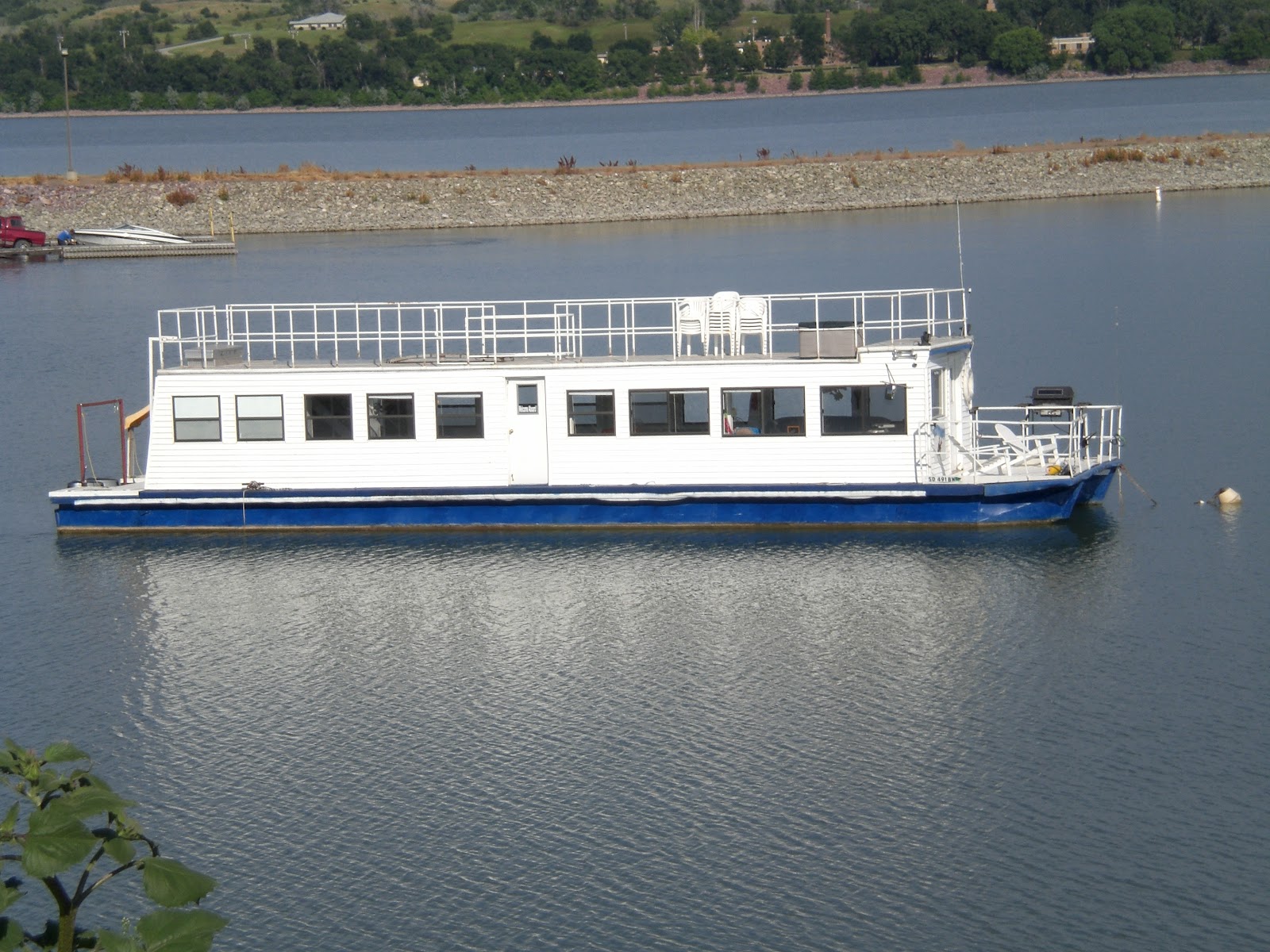
Because we live on a beautiful reservoir of the Missouri River (Lake Francis Case), boating has always been a traditional part of our Fourth of July celebration. We have had several boats through the years, but we had a 65 foot pontoon boat for ten fun-filled summers. If those ten Fourth of July celebrations on "The Krawdaddy" were the only ten times we had used that boat, it would have been worth the investment. We usually had 5-6 families with us on the river all afternoon before heading to the slip in the early evening to cook on the grill. After dinner and cleanup, it would be time to watch the community fireworks display from the top deck of "The Krawdaddy".
Our days on the river are now on our sailboat. "The BlewJay" offers a new angle on boating fun on the Fourth. We spend several hours on the water, usually in shifts, before returning home for the family Fourth of July cook out.

I have always enjoyed preparing a special cocktail for the Fourth. Whether margaritas or sangria or vodka lemonade prepared in volume or mint juleps fashioned individually, it is fun to prepare a special summer cocktail that is refreshing and relaxing. On occasion, there has been an extraordinary amount of relaxation!

It's time for the feast!
Perhaps my favorite Fourth of July tradition is to fire up the grill. We always have extended family, family friends and/or our kids' college friends celebrating with us. I enjoy cooking for a large group and especially enjoy grilling and smoking food. For years, the menu has included smoked featherbones and burgers as the main course. I usually smoke 15-20 pounds of featherbones in the days leading up to the holiday. Depending on the mood of my assistant chef, the accompaniments may include corn on the cob, baked beans, potato salad, watermelon and other delicious summer delectables.

Finally, we sit on our backyard patio overlooking the town and river and watching the community fireworks display. Because we live at the extreme western edge of the Central time zone, our fireworks don't usually start until after 10:00 pm. Often set to music, it is a fine show. On a calm night, you get the extra effect of the fireworks' reflection on the water. There is nothing like a fireworks display over water.
Our view of fireworks with an assist from Mother Nature.

By this time of the evening, mosquito repellent may be a very important part of the holiday festivities. If it has been a wet early summer, the aroma of sunsceen is replaced by the scent of Deep Woods OFF.

So each year on the Fourth, our celebration includes fireworks, featherbones and family. But let us never forget the most important part of our celebration - FREEDOM. Without it, there would not be a celebration.

Monday, June 18, 2012

If the Shoe Doesn't Fit...

Our NADA summer board conference was a very good meeting with open and free dialogue among directors. Upon hearing the directors' concerns, NADA chairman Bill Underiner decided to appoint a task force that will push for changes in manufacturers' facility renovation programs and incentives that lead to perceived two-tier pricing. 

I was very pleased when Chairman Underiner appointed me to serve on this task force. If you have visited this space before, you know that I am particularly sensitive to the treatment of smaller, rural dealers as it relates to those two areas. I will be viewing the proceedings of this task force from that standpoint.

This task force will challenge General Motors to find a way to offer dealers, especially smaller dealers, some options to comply with reasonable standards at a cost effective price. I will be looking for a way for GM to ask ALL of its dealers to help build their brand but not require the same "elements" of every dealer, regardless of size, market or geography. I am not naive enough to think that will be an easy task.

I had a dealer friend ask me if I thought General Motors should abolish the Essential Brand Elements (EBE) program and wondered what I thought they should do with those who have already made a commitment. I think that is a great question and I believe it is one that the task force had better be prepared to deal with.

There are serious questions about the role of a showroom facility in the rural setting and the importance  the customer places on that. It is becoming less a factor in the buying process as the customer goes a long way into that process in our virtual showroom - our web sites. I question whether ANYBODY at GM has thought hard and long about that.

I personally believe that General Motors has every right to expect ALL dealers, big and small, rural and metro, to have a clean, welcoming facility that projects a strong brand image for the manufacturer that they represent. There is more than one way to do that. I don't think that necessarily means a renovation every 5-6 years. I certainly do not believe that it should be part of a marketing program.

As far as EBE is concerned, I think there is a place for the program. I believe the requirements are far too stringent for smaller dealers and the economics of both the investment and the reimbursement program set forth by GM do not work for smaller volume dealers. When you have such large number and wide spectrum of dealers, it seems that at least three levels of participation would be warranted.

Does it make sense that the exact same program requirements (showroom tile, a $5,000+ greeters stand, complete glass on three sides of the showroom, etc.) would work equally well for a Chevrolet dealer in a rural community selling ten to twelve new Chevrolet vehicles each month and a metro dealer selling a thousand new vehicles per month? Does it make sense that a showroom facility in a northern climate with cold winter wind and snow be the same as one that resides in the sun belt? 

General Motors tells the dealers that it is a "voluntary" program. If you are not in compliance, however, you will missed out on the EBE quarterly payment of between $500 and $750 per vehicle. This in a business where the customers will walk over $50!! 


EBE is not a voluntary program. The greater your sales volume, the better it seems to work for you. I know dealers who are telling their people to build whatever it is that GM wants, just keep the EBE payments coming in. I have talked to other dealers who, if they project their EBE payments out through the end of the program, they won't amount to half the costs they are being asked to incur to make their facility compliant.

Not every foot does fit in a size 10 shoe. In fact, in this case, not everyone wears a size 20 shoe! If you do, the EBE program fits pretty well. But if you don't, you end up buying a lot more shoe than you need and the shoe is to be priced according to its size!

Thursday, June 7, 2012

Spending Millions on Mullions

In my last update, I indicated that I had asked General Motors for three exceptions on my EBE plan. I asked for an exception on the gray tile that GM required when I built versus the gray tile they are now asking for. The actual response from the "Ivory Tower" was "Request denied because tile appears to be too dark compared to program spec tiles". My zone manager told me that he convinced "them" to grant the tile exception request though I must sign a letter that, in part, specifies: 
"However, we anticipate this tile may need to be replaced 5-10 years in the future due to wear, overall condition, etc. If and when Chevrolet deems the tile condition is no longer acceptable, Dealer agrees to replace the existing tile with the program tile. Please counter-sign below to affirm you understand and accept this conditional exception approval."
Well, I have not signed the letter (surprise, surprise!). I'm not sure that automobile dealerships will even have showrooms in 5-10 years. Ask executives at Best Buy or Barnes & Noble what color their floor covering will be in 5-10 years. The bricks and mortar business model for all retail space is untenable. That is part of the problem with the GM EBE program - no consideration has been given to what the dealership will look like and how it will function in 5-10 years. Shouldn't we be investing in plans that move us that direction?!

I asked for an exception on the the window frames that GM required in their Image 2000 program (and for which I paid about 30% more money) when I built the facility. They are currently a "General Motors blue", but now GM wants a silver color. Their response was "Request denied, blue mullions are too far a departure from the required silver mullions. Mullions can be painted or capped to meet the color requirements."

 That tile appears to be too dark compared to program spec tiles!!!
I know of a dealer who got an exception for BROWN mullions! Apparently "General Motors blue" mullions are a more radical departure from the color scheme than is the BROWN!!! This brings to light a deeper problem with the program. It would seem that there should be some consistency with the exceptions. It is either the right color or it isn't. If it isn't, then exceptions will be granted for all or none. There is a lack of transparency that breeds mistrust. I have re-sent that request for exception, letting them know that I was aware of the dealer with brown mullions. I am looking forward to their response!


My third exception request was regarding this whole notion of my office being a customer "touch point" and thus requiring the color scheme, wall prints and furniture set forth by GM. I received a familiar response: "Request denied. Dealers office located right off showroom floor considered customer touch point. Car front desk not in line with furniture spec." (Some of my friends were very nervous to hear that GM considered my office a touch point! ;o)


Let me translate the corporate speak in that response: "This (1964 Chevrolet Impala) desk is too unique for any dealership. We want "cookie cutter" dealerships that completely remove any sense of dealer branding. If customers saw this desk, they might remember it and the dealership in which it sat. We want the boring furniture and wall prints we have chosen for EVERY Chevrolet store in America!"

Glenn Mercer, in NADA Facility Image Study presentation, said that GM boastfully says they are approving approximately 85% of the exception requests. If that is so (and my case would show that to be quite high), perhaps the standards are a bit too stringent. Perhaps if they would relax their standards some, this whole back and forth game could be avoided. But then they would not have a stranglehold on the power, would they?

More to come...


Monday, May 28, 2012

White House Burning

I have a friend that recommended that I read this book. Now that usually works out pretty well for me. But because this book is a political book and my friend comes from the opposite side of the political spectrum from me, I found the book to be a bit different than what I would choose.

The authors start with a historical view of public finance in the United States. I found that to be interesting. The book is a worthwhile read just from an educational standpoint. If you have never taken a class in public finance, you will learn a lot about how the tax system in our country works and how are Founding Fathers set up the financing of our country.

But as the book unfolds, we learn that authors Johnson and Kwak have never met a tax on the "rich" (a term they never define) that they don't embrace. They love every federal program ever enacted (or proposed).

The authors suggest that the government is our national insurance program. Geico and Progressive be damned; I think they would let the federal government take over the automobile insurance as well! There is no limit to the government in their world. The government should defend, build bridges and maintain laws that protect our property rights rather than assess energy taxes on all and rebate some of those taxes to "the poor" (another term never defined).

Johnson and Kwak don't see any problem with our current social security system other than their view that "the rich" don't contribute enough to the system and receive too much in benefits. Payroll taxes are not even paying the current obligations of retirees, much less setting aside enough money in a true financial instrument to pay for anyone in the future.

I do not recall one comment critical of "Obama Care". Rather, they embrace the federal takeover of the healthcare system. Again the problem is the rich doctors bilking the system. Of course the trial attorneys and their malpractice law suits are not a drain on the system - only the doctors.

The authors feel there is not a significant debt problem if the Bush tax cuts are allowed to expire according to the authors. They never acknowledge that, unlike every other institution in the United States (and just about every other government in the world), Congress exempts itself from normal accounting standards. Specifically, it doesn't include the cost of future retirement benefits. If any other institution in the U.S. – including corporations, state governments, local governments, or banks – did their accounting this way, they would go to jail.

This really is the single most shocking fact of our national debt crisis. It renders their argument for "tweaking" the tax system to solve the budget deficit ridiculous. When you know the real numbers, you know what a mess we're in. The only viable solution is cutting the size of government by a huge amount which Johnson and Kwak don't find necessary.


Politicians have shown us that it is politically impossible to reduce spending in Washington D.C. They see only acceptable solution to these problems is to borrow and print and repeat!


To me, "White House Burning" looks like what an unconstrained President Obama would do in his second term if he also had congressional majorities in the House and the Senate. If you like Obama's policies or if you like what you see in Europe, you will like this book.