Saturday, December 15, 2012

Bowl System Needs a Good Flushing


Though I love college football (and have since my first Husker game against Oklahoma when I was ten years old), it is not a topic I have been compelled to comment on in this space. This article in the December 11, 2012 edition of the USA Today changed that.

In 1970, when I attended that Husker game, there were 11 bowl games. This year there are 35 bowl games. The proliferation of bowl games caused the NCAA to introduce a new phrase into the American lexicon - "bowl eligibility".

Under current regulations, in order for this to occur, a team must have a winning record, which may include one win against a Division I FCS scholarship-awarding opponent, or win their conference, and the team must not be on probation. This came in response to teams with sub-winning records accepting invitations to play in bowl games.

Most bowl games operate under the laws of tax-exempt charitable organizations. Some may actually benefit a charitable cause. But most benefit a small group of people who are squeezing the host city and the participating schools and their conferences for everything they can wring out of them.

As the USA Today article points out, the Outback Bowl in Tampa pays their game's president and chief executive officer, Jim McVay, more than $750,000 per year! I am sure Mr. McVay is a talented man and does a very good job but he's making over three quarters of a million dollars to oversee a football game for a tax-exempt charitable organization!!! Does anyone else think there might be a bit of abuse of the American tax code here?

The Outback Bowl is, by no means, the only bowl game that is doing this. Mr. McVay just happens to be the highest paid in a group of overpaid bowl game presidents. John Junker, CEO of the Fiesta Bowl, was fired in 2011 after the Arizona Republic exposed his abuse of power. Among Junker's (recipient of almost $600,000 in 2010) sins, he tried to convince investigators there was a legitimate business purpose for the $1,241 he'd charged to the bowl for a visit to a high-end Phoenix strip club on September 12, 2008. The Fiesta Bowl also footed the $33,188 bill for Junker's 50th birthday party, a four-day bash in Pebble Beach. Happy birthday Mr. Junker!!

If you have been wondering why we could not get a playoff system in college football rather than a beauty contest to crown the national champion before now, look no further than the bowl system. The college presidents have always been protective of the cash that they get from the bowls (in addition to the holiday season, all-expenses paid, balmy climate venue vacation that the bowl games afford them and their huge entourage).

I am looking forward to the college football playoff system in 2014 and crowning a real national champion. I am hoping that event will land a blow to the bowl system, their overpaid executives and the abuse of the "non-profit tax exempt" status they enjoy!

Tuesday, December 11, 2012

Could We Get Some Conclusive Evidence Please?


You remember the more than a dozen Jefferson North assembly line workers who were fired after they were filmed drinking and smoking pot during their breaks by the Detroit Fox affiliate. If not, see the video above.

Well now Chrysler says it was forced to reinstate the 13 workers who were fired. It seems that "the workers followed the grievance procedure process outlined in the collective bargaining agreement between Chrysler and the United Auto Workers" according to Scott Garberding, vice president of manufacturing at Chrysler.

Understandably, Chrysler does not agree with nor are they happy about the decision. According to Garberdings entry on a company blog, "After more than two years, an arbitrator decided in the workers' favor, citing insufficient conclusive evidence to uphold the dismissals."

I invite you to watch the video and see if you can find any "conclusive evidence to uphold the dismissals". I suppose they were drinking Red Bull and smoking ginseng!

Remember this as you watch the union members storm the Michigan state capitol this week protesting a new law that allows workers the option of not joining a union!

December 2012 SDADA Column

We all remember all the bloody details of the financial meltdown of 2008. No one in our industry went unaffected. I have read several books on the characters, causes, and effects of the financial crisis. Neil Barofsky, in his book Bailout: An Inside Account of How Washington Abandoned Main Street While Rescuing Wall Street, looks at how our government tried to fix the problems leading to and caused by the financial catastrophe.

In Bailout, Barofsky, who was the first Special Inspector General for the TARP, takes a peek behind the curtain of Tim Geithner's Treasury Department. What he reveals in neither surprising nor pretty.

Barofsky, a self-admitted life-long Democrat, was appointed by George W. Bush and served under Barack Obama as the watchdog for the disbursement of the $700 billion in TARP funds. He exposes Geithner as the Wall Street apologist that he is. He turned the $700 billion TARP bailout fund into a slush fund for the Wall Street banks and made every effort to remove all accountability. Geithner worked hand-in-hand with Wall Street executives to game the system and funnel millions of taxpayer dollars into the pockets of Wall Street executives.

The further we dug into the way TARP was being administered, the more obvious it became that Treasury applied a consistent double standard. In the late fall of 2009, as I began receiving the results of two of our most important audits, the contradiction couldn’t have been more glaring. When providing the largest financial institutions with bailout money, Treasury made almost no effort to hold them accountable, and the bounteous terms delivered by the government seemed to border on being corrupt. For those institutions, no effort was spared, with government officials often defending their generosity by kneeling at the altar of the “sanctity of contracts.” Meanwhile, an entirely different set of rules applied for home- owners and businesses that were most assuredly small enough to fail. 
More than two thousand of these small businesses that weren’t “too small to fail” were automobile dealerships. Except they did not fail, their businesses were stolen from them in a conspiracy between the Treasury Department, the Automotive Task Force and the manufacturers. Barofsky discusses how GM and Chrysler used bankruptcy to skirt protections that auto dealers receive under state law. That left more than 100,000 dealer employees scrambling for new jobs, pensions and health care.

Barofsky writes that Obama’s “auto team had pressured the companies to close the dealerships” more rapidly and in greater numbers than the firms had wished. He concludes that “relatively little thought had gone into Treasury’s determination that the dealership closings had to be immediate.” He reports that after “interviewing many of the same experts Treasury had consulted,” his group of auditors “found remarkably little support for the auto team’s determination that the viability of GM and Chrysler depended on their closing so many dealerships so quickly.”

It is now 2-3 years later and manufacturers, dealers and customers have moved on. But what about those who lost their stores because of Geithner’s Treasury Department and the Automotive Task Force. Get over it right? Not really.

Some of these stores had been in the family for two or three generations. Many dealers were completely devastated financially when they had viable businesses stolen from them - because bureaucrats who had never crated a job in their lives decided that it was best. It is a very sad statement on where we are as a country and what kind of power we have allowed our government to seize.

This is a very enlightening read if you want to learn more about the TARP funds or if you were disaffected in any way by the massive bailout of our country's financial system. Barofsky takes complicated and often boring financial material understandable.

Be forewarned though, this will stoke your cynicism of our federal government.

NADA Convention Fast Approaching

I hope you’re planning to attend the 96th annual NADA convention (Feb. 8-11, 2013) in Orlando. More than 500 companies are expected to exhibit on the expo floor.

Former Secretary of Defense Robert M. Gates joins a lineup of industry and inspirational keynote speakers. Gates served as the 22nd Secretary of Defense from 2006-2011 under both President Barack Obama and former President George W. Bush. The only secretary of defense in U.S. history to be asked to remain in that office by a newly-elected president, Gates has served eight U.S. presidents.

Industry keynote speakers at the convention include John Krafcik, president and CEO of Hyundai Motor America; NADA Chairman Bill Underriner and incoming NADA Chairman David Westcott.

Captain Mark Kelly, former NASA astronaut, space shuttle commander of Endeavour’s final mission and husband of former Congresswoman Gabrielle Giffords, will deliver an inspirational address.

NADA University is offering 58 different workshops for new-car and new-truck dealers and their managers, including 27 new speakers and 20 new workshop topics.

If you are planning to attend, be sure to make your DEAC contribution at the Eagle Club level so you can enjoy the benefits of the DEAC suite, a private VIP hospitality suite accessible only to those members who contribute at least $250 to DEAC. The DEAC hospitality suite offer many amenities that allow contributors to enjoy their time while attending the NADA convention. The DEAC suite provide contributors a place to relax, catch up with friends and grab a bite to eat, all just steps away from workshops and the exposition floor.

You can easily get $250 of value from this one benefit alone!

Happy Holidays!

Let me take this opportunity to wish all of you a Merry Christmas and a very happy and prosperous 2013.


Thursday, December 6, 2012

Bailout: An Inside Account of How Washington Abandoned Main Street While Rescuing Wall Street by Neil Barofsky

In Bailout: An Inside Account of How Washington Abandoned Main Street While Rescuing Wall Street, Neil Barofsky, the first Special Inspector General for the TARP, takes a peek behind the curtain of Tim Geithner's Treasury Department. What he reveals in neither surprising nor pretty.

Barofsky, a self-admitted life-long Democrat, was appointed by George W. Bush and served under Barack Obama as the watchdog for the disbursement of the $700 billion in TARP funds. He exposes Geithner as the Wall Street apologist that he is. He turned the the $700 billion TARP bailout fund into a slush fund for the Wall Street banks and made every effort to remove all accountability. Geithner worked hand-in-hand with Wall Street executives to game the system and funnel millions of taxpayer dollars into the pockets of Wall Street executives.

From the book:
The further we dug into the way TARP was being administered, the more obvious it became that Treasury applied a consistent double standard. In the late fall of 2009, as I began receiving the results of two of our most important audits, the contradiction couldn’t have been more glaring. When providing the largest financial institutions with bailout money, Treasury made almost no effort to hold them accountable, and the bounteous terms delivered by the government seemed to border on being corrupt. For those institutions, no effort was spared, with government officials often defending their generosity by kneeling at the altar of the “sanctity of contracts.” Meanwhile, an entirely different set of rules applied for home- owners and businesses that were most assuredly small enough to fail. 

More than two thousand of these small businesses that weren't "too small to fail" were automobile dealerships. Except they did not fail, their businesses were stolen from them in a conspiracy between the Treasury Department, the Automotive Task Force and the manufacturers. Barofsky discusses how GM and Chrysler used bankruptcy to skirt protections that auto dealers receive under state law. That left more than 100,000 dealer employees scrambling for new jobs, pensions and health care.

Barofsky writes that Obama’s “auto team had pressured the companies to close the dealerships” more rapidly and in greater numbers than the firms had wished. He concludes that “relatively little thought had gone into Treasury’s determination that the dealership closings had to be immediate.” He reports that after “interviewing many of the same experts Treasury had consulted,” his group of auditors “found remarkably little support for the auto team’s determination that the viability of GM and Chrysler depended on their closing so many dealerships so quickly.”

It is now 2-3 years later and manufacturers, dealers and customers have moved on. But what about those who lost their stores because of Geitner's Treasury Department and the Automotive Task Force. Get over it right? Not really.

Some of these stores had been in the family for two or three generations. Many dealers were completely devastated financially when they had viable businesses stolen from them - because bureaucrats who had never created a job in their lives decided that it was best. It is a very sad statement on where we are as a country and what kind of power we have allowed our government to seize.

This is a very enlightening read if you want to learn more about the TARP funds or if you were disaffected in any way by the massive bailout of our country's financial system. Barofsky takes complicated and often boring financial material understandable.

Be forewarned though, this will stoke your cynicism of our federal government.

Monday, November 26, 2012

November 2012 SDADA Column


The latest assault on the franchise system comes from Ford as they place their Lincoln dealers squarely in the crosshairs. Lincoln has informed their dealers that they plan to eliminate the holdback payment which has been a standard practice for the franchise several decades. Ford indicated they made the decision in part because other luxury OEMs like Audi and BMW do not pay their dealers holdback.

Ford also says that Lincoln dealers will have an opportunity to earn additional Dealer Cash payments if they meet a variety of available programs (jump through all their “hoops”). Ford has made the programs needlessly complex. Ford will have four Dealer Cash programs for their dealers:
Lincoln Commitment Program - Phase 1: Pays 2.75% of Invoice for Lincoln dealers who meet signage, training and customer initiative requirements - e.g. washing customer service cars.
Lincoln Commitment Program - Phase 2: Pays an additional 1% of Invoice for Lincoln dealers who meet additional training requirements and manage to provide 70+% of their Internet Leads with a quality response within 12 hours.
Lincoln CPOV Incentive - Pays 2% of all new Lincolns Invoiced per quarter if a dealer meets Lincoln's CPOV sales target.
Lincoln CPOV Incentive - Pays a flat fee for each CPOV vehicle based on some other (not reported) criteria.
The “frosting on the cake” is that Lincoln's going to raise the invoice price of their vehicles 1% to pay for their new programs but MSRP pricing will remain the same.  There goes another percent of the ever shrinking Dealer Margin.

Ford indicated they've been working with their Dealer Council concerning these changes. I would love to hear the view of Dealer Council representatives who think these changes are good for the Lincoln brand or the franchise.

NADA has sent Ford a letter regarding this matter urging them to reconsider. NADA's Task Force on Facility Image Programs and Multi-Tier Pricing has taken this issue up on their agenda as well.

Do you think the other manufacturers are watching this issue closely? Do you think any of them would love to eliminate dealer holdback? Perhaps we should start a pool on which manufacturer follows suit and when it will happen. Keep an eye on this.

National Automobile Dealers Charitable Foundation Helps Victims of Hurricane Sandy

The National Automobile Dealers Association has pledged $1 million to jump-start a national fund-raising campaign for the Emergency Relief Fund of the association’s charitable foundation. The Emergency Relief Fund provides assistance to dealership employees that are affected by natural disasters.

The SDADA board of directors voted to contribute $2,500 to the Emergency Relief Fund at the November meeting in Huron. Trace Beck generously volunteered to match the $2,500 SDADA contribution.

Beck Motors and Wegner Auto had employees benefit from the NADACF Emergency Relief Fund last summer when Pierre was flooded by the Missouri River.

Since 1992, the Emergency Relief Fund has provided nearly $5 million to more than 7,700 dealership employees.
If you are looking for ways to help the victims of Hurricane Sandy, the NADACF is a great tool for that purpose. I urge you to consider contributing. Please contact me if you have questions.


Friday, November 16, 2012

Your Actual Mileage May Vary!

It is fair to say that fuel consumption is a significant factor when Americans are on the hunt for their next vehicle. Recognizing this, automakers go to great lengths to tout fuel consumption in an effort to convince car buyers to buy their product. Competition is fierce, especially in a $4/gallon fuel environment. Little wonder then that car buyers are incensed over news on November 2, South Korean automakers Hyundai Motor America and Kia Motors America announced that they had overstated the fuel economy on nearly a million late model vehicles.

In June, acting as the poster boy for fuel efficiency, Hyundai petitioned the U.S. government to declare August “National Fuel Efficiency Month.” Hyundai North American CEO John Krafcik made this comment, “As America’s most fuel-efficient car company, we want to inspire people and show them how fuel efficiency can help their wallets and the planet at the same time, no matter what kind of car they drive”.

There is no shortage of hand-wringing among the automotive press. They are quick to fawn over these fuel consumption figures (without verifying them in many cases I might add), and then among the first to chastise the automakers when the truth comes out.

Apparently this is a case of asking for forgiveness rather than permission:


“I sincerely apologize to all affected Hyundai and Kia customers, and I regret these errors occurred,” said Dr. W. C. Yang, chief technology officer of Hyundai/Kia research and development. “Following up on the EPA’s audit results, we have taken immediate action to make the necessary rating changes and process corrections.” 
Hyundai said “procedural errors at the automakers’ joint testing operations in Korea led to incorrect fuel economy ratings for select vehicle lines.” 
“Given the importance of fuel efficiency to all of us, we’re extremely sorry about these errors,” said John Krafcik, president and CEO of Hyundai Motor America. “When we say to Hyundai owners, ‘We’ve got your back,’ that’s an assurance we don’t take lightly. We’re going to make this right for everyone, and we’ll be more driven than ever to ensure our vehicles deliver outstanding fuel economy.”
Hyundai blames procedural errors for the problem. Really? Anyone who took sixth grade math can divide the miles driven by the fuel used. It didn't take Hyundai/Kia owners long to figure out that they weren't getting the fuel mileage the manufacturers claimed they would! Is it possible that Hyundai/Kia stretched the truth?

From the Detroit Free Press:
Sung Hwan Cho, president of Hyundai's U.S. technical center in Michigan, said the EPA requires a complex series of tests that are very sensitive and can have variations that are open to interpretation. The companies did the tests as they were making a large number of changes in their cars designed to improve mileage. The changes, such as direct fuel injection into the cylinders around the pistons, further complicated the tests, Cho said.
Who the hell verifies these "EPA Fuel Economy" figures anyway? These inflated mileages were discovered during an audit by the Environmental Protection Agency. One would think that, since the EPA has their name on them, they would require some proof of the claim.

How would the consumer press have reacted is this would have been Chevrolet or Ford rather than Hyundai or Kia? How about the main stream media? Do you think this would have been in the news for one night and then fallen out of the news cycle? Just wondering...


Sunday, November 11, 2012

Time to Refocus

If you are a regular visitor to this spot, you know that I have been rather critical of General Motors' Essential Brand Elements (EBE) program here. I believe the program is unreasonable and unfair.

It is unreasonable because it is an overreach by General Motors into the dealership. It attempts to strip the dealer brand from the dealership and require interior elements that may not be useful or realistic for some dealers. It forces the same system on all dealers, large or small, rural or metro.

It is unfair because unless a dealer complies with these requirements, he is at a $500-700 per vehicle disadvantage. Dealers operate in a world where customers will move on to a different store for $50. Yet, GM representatives have the gall to suggest that it is an "optional" program. It's as optional as sails are on a sail boat!

Recently, my post regarding a visit from my GM Zone Manager to discuss the exceptions to the program that I requested caught the attention of GM executives. Apparently they did not like the fact that I found the visit to be a masquerade and told me so here.

This development has caused me great distress. These posts are intended to communicate updates to my family, my friends and the dealers that I represent in my NADA Director position. I believe my reach grew as these people felt the story I told to be unfair and they saw fit to forward it on. But I am not surprised at who has read it because it is published in a very public space.

I NEVER wanted the discussion to be about MY store. I only referenced my store because it was a personal experience that I could draw upon. I wanted to call attention to a program that I believe is unreasonable and unfair to all dealers, but especially so to small and most medium sized dealers - those that I represent. I thought my experience was very typical (as I found in visiting with other dealers) and thought it would give some specific examples of how unreasonable the program was.

So I will not be discussing my store's plight against EBE here any longer. I will gladly share any experiences from my fellow dealers (anonymously if they'd prefer). I will continue to post articles (from inside and out of the automobile trade press). I will continue to be a vocal critic of EBE and an advocate for my fellow small and medium size dealers.

Does this mean GM has won? I don't believe so. It only means that this spotlight will not be on my store or my desk any more and I will keep it sharply focused where it belongs - on the GM's unfair and unreasonable EBE program.

Thursday, October 25, 2012

EBE Makes News Outside of Automotive Press

Marc Heitz Chevrolet
Earlier this week, Automotive News covered the plight of Marc Heitz Chevrolet  in Norman, OK and their loss of $1 million of EBE funds annually. It is an interesting story (be sure to check out the comments at the bottom of the Automotive News article).

Last night, Lars Larson, a nationally syndicated talk show host, interviewed Chad Baker. Baker is the co-owner and General Sales Manager at Marc Heitz Chevy. It is a compelling interview that is significant because Larson is completely outside the traditional automotive industry media and he introduces the dilemma to the general public.

You can hear the interview here.

You may have seen where NADA Chairman, Bill Underiner, made some pretty strong comments at an Automotive Press Association event this week. He criticized manufacturers for "intrusion" into dealers' operations. Bill's comments were "spot on" and much appreciated by this dealer.

Meanwhile, Automotive News Europe poses a legitimate question about what the dealership of the future will actually look like. Does it look like an EBE store? Or does that matter?

Update 10/26/2012: Here is more coverage of this issue. Be sure to check out the comments at the bottom.

Tuesday, October 23, 2012

October 2012 SDADA Column


You may recall that I told of my visit to the General Motors Renaissance Center headquarters back in August as a member of NADA's Task Force on Facility Image Programs and Multi-Tier Pricing in the space. One of the results of that meeting was a commitment by General Motors to consult with small and rural dealers on the EBE program.

Mark Reuss commented that he wanted to help dealers "do what they COULD do" on a timeline that “worked for them”. I specifically asked if that meant some flexibility going forward. I did not get a straight answer on that question.

So shortly after I returned from Detroit, I called my GM Regional manager and asked him to schedule a visit to my store. I got a call back a few weeks later from my Zone Manager who scheduled a visit to my store in mid-October.

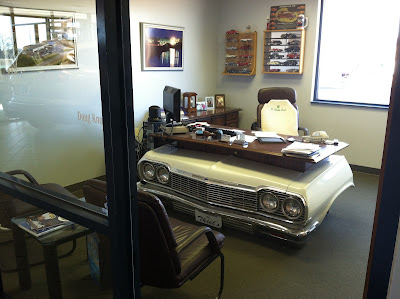
The Zone Manager came to visit my store recently. After introductions, he lusted over my desk for a couple of minutes (more on that later). I found him to be a very pleasant gentleman and we had a very cordial conversation as we learned a bit more about each other.

Eventually, the discussion turned to my facility and the EBE program. I gave him a bit of my background with the EBE program told him of the exceptions that I had asked for.

The short story here is that he had no authority, had no discretion, had no flexibility and was no help in getting relief from the EBE program. I could revisit all my discussion points that I visited with him about (they can be found here and here and here). But the bottom line is that it was a waste of time for both of us.

The irony of whole visit was the fact that he was smitten by my desk. When we discussed "customer touch points" and the fact that the EBE program disallowed the customer from seeing the desk in my office, he was stumped. After he thought about, he realized that the office was a customer touch point and there was no way that a customer could see the desk if my office was in compliance with EBE standards.

He took photos and is going to go through the motions of submitting (again) my requests but we both know that it is an exercise in futility. The requests go to the same group that rejected them before.

So I am much more skeptical about our visit to Detroit now. I feel like the whole notion about GM placing people in the field was more of an appeasement than an actual effort to help RCC dealers.

I will reiterate a point that I made after the Detroit trip: the NADA task force must hold GM accountable for the commitments they made.

I am not done with this. Stay tuned for developments...

NADA Issues Dealer Guidance on Counterfeit Air Bags

The National Highway Traffic Safety Administration (NHTSA) announced in early October a consumer advisory on counterfeit air bags.

Federal investigators have determined that thousands of counterfeit bags have been bought and installed in U.S. motor vehicles over the past three years.

NHTSA also has determined that in the event of a frontal collision, these counterfeit bags are unlikely to deploy properly or may deploy in a manner that can harm vehicle occupants. See below for an NADA dealer Q&A document.

Vehicles with counterfeit air bags installed are believed to constitute less than 0.1% of the total in-use fleet. Nonetheless, dealers should be prepared to respond to inquiries from the public on this matter.

NHTSA is urging concerned owners to start by visiting www.safercar.gov/Air+Bags to determine if they are at risk.

In addition to the NADA guidance, dealers should expect to receive communications directly from the auto manufacturers they represent, addressing how to detect and manage counterfeit air bags.

It's important to note that unlike a safety recall campaign, customers should expect to pay to have their air bags diagnosed, and if necessary, replaced.

Service Advisors Overtime Exemption Extended Through March

Congressional legislation to prevent a government shutdown includes an extension of a federal overtime exemption for service advisors through March.

Since the late 1970s, the U.S. Department of Labor (DOL) has held that the frontline employee-salespersons in the service department remain exempt from federal time-and-a-half pay requirements. In 2011, DOL attempted to reverse this policy. Congress intervened and temporarily stopped the Department from enforcing the change.

The Congressional ban was included in a funding measure that was set to expire at the end of September. Under the new continuing resolution that extends government spending through March 2013, DOL is prevented from enacting the new policy for service salespeople.

Friday, October 19, 2012

More of the Same...

You may recall that I told of my visit to the General Motors Renaissance Center headquarters back in August as a member of NADA's Task Force on Facility Image Programs and Multi-Tier Pricing in the space. One of the results of that meeting was a commitment by General Motors to consult with small and rural dealers on the EBE program.

Mark Reuss commented that he wanted to help dealers "do what they COULD do" on a timeline that “worked for them”. I specifically asked if that meant some flexibility going forward. I did not get a straight answer on that question.

So shortly after I returned from Detroit, I called my GM Regional manager and asked him to schedule a visit to my store. I got a call back a few weeks later from my Zone Manager who scheduled a visit to my store in mid-October.

The Zone Manager came to visit my store recently. After introductions, he lusted over my desk for a couple of minutes (more on that later). I found him to be a very pleasant gentleman and we had a very cordial conversation as we learned a bit more about each other.

Eventually, the discussion turned to my facility and the EBE program. I gave him a bit of my background with the EBE program told him of the exceptions that I had asked for.

The short story here is that he had no authority, had no discretion, had no flexibility and was no help in getting relief from the EBE program. I could revisit all my discussion points that I visited with him about (they can be found here and here and here). But the bottom line is that it was a waste of time for both of us.

The irony of whole visit was the fact that he was smitten by my desk. When we discussed "customer touch points" and the fact that the EBE program disallowed the customer from seeing the desk in my office, he was stumped. After he thought about, he realized that the office was a customer touch point and there was no way that a customer could see the desk if my office was in compliance with EBE standards.

He took photos and is going to go through the motions of submitting (again) my requests but we both know that it is an exercise in futility. The requests go to the same group that rejected them before.

So I am much more skeptical about our visit to Detroit now. I feel like the whole notion about GM placing people in the field was more of an appeasement than an actual effort to help RCC dealers.

I will reiterate a point that I made after the Detroit trip: the NADA task force must hold GM accountable for the commitments they made.

I am not done with this. Stay tuned for developments...